The No-Fluff Guide to Hiring Enterprise WordPress Engineers
Lessons from 20+ years in WordPress and working closely with 500+ engineers across enterprise teams.

If you’re an engineering leader at a large enterprise brand, you already know one thing: hiring the right WordPress engineer is harder than it looks.
You put out a job post, and suddenly you’re flooded with hundreds of applications. Everyone says they’ve "worked with WordPress for 8 years," everyone claims to know plugins, themes, React, Gutenberg, performance tuning… the whole list.
But then you start interviewing them—and it becomes clear very quickly:
Knowing WordPress is not the same as knowing WordPress at enterprise scale.
Over the last 20 years, between my early engineering days and building Multidots from scratch, I’ve worked with more than 500 engineers. I’ve hired them, trained them, built teams around them, and watched some of them grow into true enterprise-quality architects.
Along the way, I’ve learned something important:
Enterprise WP engineers are a rare breed—and you can lose months (and a lot of money) if you don’t know how to filter them properly.
This guide is the one I wish every enterprise engineering leader had. It’s simple. It’s straight. And it’s built from real experience, not theory.
My goal is to help you:
- avoid wasted interviews
- avoid "fake experts"
- avoid mismatched hires
- save months of searching
- and get your hands on truly enterprise-ready WP engineers faster
Let’s dive in.
Why Hiring an Enterprise WP Engineer is so Tough
There are millions of WordPress developers globally. In fact, WP powers more than 43% of the web, so naturally, the talent pool is huge.
But here’s the tricky part:
- Most WP developers are self‑taught.
- Most learned WP through theme customization.
- Most have only built marketing sites or simple business websites.
And enterprise WordPress engineering requires a completely different skill set.
Enterprise WP engineers understand things like:
- scaling WP across multiple regions
- custom Gutenberg block systems
- multi‑site architectures
- CDN layers and advanced caching
- high‑security environments
- SSO, CRM, CDP, and enterprise integrations
- data governance and content workflows
- performance under millions of monthly visitors
To put this into perspective, there are roughly 1–1.5 million WordPress developers worldwide. That number sounds huge—until you break it down.
Based on industry data and years of hiring experience:
- ~60–70% of WordPress developers are theme customizers, page‑builder users, or focused on small business and marketing sites
- ~20–30% are solid, mid‑level WP engineers who are comfortable building plugins and working with WP APIs
- Only ~1–2% truly qualify as enterprise WordPress engineers
That means the global pool of engineers who can confidently run WordPress at enterprise scale is likely somewhere around 10,000–20,000 people worldwide.
This is why only 1–2% of the global WP developer pool is truly enterprise-ready.
You can’t tell who’s who by looking at a CV. You need a deeper filter.
That’s what the next section is for.
What Makes Someone an Enterprise WP Engineer?
Let me share the simplest definition I’ve found after two decades in the WP world:
An enterprise WP engineer is someone who can safely and confidently run WordPress inside a Fortune 500 environment.
Here’s what that looks like in practice.
Filter 1: 5+ Years of Hands‑On WP Experience
This isn’t about being a senior developer.
This is about being a senior WordPress developer.
Someone who has:
- fixed database-level issues
- built multiple custom plugins
- worked with both classic and block themes
- navigated large codebases
- shipped features inside complex systems
Five years is the minimum for them to see enough real-world problems.
Filter 2: Experience With Big Brands or High‑Traffic Sites
Enterprise environments teach engineers things small business projects never can.
If they’ve worked with brands like:
- News Corp
- PMC
- Oracle
- Ask Media
- Pepsico
- Fortune 500 internal platforms
…you can assume they understand:
- scale
- load management
- performance engineering
- compliance
- content workflows
- quality gates
This experience is priceless.
Filter 3: 50+ Hours of WordPress Core Contribution
This single indicator separates the good from the elite.
Why?
Because people who contribute to WP Core learn:
- How WP works internally
- How decisions are made
- What good WP architecture looks like
- How to think about long‑term platform stability
Additionally, they naturally follow better coding practices.
Side note: Roughly, 45% of our engineering team has core contribution experiences. My agency was the 5th biggest global contributor to WordPress core in 2024, and we continued to contribute over 135 hours every week to WordPress core.
Filter 4: WordPress VIP Certified Engineer (Strong Advantage)
There are no official WordPress Certified Engineers. However, Automattic, the parent company of WordPress, offers a few advanced courses and certifications for engineers with strong enterprise WordPress experience.
If the developer you are interviewing has completed WPVIP courses and certification, it’s a big signal of:
- technical depth
- familiarity with VIP standards
- understanding high‑traffic engineering
Not mandatory—but extremely valuable. That’s why more than 40% our engineering team at Multidots are WPVIP certified Engineers.
Skills an Enterprise WP Engineer Must Have
Let’s break down the real, practical skill set.
These are the exact things we score internally at Multidots.
Aim for 7/10 or higher across the board.
Skill 1: Core WordPress Skills
- Custom plugin development
- Custom blocks with Gutenberg + React
- Theme architecture (block & classic)
- Understanding WP APIs (REST, Cron, Rewrite, Settings)
- WordPress lifecycle & hooks system (actions, filters, priorities, load order)
- WP-CLI (custom commands, migrations)
- Multisite setup & maintenance
Skill 2: Programming Fundamentals
- PHP (solid OOP + deep WP knowledge)
- JavaScript (ES6+)
- React (for Gutenberg)
- MySQL optimization
- Basic DevOps understanding
- Composer & npm workflows
Skill 3: Enterprise-Level Engineering Skills
This is where most developers fall short.
Enterprise WP engineers must understand:
- caching layers (Redis/Memcached, Varnish, CDN caching)
- performance optimization (TTFB, queries, asset strategy)
- CI/CD pipelines
- code review culture
- automated testing
- security hardening
- containerization (Docker basics)
- large team Git workflows
- Debugging & observability
- Local debugging (Xdebug, Query Monitor, WP_DEBUG)
- Safe production debugging (logs, feature flags)
- Monitoring, alerting, and root cause analysis
These aren’t "nice-to-haves."
They’re expected.
Skill 4: Soft Skills (Non‑Negotiable)
Enterprise-level success requires:
- async communication (Slack, Jira, tickets)
- documentation
- stakeholder communication
- context sharing
- predictable delivery
If a developer hates documentation, move on.
Skill 5: AI Skills (Now a Must-Have, Not a Bonus)
This is new—but critical.
In 2024 and beyond, an enterprise WP engineer must be comfortable working with AI, both inside WordPress and in their day-to-day engineering workflow.
Look for engineers who have:
- integrated AI APIs (OpenAI, Claude, Gemini) into WP plugins or themes
- built AI-powered content workflows (summarization, tagging, recommendations)
- used AI for search, personalization, or content enrichment
- worked with AI inside editorial or publishing platforms
- designed prompts and guardrails for enterprise use cases
Strong enterprise engineers don’t fear AI—they use it intelligently.
They should be comfortable with:
- AI-assisted coding (ChatGPT, Copilot, Cursor, etc.)
- using AI to debug, refactor, and review code
- generating test cases and documentation with AI
- knowing when not to trust AI-generated code
- reviewing AI output with a critical engineering mindset
The key here is judgment.
AI doesn’t replace strong engineers—but strong engineers who use AI are significantly more productive.
Where to Actually Find Enterprise WP Engineers
Knowing what to look for in an enterprise WP engineer is only half the battle. The other half—and often the harder part—is knowing where to actually find them.
If you search broadly, you’ll mostly find general WordPress developers. That’s not a bad thing—but it’s not what most enterprise teams need. Enterprise WP engineers tend to cluster in specific places and environments where they’re exposed to large-scale systems, strong engineering practices, and complex problems.
Over the years, I’ve seen a clear pattern. There are a few hiring paths that consistently work, and a few that look promising but usually disappoint at enterprise scale.
Let’s walk through the most realistic options—along with each trade-off—so you can choose the one that fits your team, timeline, and risk tolerance.
Option 1: Hire Directly (Slow but Effective)
Hiring directly is the most traditional path—and for some enterprise teams, it’s the right one. You get full ownership, long-term alignment, and someone who grows deeply into your internal systems and culture.
That said, this route is also the slowest and most resource-intensive. Finding an enterprise-ready WordPress engineer through direct hiring requires patience, well-built screening, and a willingness to say no many times before you say yes.
If you choose this path, where you look—and how you filter—matters a lot.
Best places:
- WordPress Core Contributor Directory
- Codeable
- LinkedIn (with filters like "WordPress VIP")
- GitHub
- WP-specific job boards
If you’re hiring directly, look for:
- consistency
- real plugins
- strong GitHub repos
- enterprise keywords
Option 2: Recruitment Agencies (Helpful, but Limited)
Recruitment agencies can be useful if you’re committed to hiring full-time and don’t want to manage sourcing and early screening yourself. They can save time—especially for large organizations with formal hiring processes.
The challenge is that most recruiters don’t deeply understand WordPress, let alone enterprise WordPress. Without clear guidance, you’ll often get candidates who look good on paper but fall short technically.
If you go this route, be very explicit about what "enterprise WordPress" means for your team.
You’ll often get:
- generic PHP developers,
- Shopify or Magento engineers,
- theme customizers calling themselves "WordPress experts."
Ensure that your recruiter has prior hands-on experience in WordPress hiring.
Option 3: Freelancers (Useful, But High Risk at Enterprise Scale)
Freelancers can look attractive—fast to hire, flexible, and often cost-effective on paper. And in the right situations, they can absolutely add value.
However, for enterprise WordPress platforms, freelancers come with real trade-offs around ownership, continuity, and long-term reliability.
When freelancers can make sense:
- short-term, well-defined tasks
- audits or second opinions
- spike work or experiments
- non-mission-critical features
Where freelancers usually struggle:
- long-term ownership
- deep platform context
- availability & reliability
- working across large teams
- documentation discipline
- handling enterprise-grade security & performance
Another challenge is continuity.
Enterprise WordPress platforms live for years. Freelancers often move on. When they do, knowledge leaves with them.
In practice, most enterprise brands use freelancers as a supplement, not a foundation—while relying on in-house engineers or agencies for core systems.
Option 4: WordPress Agencies (Fastest & Easiest)
For many enterprise brands, this is the most practical and lowest-risk option. Instead of finding individual engineers, you partner with a team that already hires, trains, and supports enterprise-ready WP talent.
This works especially well when speed, flexibility, and reliability matter.
WP agencies—especially WPVIP Gold partners—already:
- filter enterprise engineers internally
- maintain high training standards
- work on enterprise projects daily
- have backup engineers
- offer month-to-month flexibility
At Multidots, for example, this is how we’re set up:
- a team of 65+ WordPress engineers
- 30+ engineers certified by WordPress VIP
- 80% of the team has 5+ years of hands-on WordPress experience
- deep experience working with billion-dollar media and enterprise brands
It’s not about the numbers themselves—it’s about having enough depth and experience on the bench so enterprise teams don’t have to start from scratch every time.
This model gives enterprises:
- zero hiring risk
- fast onboarding
- predictable delivery
- scalability (1 → 10 engineers anytime)
- no HR cost
- no compliance burden
Most enterprise brands choose agency augmentation even if they have in-house teams.
What Enterprise WP Engineers Cost (By Region)
I’ve included rough yearly cost estimates—based on data from Salary.com, ziprecruiter.com, codeable.io, glassdoor.com and a few other reliable sources—showing what it typically costs to hire a full-time general WP engineer vs. an enterprise WP engineer.
Most engineering leaders focus solely on base salary when hiring full-time. But in reality, salary is just one part of the equation. A lot of additional costs quietly add up, such as:
- Hiring costs: recruitment fees, placement or consulting fees, internal hiring time
- Benefits: health insurance, payroll taxes, retirement contributions, paid time off
- Subscriptions: laptop, desk, office setup, and daily tools like Slack, GitHub, ChatGPT, Cursor, monitoring tools, and other developer subscriptions
All of these costs are easy to underestimate.
To give you a clearer sense of market dynamics, here’s a snapshot of the annual salary ranges (USD) for WordPress engineers with 5+ years of experience across four key regions.
| Region | General WP Engineer | Enterprise WP Engineer |
|---|---|---|
| North America (US/Canada) | $80k to $140k | $120k to $200k |
| Europe | $50k to $100k | $120k to $150k |
| South America | $40k to $60k | $80k to $120k |
| Asia | $30k to $50k | $70k to $120k |

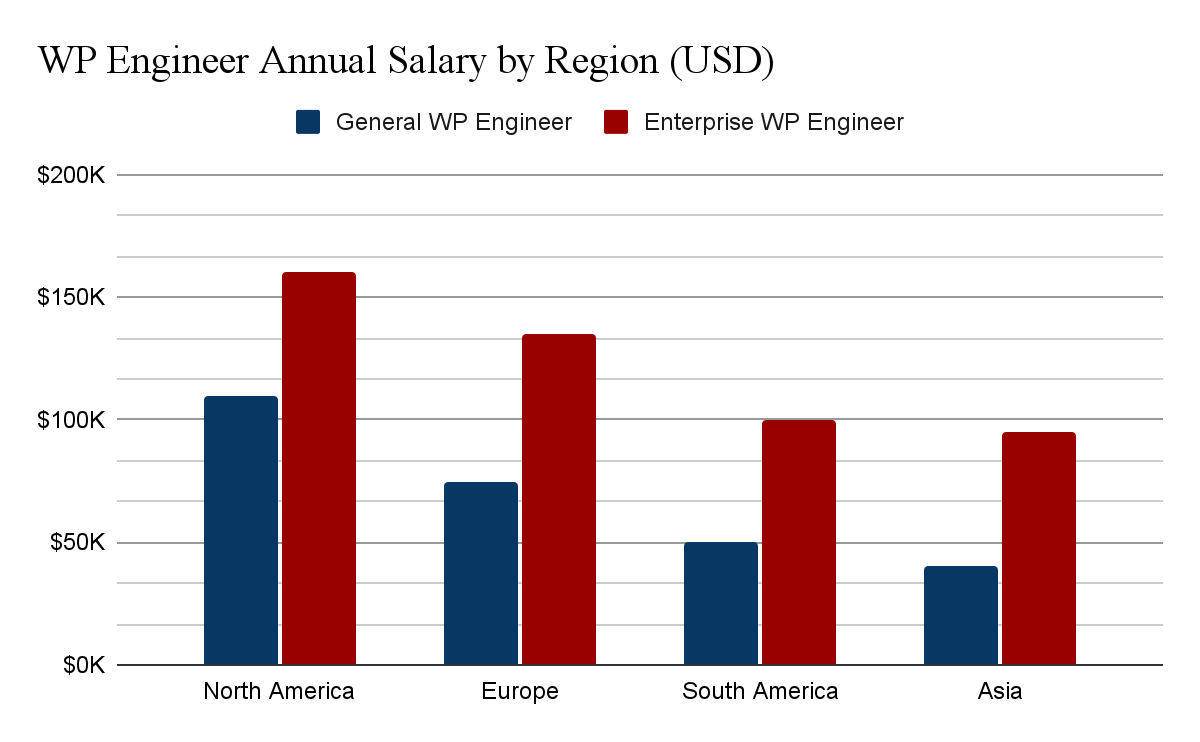
Important note: The salary numbers above reflect base compensation only. They do not include hiring costs, benefits, or the ongoing cost of tools and subscriptions.
Agencies often cost less than a single full-time US hire and provide:
- backup engineers
- immediate replacements
- multi-skill access
- zero HR overhead
But it’s not just about cost or affordability.
In my experience, the biggest concern for enterprise teams isn’t budget—it’s availability. Truly enterprise-ready WP engineers are hard to find, regardless of the region. As I mentioned earlier, they’re a rare breed.
In some countries, the total pool of enterprise-purpose engineers is simply very small. That makes hiring not only time-consuming but also unpredictable. You might have the budget ready, the role approved, and the urgency clear—yet still spend months trying to find the right person who’s actually available.
That scarcity, more than cost, is often what slows down enterprise teams.
The Interview Process
Interviewing enterprise WP engineers is where most teams either win—or lose—months of time.
Resumes can be misleading, and confident answers don’t always translate to real-world capability. Over the years, I’ve learned that a simple, structured interview process works far better than long, complicated hiring loops.
This is the exact process we use to filter strong enterprise-ready engineers from everyone else—and it’s designed to save time, reduce risk, and surface real signal fast.
Follow this, and you’ll filter out 95% of non-enterprise WP engineers.
Step 1: Pre-Screen (10 Minutes)
Look for:
- 5+ years WP experience
- enterprise projects
- core contribution
- real GitHub activity
- plugins or blocks built
- WordCamp participation
- Write or speak about WP or engineering on their blog, YouTube or events
If none of these exist → stop.
Step 2: Review Public Work (15 Minutes)
What to check:
- plugin architecture
- documentation
- security practices
- commit history
- block development samples
- performance thinking
Weak code here means a weak engineer.
Step 3: Technical Interview (30 Minutes)
Topics to cover:
- scaling WP
- CDN & caching layers
- query optimization
- multisite challenges
- wp-cron vs real cron
- REST API performance
- Gutenberg architecture
- debugging approach
You're evaluating thinking—not memorized answers.
Step 4: Practical Assignment
Great options:
- build a Gutenberg block
- refactor a slow plugin
- integrate a REST API
- do a small performance audit
- review a code sample
- Write and run unit testing
The goal is to see how they think, structure code, and communicate.
Step 5: Communication & Culture Fit
Ask yourself:
- Do they document well?
- Do they explain clearly?
- Do they communicate async?
- Do they escalate issues early?
- Do they collaborate naturally?
Enterprise work requires calm, structured, reliable engineers.
Red Flags to Avoid
Before we get into the red flags, one important thing to keep in mind:
Most candidates won’t fail because they’re bad engineers—they’ll fail because they’re the wrong fit for enterprise WordPress.
On paper, many developers look impressive. Years of experience. Long client lists. Confident answers. But when you dig a little deeper, you start to notice patterns that almost always lead to trouble at scale.
These red flags usually show up early—sometimes in the résumé, sometimes in the first 10 minutes of a technical conversation. If you spot more than one of these, it’s usually a sign that the developer hasn’t worked in true enterprise WordPress environments.
Here are the red flags I recommend avoiding immediately:
- only built small marketing sites
- no GitHub activity
- relies on page builders
- has zero WP core or plugin work
- can’t explain caching beyond "install a plugin"
- no experience with high traffic or security
- talks in buzzwords instead of systems
- overconfident with no proof
Full-Time vs Agency: What’s Better for Enterprise Brands?
This is one of the most common questions enterprise teams ask—and there’s no one-size-fits-all answer.
Choosing between full-time hires and an agency partner isn’t just a hiring decision; it’s a strategy decision. It affects speed, risk, cost, flexibility, and how quickly your team can respond to change.
Over the years, I’ve seen enterprise brands succeed with both models—and struggle with both when the choice didn’t match their reality. The key is understanding the trade-offs clearly before you commit.
Let’s break it down.
Hire full-time if:
- You need someone on-site
- Your workload is predictable
- You have strong internal leadership
Hire via agency if:
- You want to start fast
- You want flexibility
- You need backup engineers
- You need enterprise-level skills without risk
- You don’t want HR, legal, or compliance burden
Most large brands do best with a hybrid:
Small in‑house leadership team + WP agency augmentation.
Final Thoughts
Hiring a true enterprise WordPress engineer isn’t easy. They’re rare. They’re highly skilled. And they’ve spent enough time inside large-scale systems to know what actually works—and what quietly breaks under pressure.
But if you follow this guide, a few things change:
- Your search becomes more focused
- Your interviews get sharper
- Your filters get clearer
- And your chances of making the right hire go way up
We’ve seen this work in practice.
At Multidots, we’ve helped enterprise brands like Ask Media, PMC, and News Corp scale their engineering teams by placing top enterprise WP engineers into their organizations—often in under a month.
And if you want the fastest, safest path, partner with a WP agency that already has these engineers trained, certified, and ready.
Whether it’s Multidots or another trusted WordPress VIP partner, the goal is the same: build long-term, reliable engineering strength without spending months searching for it.
If you’d like to explore how this works in practice, schedule a 30-minute conversation with my team to learn more about our staff-augmentation model and how we help enterprise teams hire enterprise-ready WP engineers.