
For large media and publishing organizations evaluating CMS platforms, the choice between Arc XP and WordPress represents two fundamentally different approaches to enterprise content management. One is a vertically integrated cloud platform built for a specific industry. The other is an open-source ecosystem that powers nearly half the web.
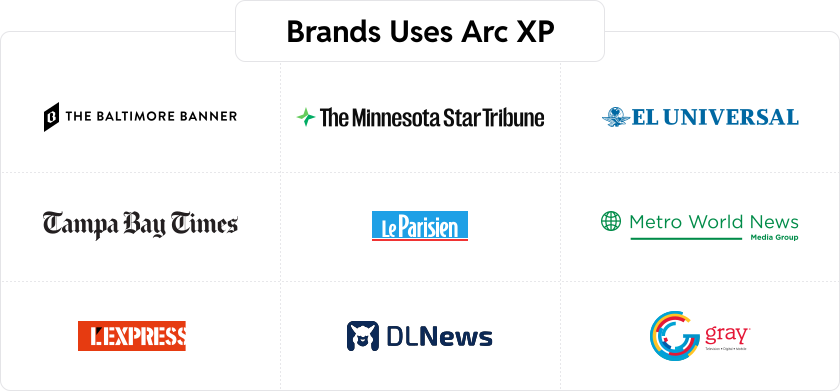
Arc XP is a cloud-based digital experience platform developed by Arc Publishing, a division of The Washington Post. It was purpose-built for media companies and large publishers. WordPress is an open-source CMS that has grown from a blogging tool into the world’s most widely used content platform, powering 43%+ of all websites, including enterprise publishers like TechCrunch, CNN, and The New York Times.
This guide breaks down Arc XP and WordPress across every dimension that matters for business decision-makers—from ease of use and customization to security, performance, cost, and long-term viability—so you can make an informed choice for your organization.
What is Arc XP?
Arc XP positions itself as a cloud-based digital experience platform in the CMS space, developed by The Washington Post to serve as a comprehensive DXP for media and publishing. The platform provides an integrated suite of tools combining content management, digital asset management, audience engagement, personalization, and commerce into one proprietary system. It features purpose-built editorial tools including Composer for article authoring, WebSked for editorial planning, and a React-based rendering engine, presenting itself as an enterprise-first platform. It appeals to large media organizations seeking a single-vendor solution and excels in scenarios requiring high-volume content production, multi-channel distribution, and newsroom-specific workflows.

What is WordPress?
WordPress, a veteran in the CMS space, has cemented its reputation as a reliable and powerful platform since its inception in 2003. WordPress thrives as an open-source platform, allowing it unlimited flexibility and customization without the constraints of a subscription-based model. Its real strength lies in its remarkable flexibility, ease of use, extensive community support, and a vast selection of over 60,000 plugins and thousands of themes that allows businesses to deploy and manage everything from blogs to complex e-commerce and enterprise sites. WordPress stands out for delivering an all-inclusive, user-friendly experience, making it the preferred choice for businesses seeking a proven and adaptable web solution that powers over 43% of all websites on the internet.
Arc XP vs WordPress: Understanding the Differences
At its core, the difference between Arc XP and WordPress comes down to philosophy and architecture. Arc XP is a closed-source, vertically integrated digital experience platform built for a specific niche: media and publishing. WordPress is an open-source, modular CMS platform designed for broad flexibility across every industry and use case.
Arc XP takes a “single vendor, integrated suite” approach. Content management, asset management, personalization, and commerce are all bundled into one proprietary platform. This can simplify vendor management but creates significant dependency on a single provider.
WordPress takes a “modular ecosystem” approach. The core CMS is free and open-source, and organizations build on top of it with plugins, themes, and custom development. This provides maximum flexibility and eliminates vendor lock-in, but requires more deliberate architectural decisions.
The Qualities of an Ideal Enterprise CMS Solution
Before diving into the detailed comparison, it helps to establish what makes a CMS truly enterprise-ready. Regardless of which platform you choose, your CMS should deliver on these seven core qualities:
- Ease of Use: Content teams should be able to create, edit, and publish without relying on developers for day-to-day tasks.
- Flexibility and Customization: The platform should adapt to your business requirements, not the other way around.
- Security: Enterprise-grade security including regular updates, vulnerability monitoring, access controls, and compliance certifications.
- Support and Community: Access to reliable support channels, documentation, and a talent pool for ongoing development.
- Integrations: Ability to connect with your existing tech stack: CRM, marketing automation, analytics, e-commerce, and more.
- Performance and Scalability: Consistent speed and uptime under high traffic, with the ability to scale without re-platforming.
- SEO-Friendly Architecture: Clean URLs, structured data support, fast page rendering, and tooling for on-page optimization.
Keep these qualities in mind as you evaluate Arc XP and WordPress across each dimension below.
Quick Comparison of Arc XP vs WordPress
Here’s a quick comparison between the two CMS across key aspects:
| Arc XP | WordPress | |
|---|---|---|
| Type of CMS | Cloud-based DXP (closed-source) | Open-source CMS |
| Licensing | Subscription-based (custom pricing) | Free (GPLv2) |
| Target Audience | Media, publishing, enterprise | All industries, all sizes |
| Ease of Use | Moderate (enterprise complexity) | User-friendly admin interface |
| Customization | Limited (closed-source) | Extensive (60K+ plugins, themes, custom code) |
| Performance & Scalability | Moderate (cloud-native) | High with enterprise hosting |
| Security | Built-in enterprise security | Secure core + plugins + enterprise hosting |
| Developer Experience | Specialized skills required | Massive community, abundant resources |
| E-commerce | Integrated commerce capabilities | WooCommerce (36%+ of online stores) |
| Cost Efficiency | Low (enterprise subscription) | High (no licensing fees) |
| Support & Community | Vendor support (contract-based) | Global community + pro services |
Arc XP vs WordPress: Full Comparison
Below is a detailed comparison of Arc XP and WordPress across the dimensions that matter most for enterprise CMS decision-making.
1. Ease of Use and Setup Process
Arc XP is an enterprise platform with a correspondingly complex onboarding process. Implementation typically requires vendor involvement, and the learning curve is steeper due to the platform’s focus on enterprise-grade features and workflows. Teams generally need dedicated training before they can use the platform productively.
WordPress is renowned for its ease of use. The famous “5-minute install” gets a site running quickly, and the intuitive admin dashboard allows non-technical users to create and publish content with minimal training. The Gutenberg block editor provides a visual, drag-and-drop content creation experience that content teams can adopt rapidly.
For enterprise deployments, WordPress VIP and other managed hosting providers handle the infrastructure complexity, allowing teams to focus on content rather than server management.
Verdict: WordPress wins decisively on ease of use and speed to productivity. Arc XP requires significantly more training and onboarding investment.
2. Customization and Flexibility
Arc XP is a closed-source platform, which inherently limits customization options. Extending the platform with new features often requires working through the vendor or engaging specialized developers who understand Arc XP’s proprietary architecture. The platform is optimized for publishing workflows, but adapting it for use cases outside of media and publishing can be challenging and costly.
WordPress, as an open-source platform, offers virtually unlimited customization potential. With over 60,000 free plugins, thousands of themes, custom post types, an extensive hooks and filters system, REST API, and Full Site Editing, organizations can tailor WordPress to meet virtually any requirement. Whether you need a content-heavy publishing platform, an e-commerce store (via WooCommerce), a learning management system, or a multi-site network, WordPress can be configured to deliver.
Verdict: WordPress wins. Its open-source nature provides far greater flexibility for customization without vendor dependency.
3. Content Management and Editorial Experience
Arc XP was purpose-built for newsroom and editorial workflows. It offers structured content modeling, a built-in digital asset management system, and workflow management tools designed specifically for editorial teams producing high-volume content. For organizations whose primary operation is digital publishing, Arc XP’s content management tools are well-suited to the task.
WordPress provides a powerful and flexible content management experience through the Gutenberg block editor, which supports reusable blocks, patterns, and a visual editing experience. For collaborative editing, plugins like Multicollab bring Google Docs-style commenting and real-time collaboration directly into the WordPress editor. Custom editorial workflows can be implemented through plugins, and the platform’s revision history and role-based access control provide robust content governance.
Verdict: Arc XP has a slight edge for pure newsroom workflows. WordPress matches it for broader content operations and wins on editorial flexibility across diverse use cases.
4. Plugins, Extensions, and Integrations
Arc XP offers built-in integrations focused on media workflows, including content delivery, audience analytics, and advertising. However, its third-party ecosystem is limited compared to open-source alternatives. Adding new integrations or extending functionality often requires custom development or working through Arc XP’s professional services.
WordPress boasts the largest plugin ecosystem of any CMS, with over 60,000 free plugins available on WordPress.org and thousands more premium options. This ecosystem covers virtually every business need: SEO (Yoast, Rank Math), e-commerce (WooCommerce, which powers 36%+ of all online stores), marketing automation, CRM integrations, analytics, accessibility, multilingual support, and much more. The REST API enables custom integrations with any external system.
Verdict: WordPress wins decisively. The plugin ecosystem is unmatched in both scale and breadth.
5. Security Features
Arc XP, as a closed-source, vendor-managed platform, handles security updates and patches internally. The closed-source nature means no public code exposure, which can reduce the surface area for targeted attacks. However, users have limited control over security configurations and must rely entirely on the vendor for vulnerability response and breach management.
WordPress takes a transparent approach to security. The open-source core is audited by a global community of security researchers. Regular core updates address vulnerabilities promptly. The ecosystem offers robust security plugins (Wordfence, Sucuri, iThemes Security) that provide firewalls, malware scanning, login protection, and vulnerability detection.
Enterprise hosting providers like WordPress VIP add additional security layers, including automated updates, DDoS protection, and code review processes. WordPress VIP is also FedRAMP-authorized, meeting the highest standards for government-grade security.
Verdict: Both platforms offer strong enterprise-grade security. Arc XP provides managed security with less operational overhead. WordPress offers greater transparency, control, and flexibility, especially with enterprise hosting.
6. Performance and Scalability
Arc XP is built on cloud-native architecture with dynamic resource allocation, designed to handle the traffic demands of large media properties. The platform can scale to support high-concurrency publishing scenarios. However, scaling costs can increase significantly with traffic volume, as pricing is tied to usage.
WordPress is highly scalable when paired with the right infrastructure. Enterprise hosting providers like WordPress VIP, Pantheon, and WP Engine offer auto-scaling, global CDN integration, edge caching, and performance optimization out of the box. With proper configuration, WordPress can handle billions of page views per month.
For a deeper dive into how WordPress stacks up against Arc XP on performance, see our detailed feature and performance comparison.
Verdict: Both platforms handle enterprise-level scale effectively. WordPress offers comparable performance at significantly lower cost with the right hosting infrastructure.
7. Ownership Costs and Total Cost of Ownership
This is where the differences between Arc XP and WordPress become most stark.
Arc XP uses custom enterprise pricing that is not publicly disclosed. Industry estimates suggest costs start at approximately $10,000 per month or more, with pricing increasing based on traffic, features, and scale. For a detailed breakdown of Arc XP’s pricing structure, see our Arc XP vs WordPress pricing analysis.
WordPress core software is free and open-source, with no licensing fees. Total costs depend on hosting, development, and premium plugins. Enterprise hosting through WordPress VIP starts at approximately $25,000 per year. The larger WordPress developer talent pool also means lower hourly rates compared to Arc XP specialists, who command a premium due to their scarcity.
Here’s a quick cost comparison of both CMS:
| Cost Category | Arc XP (Estimated) | WordPress (Estimated) |
|---|---|---|
| CMS License | Custom enterprise pricing | Free (GPLv2) |
| Hosting (Annual) | Included (~$120K-$300K+/yr) | $5K-$60K+/yr |
| Developer Rate (US) | $120-$200/hr (specialized) | $50-$150/hr |
| Available Talent Pool | Very small (Arc XP specialists) | Very large (millions of WP devs) |
| Design and Build | $100,000-$500,000+ | $25,000-$150,000+ |
| Premium Add-ons | Custom dev costs | $500-$5,000/year |
| Maintenance (Annual) | Included in subscription | $5,000-$30,000+/year |
| Enterprise 3-Year TCO | $500,000-$1,500,000+ | $100,000-$400,000+ |
Verdict: WordPress offers substantially lower total cost of ownership. The absence of licensing fees, a larger and more affordable talent pool, and flexible hosting options create significant savings over time.
8. SEO and Marketing Capabilities
Arc XP includes basic SEO features, but its marketing and SEO tooling is limited compared to what’s available in the WordPress ecosystem. Organizations using Arc XP often need to supplement the platform with third-party marketing tools, adding to overall complexity and cost.
WordPress is widely regarded as one of the most SEO-friendly CMS platforms available. Plugins like Yoast SEO and Rank Math provide comprehensive on-page SEO management, including meta tags, schema markup, XML sitemaps, content analysis, and readability scoring. WordPress’s clean URL structure, fast page rendering, and native support for structured data make it a strong foundation for search visibility. The ecosystem also offers extensive marketing integrations, including Google Analytics, Google Tag Manager, HubSpot, Mailchimp, and A/B testing tools.
Verdict: WordPress wins. The SEO and marketing plugin ecosystem is unrivaled.
9. Support and Community
Arc XP provides vendor support through contract-based service agreements. Support quality is tied to the service tier, and the broader community of Arc XP users and developers is relatively small and specialized. Third-party resources, tutorials, and documentation are limited compared to open-source alternatives.
WordPress has the largest CMS community in the world, with millions of developers, designers, and users contributing to forums, documentation, tutorials, and open-source development. WordCamps (community conferences) are held globally. Professional services and agencies specializing in WordPress are abundant. For enterprise clients, WordPress VIP offers dedicated account management and premium support. The talent pool for WordPress development is the largest of any CMS, making it easier and more cost-effective to find qualified developers.
Verdict: WordPress wins. Community size, talent availability, and the breadth of available support resources are unmatched.
Arc XP vs WordPress: Which CMS is Right for Your Business?
Choose Arc XP if:
- You are a large media or publishing organization with publishing-specific workflow needs
- You want a fully managed, vendor-supported platform and have the budget for enterprise pricing
- Your team is already experienced with Arc XP’s tooling and ecosystem
- You need integrated digital asset management specifically designed for newsroom operations
- You prefer a single-vendor solution over assembling best-of-breed tools
Choose WordPress if:
- You want maximum flexibility to customize your platform for any use case
- You need a cost-effective CMS without enterprise licensing fees
- Your content strategy extends beyond publishing (e-commerce, lead generation, community, etc.)
- You want access to the largest developer talent pool in the CMS market
- SEO and marketing capabilities are central to your digital strategy
- You want full ownership of your data and code with no vendor lock-in
- You need a proven enterprise CMS with WordPress VIP, trusted by CNN, TechCrunch, and more
For most organizations, WordPress is the more practical, cost-effective, and versatile choice. Arc XP serves a specific niche well for large media companies with dedicated budgets, but the advantages of WordPress’s open ecosystem, massive talent pool, and dramatically lower total cost of ownership make it the stronger option for the majority of enterprise use cases.
Why Companies Migrate from Arc XP to WordPress
The shift from Arc XP to WordPress is not hypothetical. Organizations across media, publishing, and enterprise are making this move for five consistent reasons.
1. Cost reduction
Arc XP’s enterprise subscription pricing creates significant ongoing costs that compound over time. Organizations that migrate to WordPress typically report 50-70% reductions in total cost of ownership for comparable or superior functionality. For a detailed pricing breakdown, see our analysis of the real cost of Arc XP vs WordPress.
2. Vendor lock-in concerns
Arc XP’s closed-source architecture means complete dependency on a single vendor for updates, new features, and support. WordPress’s open-source model provides full data portability, platform independence, and the freedom to switch hosting providers or development partners at any time.
3. Broader functionality needs
Arc XP is purpose-built for digital publishing. Organizations that need to expand into e-commerce, lead generation, membership programs, learning management, or other digital experiences often find that they’ve outgrown Arc XP’s scope. WordPress supports all of these use cases through its plugin ecosystem.
4. Talent availability
Finding developers with Arc XP expertise is difficult and expensive due to the platform’s smaller user base. WordPress developers are abundant globally, reducing hiring costs and timelines. This also reduces the risk of key-person dependency.
5. Plugin ecosystem advantages
WordPress’s 60,000+ plugins provide ready-made solutions for SEO, marketing, analytics, accessibility, multilingual support, and much more. On Arc XP, achieving equivalent functionality often requires expensive custom development.
How Multidots Can Help?
Multidots is a WordPress VIP Gold Partner with over 16 years of experience in enterprise WordPress development. We have completed more than 300 successful website migrations from platforms including Arc XP, Sitecore, Drupal, Adobe Experience Manager, and more.
Our services include:
- Platform assessment and CMS migration strategy
- End-to-end Arc XP to WordPress migration
- Custom WordPress development for enterprise requirements
- Performance optimization and security hardening
- Ongoing support and maintenance
If you’re evaluating a move from Arc XP to WordPress, or simply exploring which CMS is the right fit for your organization, we’d love to talk. Schedule a free consultation to discuss your project.
Arc XP vs WordPress: FAQs
Both platforms serve enterprise publishers effectively. Arc XP was purpose-built for media organizations, while WordPress powers some of the world’s largest publishers including CNN, TechCrunch, and The New York Times. WordPress offers greater flexibility and significantly lower costs while matching Arc XP’s scalability through enterprise hosting providers like WordPress VIP.
Yes. WordPress offers robust editorial workflow capabilities through its core features and plugins. The Gutenberg block editor provides a powerful content creation experience, and plugins like Multicollab add Google Docs-style collaborative editing. Custom editorial workflows, content scheduling, revision history, and role-based access control are all available natively or through plugins.
The primary considerations include content structure mapping, URL preservation for SEO equity, editorial workflow retraining, and integration reconfiguration. These are well-understood challenges that experienced migration partners handle routinely. Multidots has completed 300+ enterprise CMS migrations with minimal disruption to operations and SEO performance.
Yes. WordPress core is actively maintained and audited by a global security community. Enterprise hosting providers like WordPress VIP add additional security layers, including automated updates, vulnerability scanning, DDoS protection, and code review. WordPress VIP is FedRAMP-authorized, meeting government-grade security standards.
WordPress powers over 43% of all websites and is supported by a massive open-source community that ensures continuous development and innovation. Arc XP depends on a single vendor (The Washington Post’s Arc Publishing division) for its product roadmap and continued support. WordPress’s market dominance and community-driven development model provide stronger long-term viability assurances.