
Understanding Sanity Web Development and the Future of Headless CMS
Explore how Sanity’s headless CMS enables structured, reusable content across web, mobile, and beyond – plus what to know about architecture, pricing, and migration before you switch.
Table of Contents
Key Takeaways
- Model content as structured data so you can update once and publish everywhere without duplication.
- Send production traffic through Sanity’s CDN, not the Live API, to keep usage-based costs predictable.
- Invest upfront in clean content models and tight GROQ queries to avoid developer bottlenecks later.
- Configure Studio around real workflows – roles, approvals, validation – so editors move fast without breaking structure.
- Plan migrations with zero-downtime sync and structured data cleanup, or you’ll pay for legacy shortcuts twice.
Your team drafts a product announcement. Then rewrites it for the website. Reformats it for the mobile app. Tweaks it again for email. Three versions, three rounds of edits, triple the effort. By launch day, you’re juggling version control, chasing last-minute changes, and wondering why "go live" feels more like "hold everything."
The issue is traditional platforms were built for a world where "the website" was the main event. Whereas now your business spans web, mobile, email, digital signage, voice assistants, and whatever channel will launch next quarter. Duplicating content for every channel simply doesn’t scale. It’s slow, expensive, and full of opportunities for things to go slightly (or wildly) wrong.
With Sanity, instead of locking content into page templates for specific screens, everything is stored as structured, reusable data. You write the product announcement once – headline, description, specs, images – and that single source flows wherever it’s needed.
In practice, your website pulls structured content via APIs, mobile apps request the same data for smaller screens, while email platforms extract what they need for campaigns. Any new channels just connect to the same content pool without forcing you to rebuild from scratch.
The end result is you get to create once and publish everywhere. Fewer formatting marathons. Far less launch-day chaos. Just structured content that’s ready for whatever comes next.
What Sanity Is and Why It's Different
Sanity is a headless CMS that stores content as structured data in a central Content Lake, enabling teams to deliver it across multiple channels and frontends.
Content as Reusable Data
Instead of tying content to a single design, Sanity treats products, articles, and author profiles as independent data objects, allowing each one to be referenced across every digital property you run.
Write a product description once – headline, features, pricing, images defined as fields – and that same source can power your website, mobile app, email campaigns, and whatever channel comes next. Update the price in one field, and it updates everywhere, removing the need to republish across half a dozen systems and eliminating the risk of duplication entirely.
Sanity's Architecture
Sanity runs on two separate systems.
The Content Lake (hosted by Sanity) stores your structured data.
Studio (a React app you deploy) is the editing interface your team uses.
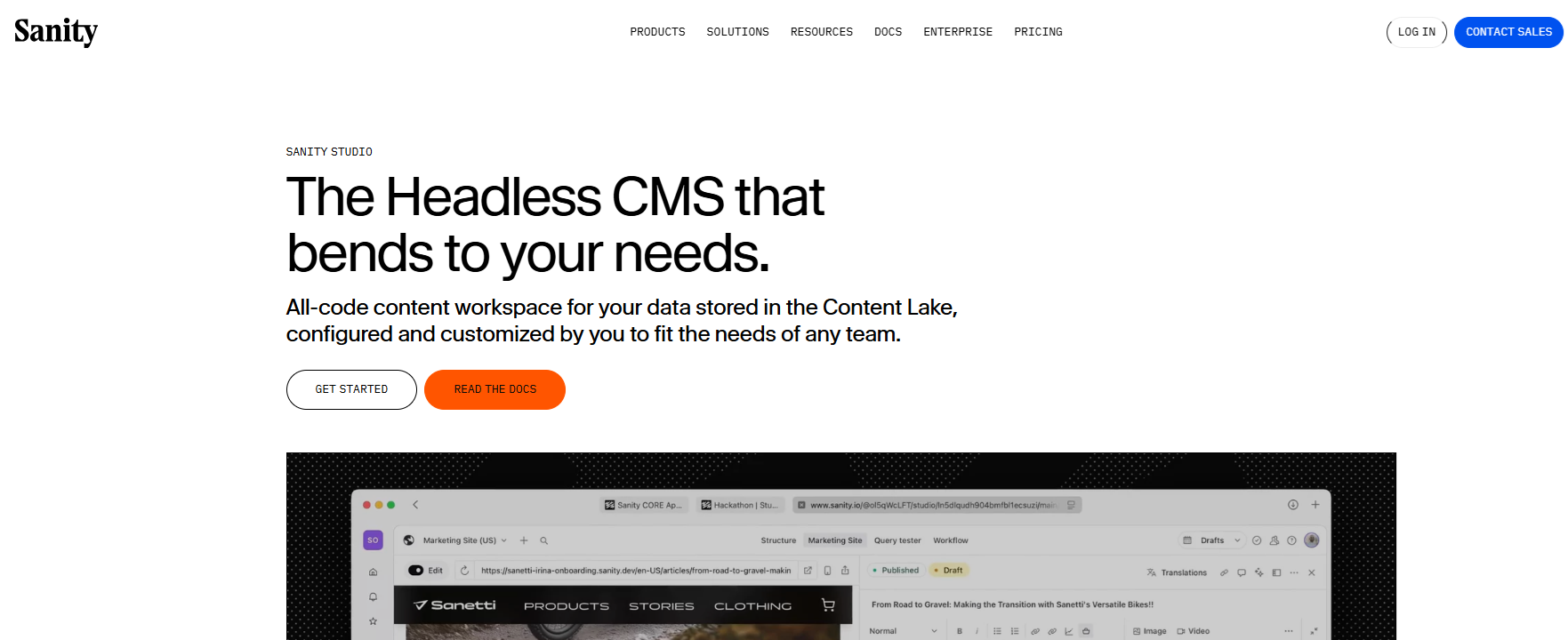
Sanity web development with Sanity Studio
You pay Sanity for Content Lake services – storage, API requests, bandwidth, and editor seats.If you choose to self-host Sanity Studio, you would also pay Vercel, Netlify, or another provider to host it – but this is entirely optional. Studio can be hosted for free using Sanity’s managed hosting, so separate hosting costs aren’t mandatory.
API-Based Content Delivery
When someone visits your site, your frontend requests the specific content it needs from the Content Lake. Sanity returns clean JSON via API, and your application renders it appropriately.
That same product data can power your marketing site, mobile app, and in-store kiosks simultaneously. You simply update it once in Studio, and it propagates everywhere automatically.
It’s the ultimate future-proof solution. As you expand – voice integrations, AR experiences, new digital properties – you don’t migrate content. You just connect whatever is next to the existing API.
How Sanity Differs from Traditional CMS
Traditional platforms like WordPress bundle content and presentation together in one monolithic system. The same software handles what you create, how it looks, and the URLs users land on, keeping content and presentation tightly intertwined.
Sanity separates those concerns entirely, storing content as structured data in the Content Lake while your React site, Vue app, or Next.js frontend each pulls from that same source and renders it in their own way.
The payoff is long-term stability. You can redesign your site every couple of years, swap out frontend frameworks, or evolve your tech stack without having to rebuild or untangle your content each time.
Understanding Sanity's Dual-Billing Structure
Sanity’s pricing has two moving parts. First, you pay for Content Lake services – storage, API requests, bandwidth, and editor seats. The free tier covers 20 seats, two public datasets, and unlimited content types, which is plenty for personal projects. Growth plans start at $15 per seat per month (up to 50 seats) plus usage-based costs, while Enterprise plans move to custom pricing and layer in SLAs, SAML SSO, audit trails, and dedicated support.
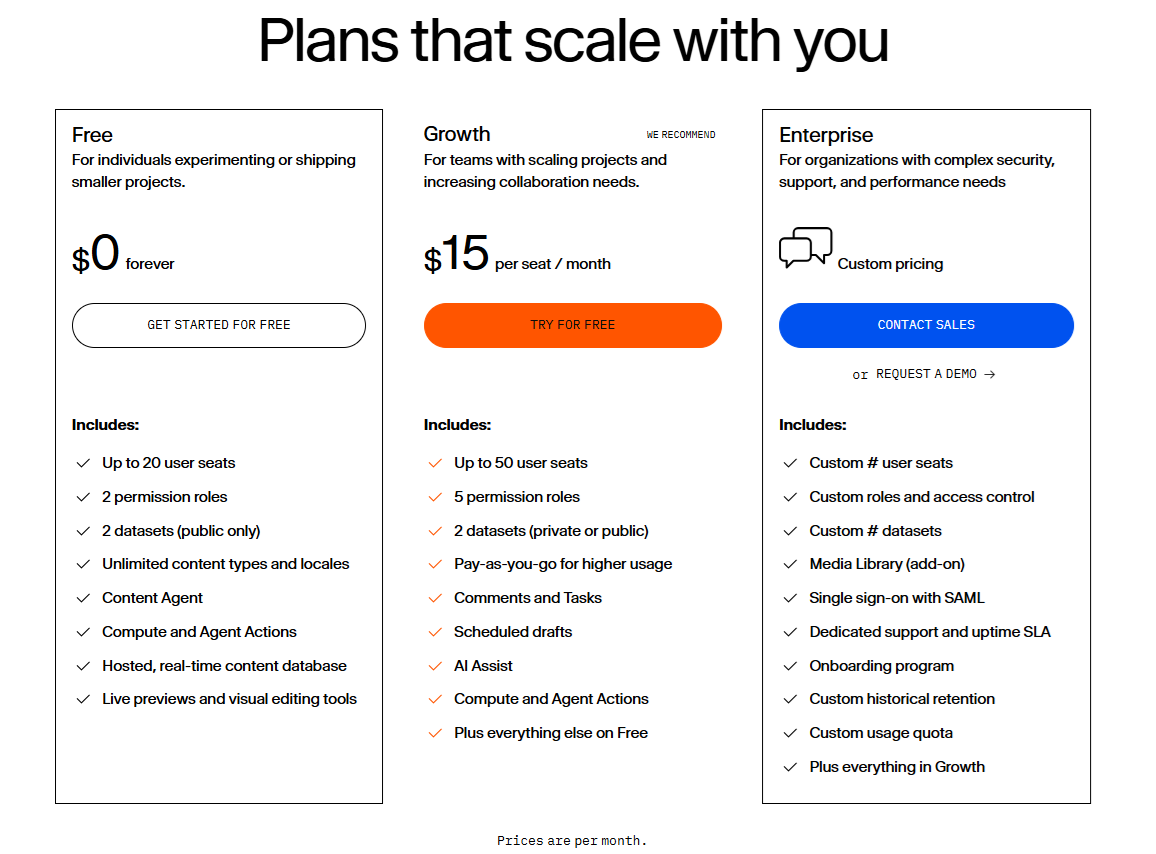
Pricing options for Sanity web development
Studio hosting sits separately. You can deploy to yourname.sanity.studio with a single command for free, or self-host via Vercel, Netlify, or your own infrastructure. Most teams opt for Vercel or Netlify, which typically adds $20–200 per month, depending on traffic.
Total cost of ownership is discussed at the platform level but ignores developer time costs - GROQ learning curves, content modeling, and custom Studio configuration are real budget line items for prospects evaluating Sanity vs WordPress.
Because costs scale with API usage, request monitoring isn’t optional. Routing traffic through Sanity’s CDN endpoint – rather than the Live API – keeps spending predictable, so don’t overlook this. It’s best not to discover the pricing mechanics after the invoice arrives.

How Sanity Works for Your Organization
Centralized Content Storage
Imagine every piece of content in one place, rather than scattered across marketing drives, engineering repos, or fossilized in SharePoint. Just a single, managed database your team accesses through the editing interface: the Content Lake. Versioned. Searchable. Available to every digital property.
Content is structured around models that reflect how your business actually operates. Product models include SKU, title, description, specs, pricing, and images. Article models define headline, body, author, publish date, and SEO metadata. Those models enforce consistency, so checkout always gets the fields it expects, and SEO tools always have the metadata they require.
Rich content lives in Portable Text, which renders cleanly across desktop, mobile, and voice assistants when developers configure and build the appropriate renderers for each frontend. Portable Text provides the structured content format, but how it displays is defined in code. Whereas traditional HTML can splinter across platforms, Portable Text adapts.
The outcome is no silos and no version-control roulette. Marketing can’t publish outdated pricing because there’s one source of truth. Your mobile app can’t pull the wrong description because everything syncs from the same place.
Customizable Editing Experience
Developers shape the editing interface around real workflows. Junior editors draft, senior editors approve. Slugs auto-generate from headlines. Conditional fields appear by content type. It’s all configurable.
Content models are defined as code – JavaScript files under version control, alongside the rest of your software. You can test before deployment, roll back if needed, and track exactly who changed what.
Field layouts, validation rules, previews – you decide how they work. Simply add custom inputs when plain text isn’t enough. The system will adjust to your team’s processes.
Efficient Content Retrieval
Sanity runs on GROQ, a query language designed to fetch precisely what each platform needs. A single query can return a blog post with its author, or a product with its category and related items, rather than the surrounding catalogue of content. That means fewer round-trips than traditional REST APIs, less data transfer, and much faster load times.
But there is a learning curve. GROQ is proprietary and differs from SQL. Although GraphQL is available, it’s less powerful for projecting and transforming content during retrieval, which is why most teams invest in GROQ training to unlock the full advantage.
From Editor to Delivery
Editors work inside the customized Studio interface and see only what’s relevant to their role, allowing product managers access to different content types than blog editors.
Once content is saved, it lands in the Content Lake and becomes instantly available everywhere, with updates syncing in real time. As soon as changes are published (rather than left in draft), they’re immediately queryable via Sanity’s APIs and can be fetched by any connected frontend. Exactly when those updates appear to end users then depends on your delivery setup – for example, whether you’re using static site generation, incremental static regeneration, or a fully dynamic frontend – but the source of truth is updated the moment you hit publish.
Each channel then queries what it needs – the homepage pulls featured products, the mobile app requests purchase data, and the email platform retrieves campaign copy. Same source. Purpose-built output.
Because editing, storage, and delivery are decoupled, each layer scales independently. You can expand your editorial team from five to fifty without reworking infrastructure, absorb traffic spikes without slowing content operations, and launch new digital properties without migrating content or rebuilding backends.
Webhooks and event-driven architecture
Sanity's webhook system is a meaningful capability for triggering rebuilds or syncing downstream systems, and it's absent despite the document covering content delivery in detail.
Why Organizations Choose Sanity
Publish Once, Distribute Everywhere
Managing content across channels can feel like plate-spinning: update it here, tweak it there, fix it again somewhere else. With Sanity, you get to cut out the scavenger hunts when you spot a typo or need to change a price. Once you make the change at source, you don’t have to worry about outdated copy hiding in forgotten corners.
The payoff is speed and sanity (pun intended), with teams regularly reporting cutting publication time in half after replacing manual multi-channel workflows with Sanity’s unified model.
Real-Time Editorial Collaboration
No more waiting for someone to "unlock" a page. Multiple editors can work simultaneously, with live cursors and field highlights showing exactly who’s editing what. Sanity's real-time listener API (for live previews and collaborative editing) is never explained, even though real-time collaboration is listed as a selling point. Less duplication. Fewer crossed wires.
Version history means instant rollbacks if something goes sideways. Granular permissions keep control tight and workflows smooth – junior editors draft, managers approve, marketing updates campaigns without touching product specs. Everyone moves faster, with guardrails intact.
And it doesn’t stop at workflow. Sanity has been steadily layering AI into the editing experience itself. Through Sanity AI Assist, teams can generate summaries, rewrite or translate content, extract structured data, and even auto-tag entries directly within the Studio. Because it operates on your structured content model, the output stays aligned to your schema and governance rules. In practice, that means AI can speed up production without bypassing the same permissions, version history, and approval flows that keep your content operation safe.
Protection for Your Content Investment
Although frontend trends will change, your content doesn’t have to.
Whether you’re on React today and Vue tomorrow, your content stays put in the Content Lake. You just point a new frontend to the existing API and keep moving. Redesigns don’t require migrating thousands of items or risking SEO turbulence. Content and presentation evolve independently, avoiding risky all-at-once overhauls.
When Sanity Matches Your Needs
Sanity excels when you’re managing content across multiple properties and have development resources to shape and maintain the architecture. It’s built for teams that need flexibility and control. But there are a few realities to plan for:
Pricing is usage-based (API requests, bandwidth, editor seats), so scale needs monitoring, while routing the lion’s share of traffic through the CDN rather than the Live API is an important step to keep costs in check.
Enterprise migrations typically take 12–20 weeks, covering content modelling, legacy transition, Studio customization, frontend integration, and testing. If you’re moving from platforms like Sitecore or AEM, experienced implementation partners are critical to manage complexity and safeguard SEO.
Partner with Multidots for Sanity Implementation
Implementation Expertise Drives Results
So, you’ve chosen Sanity. Excellent. Now comes the part that actually determines whether it pays off: implementation.
Sanity’s flexibility is powerful, but every architectural decision carries weight. Route content through the wrong API endpoint, and costs climb. Design an awkward content model, and developers get pulled into everyday edits. Overlook image optimization, and page speeds slow to a crawl.
Strong results demand more than platform familiarity. You need precise content architecture, disciplined migration planning, and cost control embedded from day one. Structuring a 100,000-SKU catalogue is worlds apart from modeling an editorial workflow. Knowing when to denormalize for performance, and when restraint is wiser, can spare you an expensive rebuild later.
Multidots is an official Sanity partner with 300+ enterprise platform migrations completed, spanning Sitecore, AEM, Drupal, and Contentful. We’ve architected for publishers serving 35 million monthly page views, e-commerce platforms managing 100,000+ SKUs, and global teams coordinating content across regions.
Our approach is practical: build models around how your teams actually operate. Custom approval flows, conditional publishing rules, specialized fields – all configured in Studio from the outset so editors can move without workarounds.
Zero-Downtime Migration Methodology
With Multidots, migrations don’t need to mean crossed fingers and midnight launches. Our delta synchronization method keeps Sanity updating continuously while your existing platform remains live. Content created mid-migration syncs automatically, keeping both systems aligned.
Deterministic IDs prevent duplicates if scripts restart. Legacy quirks like missing metadata, broken references, or inconsistent formatting are resolved during transfer, rather than uncovered after launch.
Our expert engineers also apply semantic modeling to transform unstructured legacy content into structured Sanity schemas ready for multi-channel reuse. HTML blobs become portable text. Product copy buried in templates becomes clean, queryable data your mobile app can use independently.
Before production cutover, staging validation gives every team visibility. Marketing reviews campaigns. Editorial checks formatting. IT verifies integrations. This way, problems can surface early when they’re still straightforward to fix.
Get Started with Sanity
You’ve got plenty of reasons for eyeing Sanity – multi-channel content, serious flexibility, big ambitions. But naturally, a few practical questions will follow.
Will your architecture keep API costs predictable, or quietly inflate them? Will editors move at the pace, or rely on developers for every change? And will your content models scale smoothly, or need expensive refactoring down the line?
Sanity delivers on its promise. It powers everything from focused marketing sites to complex enterprise publishing ecosystems. But the outcome hinges on the decisions you make early. Architecture and migration planning determine whether that flexibility becomes a competitive edge or an operational drag.
The difference between promise and performance is implementation expertise and proven migration methodology. First-time teams often run into familiar issues: content models that bottleneck daily workflows, API usage that becomes costly at scale, or migrations that compromise metadata and content relationships.
Experienced implementation partners remove that risk. You get architecture aligned to real editorial workflows, API routing designed for cost efficiency from day one, and a migration approach refined across hundreds of enterprise transitions.
So, if you’re ready to explore Sanity for your organization, contact Multidots for a migration assessment and implementation roadmap. We’ll review your current platform, map your content architecture requirements, and define a realistic timeline and budget for transitioning to Sanity’s multi-channel content operating system.
Feel free to schedule a quick call with our migration expert.
Contact Us