
Key Takeaways
- Sitecore’s shift to SitecoreAI introduces powerful AI capabilities, but requires a full rebuild for XP users, not a simple upgrade.
- Most enterprises evaluate alternatives due to rising costs, architectural changes, and developer dependency.
- Competitors fall into four categories: enterprise DXPs, headless CMS platforms, open-source solutions, and .NET-based alternatives.
- The right choice depends on cost, architecture (monolithic vs. composable), team capability, and how much of the platform you’ll actually use.
- For organizations moving to WordPress or composable stacks like Sanity, Multidots helps de-risk migrations with proven enterprise outcomes and measurable cost savings.
In November 2025, Sitecore relaunched as SitecoreAI, bundling its CMS, DAM, Unified Data Layer, personalization, and Agentic Studio under a single visits-based license. It’s a clear push toward an integrated, AI-driven Digital Experience Platform (DXP).
However, it’s important to know that legacy Sitecore XP environments aren’t compatible with SitecoreAI. Moving forward requires a full rebuild of the frontend in Next.js. For many organizations, that means significant new investment in development, infrastructure, and team capabilities. That’s why some are now evaluating whether they should stay at all or look for Sitecore alternatives. In many cases, this evaluation is less about features and more about cost, flexibility, and long-term maintainability.
As a result, the competitive field has split into four clear categories: enterprise DXP suites, headless CMS platforms, open-source foundations, and .NET alternatives. This guide breaks down each category and helps you map the right alternative to the reason you’re evaluating a move.
Why Enterprises Are Evaluating Sitecore Alternatives
Enterprises don’t typically replace a platform like Sitecore without a clear trigger. In most cases, the evaluation starts at renewal – when the cost, architecture, and day-to-day usability are reassessed against modern alternatives. Let’s unpack this:
- Licensing escalation: SitecoreAI’s visits-based pricing is landing at multiples of previous XP contracts, with total implementation costs often reaching the low-to-mid six figures. Add $8,000–$35,000 per year for Vercel hosting, and the total cost of ownership rises quickly, especially for multi-site environments.
- Architectural incompatibility: Sitecore XP’s .NET rendering model doesn’t carry forward. Moving to SitecoreAI requires a headless, Next.js-based frontend, meaning organizations must rebuild their presentation layer from scratch rather than upgrade incrementally.
- Developer dependency: Many teams find that even basic content updates or layout changes still require developer involvement, slowing down marketing execution and increasing operational overhead.
- Vendor lock-in: Sitecore’s all-in-one architecture tightly couples its CMS, DAM, and data layer. Replacing underperforming components risks breaking the broader system, limiting flexibility.
- The shift from .NET to modern JavaScript ecosystems: While Sitecore has moved toward headless delivery, it still lags in native support for frameworks like React and Next.js compared to API-first alternatives.
To be clear, Sitecore’s capabilities remain strong. It was named a Leader in the Q4 2025 Forrester DXP Wave, earning top marks for its Agent Orchestration Framework alongside Optimizely. But for many organizations facing renewal, the issue is whether the investment still makes sense.
Enterprise DXP Alternatives to Sitecore
For organizations that still need the full breadth of a digital experience platform, enterprise DXP suites are the most direct alternatives to Sitecore. Platforms like Adobe Experience Manager and Optimizely offer comparable capabilities across content management, personalization, analytics, and digital commerce.
However, it’s important to frame this category correctly: these are lateral moves, not simplifications. You’re trading one enterprise platform for another, not reducing complexity. They match Sitecore’s scale, complexity, and cost structure. If licensing or operational overhead triggered your evaluation, switching to another enterprise DXP is unlikely to solve that problem.
Adobe Experience Manager
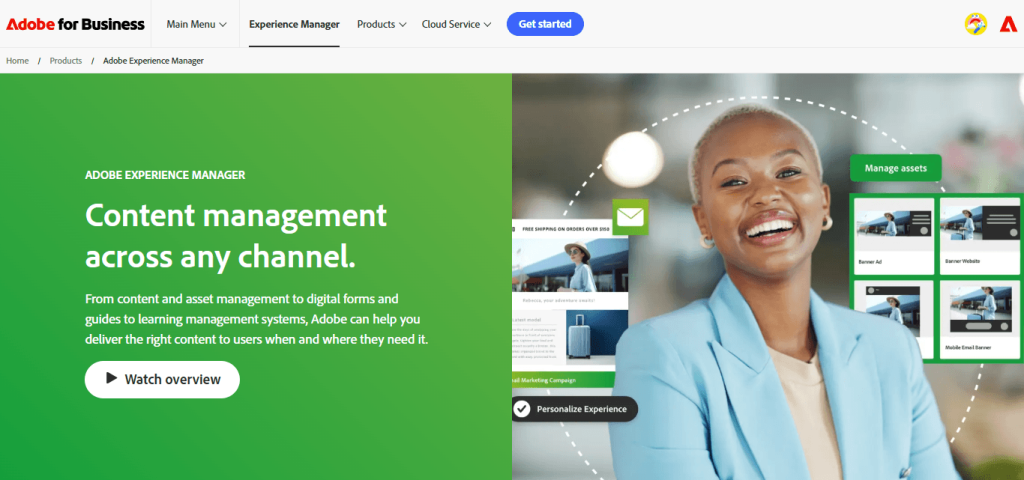
Adobe Experience Manager (AEM) is Sitecore’s closest enterprise rival, with significantly broader adoption – over 30,000 live sites compared to Sitecore’s ~11,000. It consistently earns strong enterprise reviews, including a 4.3/5 rating across hundreds of Gartner reviews.
AEM’s biggest advantage is its deep integration with the Adobe ecosystem. Organizations already using Adobe tools benefit from unified workflows, especially with AI-powered content creation through Firefly and tight DAM integration.
That said, the cost profile is similar, if not higher. A three-year total cost of ownership typically ranges from $300K to $1.5M, with Java developer rates between $100 and $180 per hour.
Takeaway: AEM is best suited for large enterprises already invested in Adobe; however, if cost is your primary concern, it won’t be the answer.
Optimizely
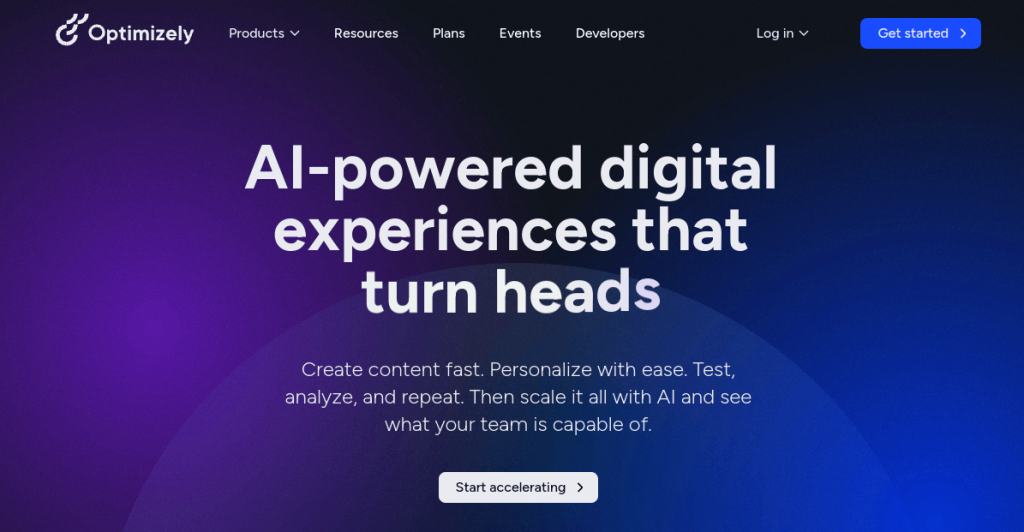
Optimizely differentiates itself through its experimentation-first approach. Its AI layer, Opal, has been adopted by nearly 900 companies, with high acceptance rates for AI-generated content and strong usage in A/B testing workflows.
It also performs well in enterprise evaluations, with a 4.3/5 Gartner rating. Compared to Sitecore, Optimizely is often favored by marketing teams that prioritize experimentation and conversion optimization. Sitecore, however, still claims an edge in deep personalization and headless architecture.
Takeaway: Optimizely is best suited for organizations where testing and optimization drive digital strategy. Yet, if Sitecore, AEM, and Optimizely feel overbuilt, it’s a signal to explore more flexible categories like headless or open-source alternatives.
Headless CMS Alternatives to Sitecore
Headless CMS platforms represent a fundamentally different approach from traditional DXPs like Sitecore. Instead of bundling content, personalization, search, and analytics into a single system, API-first platforms focus purely on structured content delivery via REST or GraphQL APIs. Everything else – personalization, experimentation, analytics – is assembled as part of a composable stack.
This shift gives teams far more flexibility. You can choose best-of-breed tools for each layer instead of being locked into a single vendor’s ecosystem. The trade-off is increased integration overhead and managing multiple vendors instead of one. This shifts complexity from the platform to your architecture.
A common misconception is that headless platforms lack enterprise-grade personalization. In reality, they integrate directly with tools like Ninetailed, Uniform, and Kameleoon via API. This decoupled approach can be more flexible than bundled systems, especially when compared to constraints like SitecoreAI Essentials limiting Experience Interactions to 20,000 per year.
Contentful
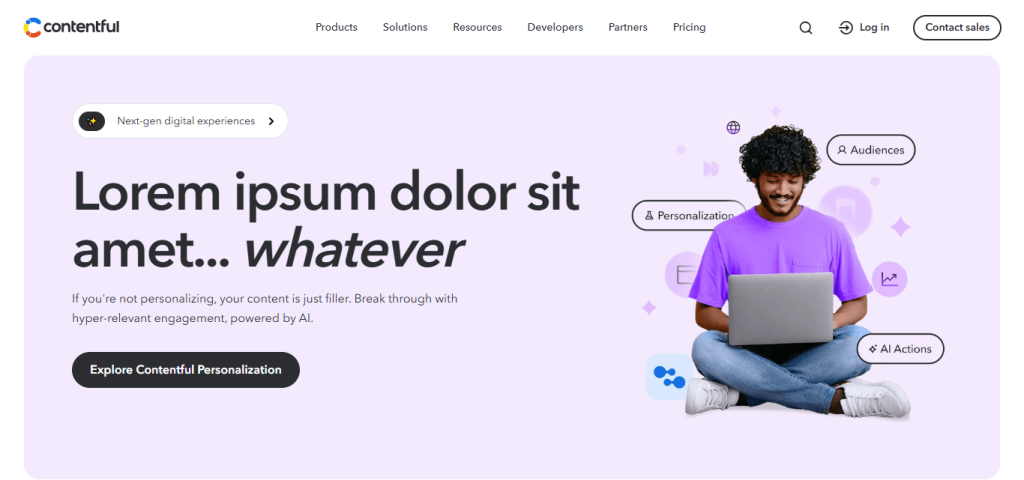
Contentful is one of the most established headless CMS platforms, with a 4.4/5 Gartner rating across 400+ reviews – more than most Sitecore competitors. It offers REST and GraphQL APIs, a free developer tier, and scales into enterprise use cases. Also, its AI capabilities are embedded into the editorial workflow, including content generation, translation, and SEO optimization.
Best fit: Developer-led teams prioritizing speed and flexibility over monolithic feature sets.
Storyblok
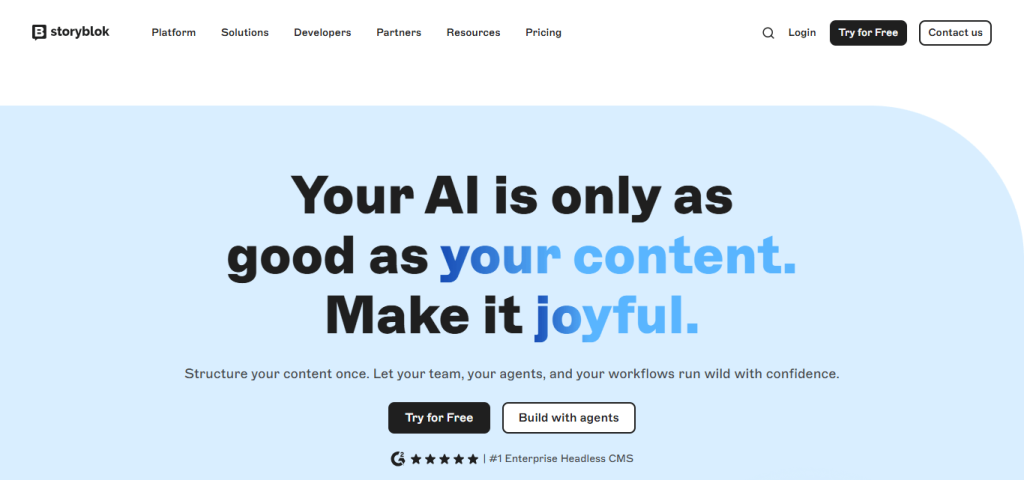
Storyblok stands out with its Visual Editor, allowing marketers to preview and edit content without developer involvement. This directly addresses one of Sitecore’s biggest pain points: developer dependency. This is often one of the first improvements teams notice after migration.
Real-world migrations reflect this impact. Damen Shipyards reported a 75% cost reduction after moving 70 sites from Sitecore.
Best fit: Teams that want headless architecture without sacrificing ease of use for non-technical users.
Other Headless Options
Not every headless CMS is designed for the same use case. Beyond leading platforms like Contentful and Storyblok, other options differentiate based on how much control, structure, or flexibility your team needs:
- Hygraph is built for complex, composable architectures. It allows teams to unify content from multiple systems into a single GraphQL API, making it ideal for multi-source environments.
- Kontent.ai focuses on governance and structured workflows, making it a strong fit for organizations that need editorial control without heavy customization.
- Sanity offers maximum flexibility, with a fully customizable React-based editing environment and real-time collaboration.
It’s also worth noting that headless WordPress isn’t limited to purpose-built platforms. Some teams adopt a headless architecture using WordPress as a backend, exposing content via REST or GraphQL and pairing it with a modern frontend like Next.js. This approach delivers many of the same benefits, but it’s better understood as an architectural pattern – one we’ll revisit in the open-source category.
Download a Free Actionable Guide: 45+ Actionable Tips to Boost WordPress Speed for High-Traffic Sites (Includes Impact Score)
Open Source Alternatives to Sitecore
Open-source platforms are the most common path for organizations looking to exit Sitecore primarily due to cost. Unlike enterprise DXPs, they eliminate licensing fees entirely and benefit from significantly larger developer ecosystems. Platforms like WordPress and Drupal compete not by matching Sitecore feature-for-feature, but by offering flexibility and cost efficiency at scale.
That said, it’s important to address a common misconception upfront: zero licensing cost does not automatically mean lower total cost of ownership. Savings on software licenses are often offset by higher implementation, integration, and long-term maintenance costs, especially in enterprise environments. The difference is control. You choose where to invest, rather than being locked into a bundled vendor model.
When the model is implemented correctly, the savings can be substantial.
WordPress
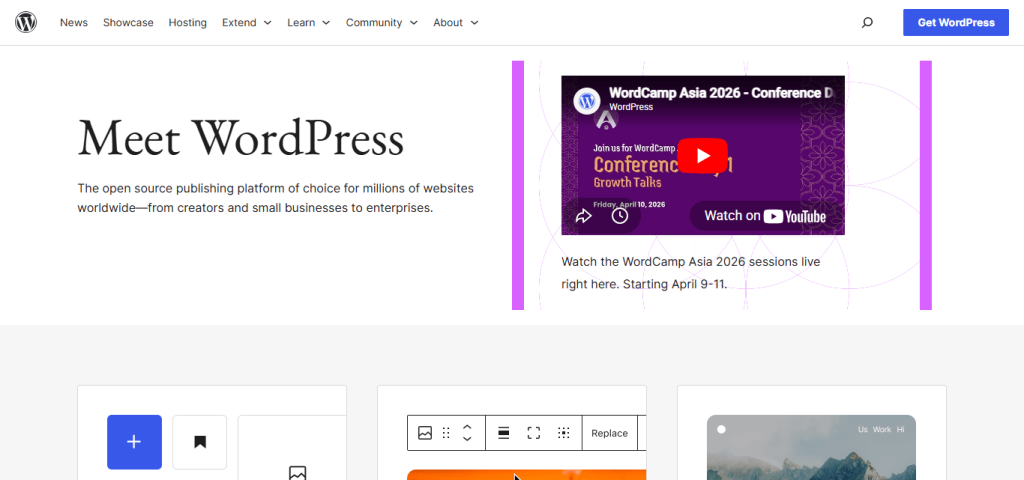
WordPress has evolved far beyond its origins as a blogging platform. It can operate as both a traditional CMS and a headless backend, making it flexible across architectures. Enterprise hosting platforms like WordPress VIP and Pantheon address common concerns around security, scalability, and performance.
From a cost perspective, WordPress benefits from a much larger developer pool, with rates typically ranging from $50 to $115 per hour compared to Sitecore’s $90 to $155. Over a three-year period, total cost of ownership often falls between $200K and $350K, versus $700K to $1.5M for Sitecore – representing a 70–80% reduction.
Migration outcomes support this. A $16B automotive manufacturer migrated 20 sites in 22 weeks and reduced costs by 35%, while EFI achieved a 62.5% performance improvement in just 10 weeks.
Best fit: Cost-driven exits, especially in complex multi-site environments where teams want greater control over content workflows.
Drupal
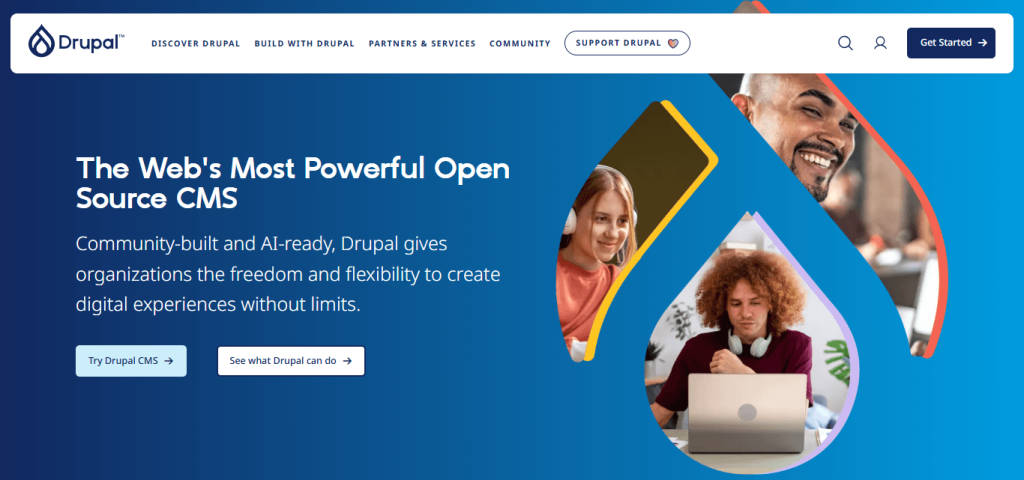
Drupal is often considered the closest open-source alternative to Sitecore in terms of capability. It offers advanced content modeling, granular permissions, and multilingual support out of the box, making it a strong fit for government, education, and large institutional use cases.
However, the same TCO caveat applies. Enterprise Drupal implementations can absorb licensing savings through higher development and maintenance effort.
Best fit: Organizations that value open-source governance, require deep customization, or already have internal Drupal expertise.
.NET Based Alternatives to Sitecore
For organizations deeply invested in Microsoft technologies, moving away from Sitecore is a staffing and ecosystem decision. Teams with years of experience in .NET, established hiring pipelines, and existing infrastructure often prioritize continuity over switching to entirely new stacks. That’s where .NET-based alternatives come in.
The advantage is straightforward: shared foundations. These platforms retain the .NET development model, reducing retraining costs and making migration more manageable from a team perspective. However, this benefit is situational. Organizations not tied to .NET should weigh this against the significantly larger and more flexible developer ecosystems available in platforms like WordPress.
Xperience by Kentico
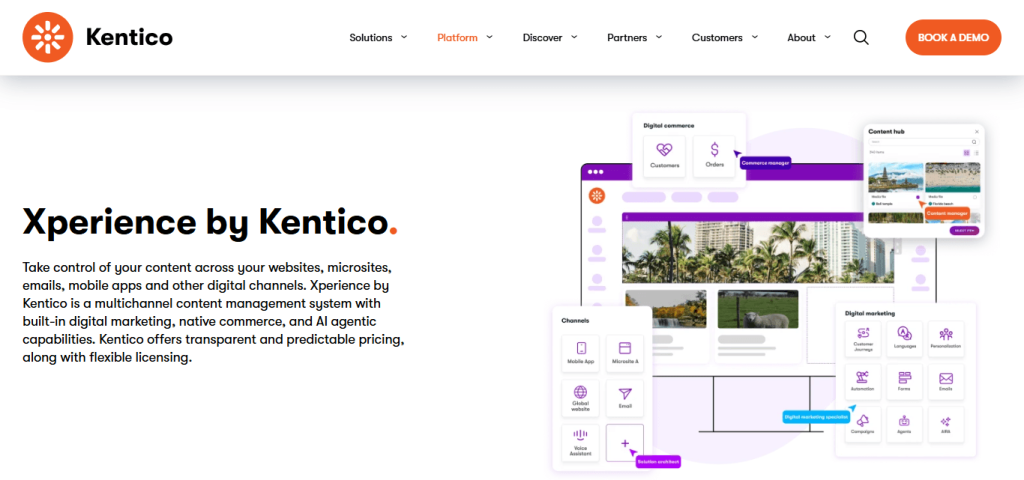
Xperience by Kentico is one of the closest .NET-based alternatives to Sitecore. It offers DXP-level capabilities while maintaining a more accessible pricing model, with contracts starting in the mid-five-figure range – well below Sitecore’s typical six-figure licensing.
It also performs strongly in enterprise evaluations, with a 4.4/5 Gartner rating across 200+ reviews, matching platforms like AEM and Contentful.
Best fit: Mid-market organizations that want DXP functionality without the cost and complexity of Sitecore.
Umbraco
Umbraco is often positioned as a lightweight alternative. It retains Sitecore XP’s core development patterns while offering more flexibility and lower overhead, making it appealing to teams that want to stay within the .NET ecosystem without enterprise licensing.
Sitefinity
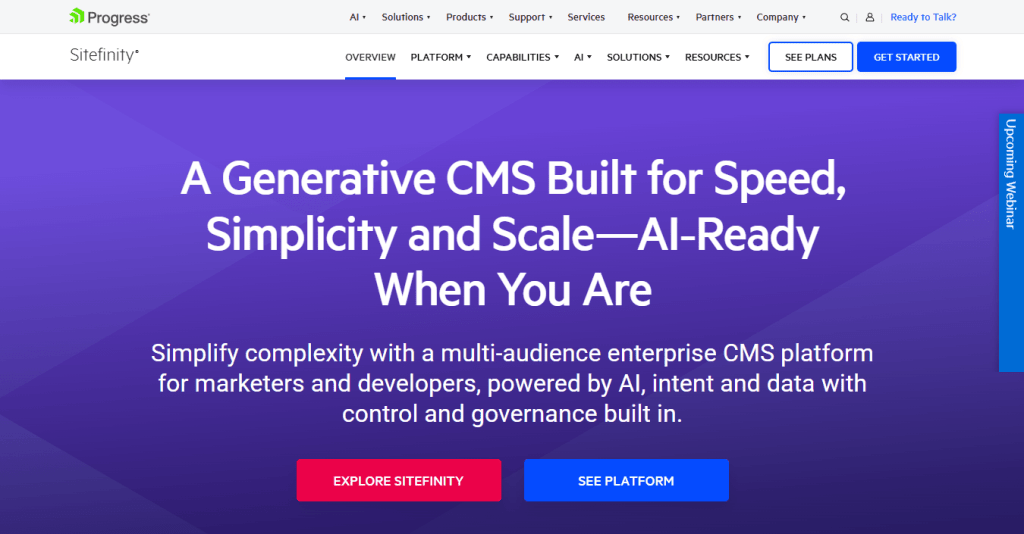
Sitefinity takes a more packaged approach. It’s easier to deploy and more intuitive for non-technical users, often described as a midpoint between Umbraco and Sitecore.
The trade-offs are clear. Sitefinity can struggle at a larger scale, while Umbraco requires assembling your own hosting and enterprise capabilities.
Best fit: Teams prioritizing .NET continuity over architectural change.
Composable Architecture vs. All-in-One DXP Platforms
At the core of any Sitecore alternative decision is an architectural choice: Do you want an all-in-one platform, or a composable stack?
Traditional DXPs like Sitecore are monolithic by design. They bundle content management, personalization, search, and analytics into a single system. The benefit is simplicity in vendor management and pre-integrated features. The trade-off is lock-in. Because the platform is tightly coupled, you’re incentivized to use most of its modules to justify the cost.
Composable architecture, often defined by MACH (Microservices, API-first, Cloud-native, Headless), takes the opposite approach. Instead of buying everything from one vendor, you assemble best-of-breed tools for each layer. For example, you might pair a headless CMS with Algolia for search and a separate personalization engine, swapping components as your needs evolve.
SitecoreAI’s restructuring reflects this shift. By bundling previously separate products into one license, it attempts to compete with the flexibility that composable architectures offer.
The trade-offs are practical. Composable gives you flexibility and control, but requires stronger technical teams and more integration management. Monolithic platforms reduce complexity upfront but limit flexibility over time.
Takeaway: In simple terms, enterprise DXPs (like Adobe Experience Manager and Optimizely) are monolithic, headless platforms (like Contentful and Storyblok) are composable building blocks, and open-source platforms (like WordPress and Drupal) can support either approach depending on how they’re implemented.
How Sitecore’s AI and Personalization Stack Compares
Sitecore’s move to SitecoreAI positions it as one of the most advanced platforms for AI-driven personalization. With Agentic Studio and Marketer MCP enabling natural language campaign execution, it delivers a tightly integrated system where content, data, and automation work together. This is backed by strong analyst validation – Sitecore earned the highest possible marks for its Agent Orchestration Framework, alongside Optimizely in the same evaluation.
That said, competitors are closing the gap in different ways. Adobe Experience Manager focuses on brand-aware AI, with Firefly powering content and image generation directly within its DAM and authoring workflows. Optimizely differentiates through experimentation – its Opal AI sees high adoption, with strong acceptance rates for AI-generated content and heavy usage in A/B testing scenarios.
Meanwhile, Contentful embeds AI into the editorial experience itself, offering content generation, translation, and SEO optimization without requiring a full DXP layer.
On personalization depth, Sitecore remains one of the strongest platforms at higher tiers. But that strength comes with a trade-off. Many organizations don’t fully utilize the breadth of its personalization capabilities, effectively paying for features that go unused. This is more pronounced in lower tiers, where limits like 20,000 annual Experience Interactions can restrict real-world usage.
The result is a clear divide: Sitecore leads in depth, while competitors often win on usability, flexibility, or cost efficiency.
Matching the Right Platform to Your Enterprise
Choosing a Sitecore alternative comes down to four factors: total cost of ownership, architectural fit (monolithic vs. composable), team capability, and required feature depth. The right platform is the one your team can realistically use and maintain. Overbuying capability is one of the most common enterprise mistakes.
The patterns are consistent:
- Cost-driven exits often land on WordPress.
- Mid-market teams staying in .NET lean toward Kentico.
- Organizations already invested in Adobe typically choose Adobe Experience Manager.
- Developer-led, API-first teams favor Contentful or Storyblok.
- Government and education sectors often standardize on Drupal with Acquia.
Whichever path fits, the principle stays the same – match the platform to your actual needs, not the vendor’s full feature set.
Planning Your Sitecore Migration
Choosing the right platform is only the first step – execution is where most migration risk sits. Timelines, data integrity, and team continuity all determine whether the move delivers real value or introduces new complexity.
This is where an experienced partner like Multidots matters.
Multidots has delivered 1000+ enterprise migrations, including Sitecore exits with measurable impact: EFI saw a 62.5% performance improvement, Syufy migrated five websites, and a $16B automotive manufacturer reduced costs by 35% across 20 sites.
If you’re evaluating WordPress or Sanity, don’t guess the outcome. Model your total cost of ownership with Multidots’ cost comparison calculator or explore the Sitecore-to-WordPress migration process to see what your transition could look like in practice!
Ready to make your move with confidence? Book a migration consultation with Multidots and get a clear plan from a team that’s done it 1000+ times.
Frequently Asked Questions About Sitecore Competitors
Sitecore is a Digital Experience Platform (DXP) with a CMS at its core. It includes content management, personalization, and analytics, powered by its xDB. While xDB collects behavioral data similar to a CRM, Sitecore does not manage sales pipelines, customer support, or account records – so it’s not a true CRM.
Sitecore’s future is centered on SitecoreAI, an AI-first platform that unifies content, data, and automation under a single model. It was named a DXP Leader in Q4 2025, reflecting strong capabilities. The challenge lies in the transition – XP customers must fully replatform, and not all organizations will find the investment justified compared to lower-cost alternatives.
Sitecore competitors fall into four categories:
- Enterprise DXPs like Adobe Experience Manager and Optimizely.
- Headless CMS platforms like Contentful and Storyblok.
- Open-source options like WordPress and Drupal.
- .NET alternatives such as Kentico, Umbraco, and Sitefinity.