

The No-Fluff Guide to Hiring Expert Sanity Engineers
The Complete, No-Fluff Guide to Hiring a Certified Sanity Engineer.
Table of Contents
If you’re leading engineering or product at an enterprise company, there’s a good chance Sanity entered your stack for a very specific reason:
You wanted structured content without giving up developer control.
Sanity delivers that promise—but it also changes the hiring equation.
Once you adopt Sanity, content is no longer "configured."
It’s designed, modeled, queried, delivered, and evolved through code.
And that’s where many teams get stuck.
You open a role. Applications start coming in. Everyone claims Sanity experience. Everyone lists React. Everyone says "headless."
But after a few interviews, a pattern emerges:
Most candidates know JavaScript. But very few really understand Sanity.
There’s also an important market reality to acknowledge upfront:
Sanity is still a relatively new CMS.
That means the true expert pool is small, and traditional "10-year experience" filters simply don’t apply.
In today’s Sanity ecosystem, 5+ years of real, production experience is often senior-level—if the engineer has owned the right problems.
So the hiring mindset has to change.
Over the last 20 years, between my early engineering days and building Multidots from scratch, I’ve worked with hundreds of engineers. I’ve hired them, trained them, built teams around them, and watched some of them grow into true enterprise-quality architects.
Along the way, I’ve learned something important:
Strong Sanity engineers are a rare breed—and you can lose months (and a lot of money) if you don’t know how to filter them properly.
This guide is the one I wish every enterprise team had. It’s simple. It’s straight. And it’s built from real experience, not theory.
My goal is to help you:
- avoid wasted interviews
- avoid "fake experts"
- avoid mismatched hires
- save months of searching
- and get your hands on truly enterprise-ready Sanity engineers faster
Let’s dive in.
Why Hiring a Sanity Engineer is so Tough
Sanity is a modern content platform built for structured content, multi-channel delivery, and composable architecture.
But here’s the tricky part:
Most candidates haven’t used Sanity long enough to develop depth.
Because Sanity has only been around for 9–10 years, the ecosystem is still maturing. Most people who list Sanity experience fall into one of these buckets:
- they used it once on a marketing site
- they followed tutorials and copied schema patterns
- they never owned content architecture decisions
- they never supported real editorial workflows
- they never dealt with schema evolution, governance, or scale
And here’s the biggest difference compared to older CMS roles:
Sanity is built on JavaScript. So what you’re really hiring is a JavaScript engineer with strong React + Node.js skills, plus deep ownership of content modeling, schema architecture, migrations, and GROQ data pipelines.
Enterprise Sanity engineers understand things like:
- modeling structured content that survives years of growth
- preventing schema sprawl across teams
- designing scalable Portable Text patterns, including custom block rendering
- building stable preview pipelines
- integrating with React frontends and Node.js tooling
- scaling GROQ querying patterns
- handling governance, validation, workflows, and localization
- supporting multiple frontends (web, apps, email, kiosks, etc.)
You can’t tell who’s who by looking at a CV.
You need a deeper filter.
That’s what the next section is for.
What Makes Someone an Expert Sanity Engineer?
An Expert Sanity engineer is someone who can safely and confidently run Sanity inside a high-stakes enterprise environment.
Here’s what that looks like in practice.
Filter 1: 5+ Years of Hands-On Sanity Experience (Senior in Sanity World)
This isn’t about being a senior developer.
This is about being a senior Sanity developer.
And because Sanity is new, the timeline is different:
It’s hard to find people with 10 years of Sanity experience. Today, 5+ years of real production Sanity work is often senior-level.
But "5 years" only counts if they’ve actually owned meaningful work.
Look for someone who has:
- shipped multiple Sanity projects
- owned schema design decisions
- refactored or evolved schemas post-launch
- supported editors after go-live
- handled real-world content constraints and tradeoffs
This is where the real learning happens.
Filter 2: Strong JavaScript Skills (Non-Negotiable)
This is the #1 filter most teams miss.
Sanity is a JavaScript-native platform. Studio is built with React. Tooling often runs through Node.js.
So the real baseline is:
- modern JavaScript (ES6+)
- clean data modeling habits
- async patterns and reliability thinking
- strong React fundamentals
- comfort with Node.js tooling and workflows
If their JavaScript is weak, their Sanity work will be weak.
They may "get things working." But they won’t build something that scales cleanly.
Filter 3: Experience With Real Editorial Complexity
Enterprise Sanity isn’t just engineering.
It’s engineering + editorial workflows + governance.
Look for candidates who have worked with:
- large editorial teams
- approvals and drafts
- structured validation rules
- localization needs
- multi-brand or multi-site reuse
- content governance across teams
Small teams can build simple Sanity schemas.
Enterprise teams need someone who can build systems editors can live in daily.
Filter 4: Ability to Evolve a Schema Without Breaking Everything
This is where most Sanity implementations collapse.
A strong Sanity engineer understands:
- schema versioning mindset
- migration strategy
- backward compatibility patterns
- refactoring without chaos
- preventing duplication and "schema sprawl"
A weak Sanity engineer creates a schema jungle.
A strong one builds a platform.
Filter 5: Sanity Certified Content Operator (Strong Signal)
This is one of the most underrated indicators when hiring for Sanity.
Sanity sits at the intersection of engineering and content operations. The best engineers don’t just build schemas—they understand how editors, marketers, and content teams actually use the platform day to day.
That’s why the Sanity Certified Content Operator certification is a strong signal.
If a candidate has completed this certification, it shows that they:
- understand how editors work inside Sanity Studio
- know how structured content is created, reviewed, and published
- can design schemas that support real editorial workflows
- think beyond code and consider usability and governance
- understand the operational side of content platforms
This matters because many Sanity problems aren’t technical failures—they’re operational failures:
- editors get confused
- content becomes inconsistent
- workflows break down
- governance disappears
- teams lose trust in the system
Engineers who understand content operations design better systems from day one. That’s why more than 12 of our Sanity engineers at Multidots are Sanity Certified.
Skills a Senior Sanity Engineer Must Have
Let’s break down the real, practical skill set.
These are the exact things we score internally.
Aim for 7/10 or higher across the board.
Skill 1: Advanced JavaScript Fundamentals (The Foundation)
This is the core.
- JavaScript (ES6+, modules, clean patterns)
- async/await and data reliability thinking
- debugging skills
- writing maintainable code (not just working code)
- working with modern tooling (npm, bundlers, environments)
If this isn’t strong, don’t move forward.
Skill 2: React + UI Architecture (Sanity Studio Is React)
Sanity Studio customization is React work.
Look for:
- React component patterns
- state handling
- custom input components
- Studio structure customization
- building good editor UX (not just "functional")
Skill 3: Sanity Content Modeling (The Real CMS Skill)
This is where most candidates fail.
A strong Sanity engineer can:
- design reusable schema patterns
- avoid duplication
- create guardrails with validation
- model relationships cleanly (references vs embedded)
- build composable content systems
- keep schemas consistent across teams
Skill 4: GROQ + Data Fetching (Performance Thinking)
Sanity doesn’t scale if querying is sloppy.
Look for:
- strong GROQ fluency
- clean projections
- avoiding over-fetching
- query reusability patterns
- performance awareness as content grows
Skill 5: Enterprise Delivery Skills (Platform Thinking)
Enterprise Sanity engineers should understand:
- preview pipelines (reliable across environments)
- webhooks + revalidation strategies
- caching and delivery patterns
- multi-frontend architectures
- CI/CD comfort
- basic security discipline
These aren’t "nice-to-haves." They’re expected.
Skill 6: Soft Skills (Non-Negotiable)
Enterprise success requires:
- async communication (Slack/Jira/tickets)
- documentation
- stakeholder communication
- context sharing
- predictable delivery
If a developer hates documentation, move on.
Where to Actually Find Strong Sanity Engineers
Knowing what to look for is only half the battle. The other half is knowing where to find them.
Let’s walk through the most realistic options—along with the trade-offs of each.
Option 1: Hire Directly (Slow but Effective)
Hiring directly gives you long-term ownership.
But it’s slow—especially in a newer ecosystem like Sanity.
Best places:
- Sanity community spaces (Slack/Discord)
- GitHub (look for schema-heavy repos)
- LinkedIn (filter for Sanity + React + Node.js)
- engineers who write about headless CMS and content modeling
If you’re hiring directly, look for:
- strong JavaScript depth
- multiple Sanity launches
- schema ownership
- ability to explain tradeoffs clearly
- Sanity Certified Content Operator
Option 2: Recruitment Agencies (Helpful, but Limited)
Recruiters can help, but most don’t understand Sanity deeply.
You’ll often get:
- frontend devs who used Sanity once
- headless buzzword candidates
- people who confuse "content modeling" with "form building"
If you use recruiters, be very explicit:
You want a strong JavaScript engineer who has owned Sanity content architecture, not a beginner who "set up a Studio."
Option 3: Freelancers (Useful, But High Risk at Enterprise Scale)
Freelancers can be useful for:
- audits
- short spikes
- prototypes
- schema reviews
But enterprise platforms suffer when there’s no continuity.
Freelancers usually struggle with:
- long-term ownership
- deep platform context
- consistent availability
- documentation discipline
- governance and reliability needs
Use freelancers as a supplement, not a foundation.
Option 4: Sanity Agencies (Fastest & Safest)
For many enterprise brands, this is the most practical and lowest-risk option. Instead of finding individual engineers, you partner with a team that already hires, trains, and supports enterprise-ready Sanity talent.
This works especially well when speed, flexibility, and reliability matter.
Official Sanity Partner Agency—already:
- filter enterprise engineers internally
- maintain high training standards
- work on enterprise projects daily
- have backup engineers
- offer month-to-month flexibility
At Multidots, for example, this is how we’re set up:
- a team of 30+ strong JavaScript engineers
- 12+ engineers are Sanity certified Engineers
- deep experience working with billion-dollar media and enterprise brands
It’s not about the numbers themselves—it’s about having enough depth and experience on the bench so enterprise teams don’t have to start from scratch every time.
This model gives enterprises:
- fast onboarding
- reduced hiring risk
- predictable delivery
- scalability (1 → 10 engineers anytime)
- no HR overhead
Most enterprise brands choose agency augmentation even if they have in-house teams.
What Expert Sanity Engineers Cost (By Region)
I’ve included rough yearly cost estimates—based on data from Salary.com, ziprecruiter.com, glassdoor.com and a few other reliable sources—showing what it typically costs to hire a full-time Sanity Engineer.
Most engineering leaders focus solely on base salary when hiring full-time. But in reality, salary is just one part of the equation. A lot of additional costs quietly add up, such as:
- Hiring costs: recruitment fees, placement or consulting fees, internal hiring time
- Benefits: health insurance, payroll taxes, retirement contributions, paid time off
- Subscriptions: laptop, desk, office setup, and daily tools like Slack, GitHub, ChatGPT, Cursor, monitoring tools, and other developer subscriptions
All of these costs are easy to underestimate.
To give you a clearer sense of market dynamics, here’s a snapshot of the annual salary ranges (USD) for Sanity engineers with 5+ years of experience across four key regions.
| Region | Expert Sanity Engineer Yearly Cost |
|---|---|
| North America (US/Canada) | $130,000 to over $278,000 |
| Europe | $60,000 – $120,000 |
| South America | $55,000 – $90,000+ |
| Asia | $40,000 – $100,000 |
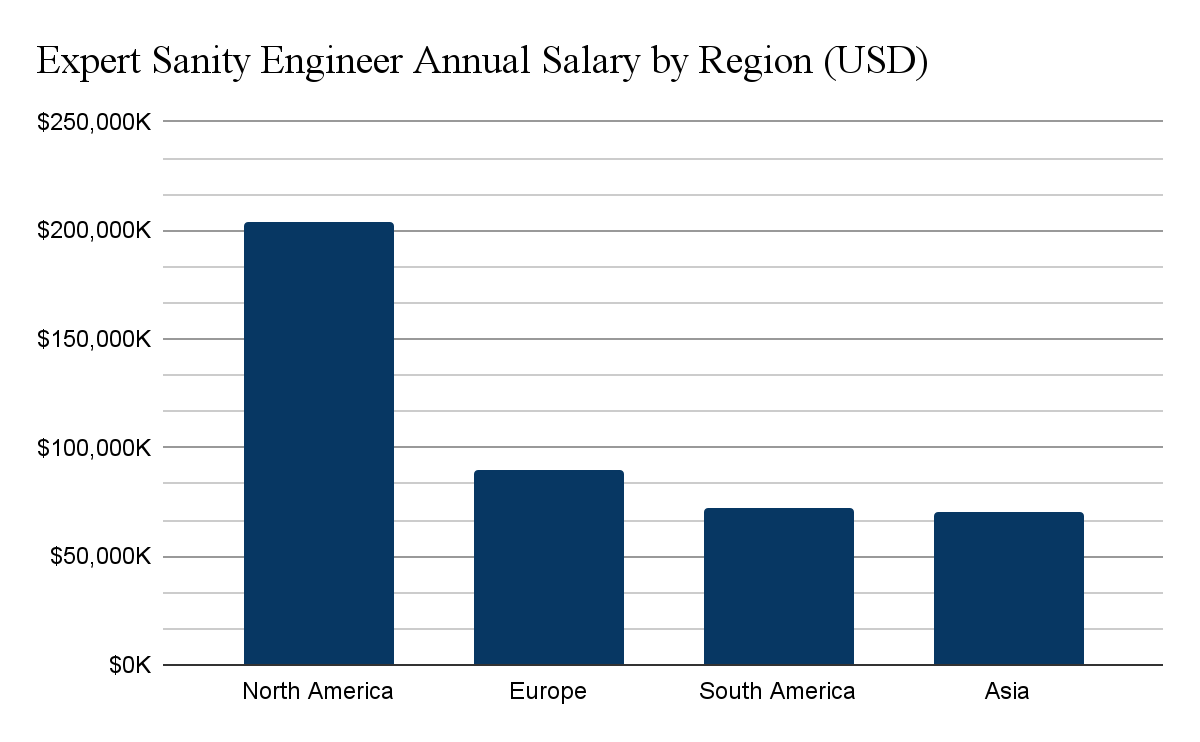
Important note: The salary numbers above reflect base compensation only. They do not include hiring costs, benefits, or the ongoing cost of tools and subscriptions.
Agencies often cost less than a single full-time US hire and provide:
- backup engineers
- immediate replacements
- multi-skill access
- zero HR overhead
But it’s not just about cost or affordability.
In my experience, the biggest concern for enterprise teams isn’t budget—it’s availability. Truly enterprise-ready Sanity engineers are hard to find, regardless of the region. As I mentioned earlier, they’re a rare breed.
In some countries, the total pool of enterprise-purpose engineers is simply very small. That makes hiring not only time-consuming but also unpredictable. You might have the budget ready, the role approved, and the urgency clear—yet still spend months trying to find the right person who’s actually available.
That scarcity, more than cost, is often what slows down enterprise teams.
The Interview Process That Actually Works
Interviewing Sanity engineers is where most teams either win—or lose—months of time.
Here’s a simple 5-step process that works.
Step 1: Pre-Screen (10 Minutes)
Look for:
- 5+ years of real Sanity experience (senior in Sanity-world)
- strong JavaScript + React background
- ownership of schema decisions
- shipped projects (not just "helped")
- ability to explain modeling choices
If none of these exist → stop.
Step 2: Review Public Work (15 Minutes)
What to check:
- schema organization and consistency
- reuse patterns (not duplication)
- validation discipline
- GROQ quality
- repo hygiene + documentation
- commit history quality
Messy schemas usually mean messy systems.
Step 3: Technical Interview (30 Minutes)
Topics to cover:
- JavaScript fundamentals (real depth)
- React thinking
- schema evolution strategy
- references vs embedded tradeoffs
- Portable Text boundaries
- preview architecture
- GROQ performance awareness
- debugging approach
You’re evaluating thinking—not memorized answers.
Step 4: Practical Assignment
Great options:
- design a content model for a real use case (home + article + taxonomy)
- refactor a messy schema into clean patterns
- critique an existing model and propose improvements
- write a few GROQ queries with sensible projections
The goal is to see how they think, structure, and communicate.
Step 5: Communication & Culture Fit
Ask yourself:
- Do they explain clearly?
- Do they document well?
- Do they collaborate with non-engineers?
- Do they flag risks early?
- Do they think long-term?
Enterprise work needs calm, structured, reliable engineers.
Red Flags to Avoid
Most candidates won’t fail because they’re bad engineers. They’ll fail because they’re the wrong fit for enterprise Sanity.
Here are the red flags I recommend avoiding immediately:
- weak JavaScript fundamentals
- "I only worked in Sanity Studio, not the frontend"
- no schema ownership (only ticket execution)
- over-flexible schemas with no guardrails
- duplication everywhere ("copy/paste schema")
- can’t explain references vs embedded content
- no preview experience (or preview breaks often)
- buzzwords instead of systems thinking
Full-Time vs Agency: What’s Better for Enterprise Brands?
There’s no one-size-fits-all answer. It’s a strategic decision.
Hire full-time if:
- you want long-term ownership
- your workload is predictable
- you have strong internal platform leadership
Hire via agency if:
- you want to start fast
- you need flexibility
- you want backup engineers
- you need senior skill without hiring risk
- you don’t want HR, legal, or compliance burden
Most large brands do best with a hybrid:
Small in-house leadership team + Sanity agency augmentation.
Final Thoughts
Hiring a strong Sanity engineer isn’t easy.
Sanity is modern—and because it’s only been around 9–10 years, the expert pool is still small. You won’t find many people with 10 years of experience.
So instead of chasing "years," focus on signal:
- 5+ years of real production Sanity work (often senior-level today)
- strong JavaScript fundamentals
- React + Node.js comfort
- content modeling ownership
- schema evolution experience
- editorial workflow empathy
At Multidots, we’re an official Sanity Enterprise Agency Partner, with 12+ Sanity-certified engineers. If you want the fastest, safest path to adding senior Sanity capability, partnering with a certified Sanity agency can save months of trial and error.If you’d like to explore how this works in practice, schedule a short conversation with my team and we’ll walk you through what a "senior Sanity engineer" actually looks like in real enterprise delivery.
Feel free to schedule a quick call with our expert.
Contact Us