
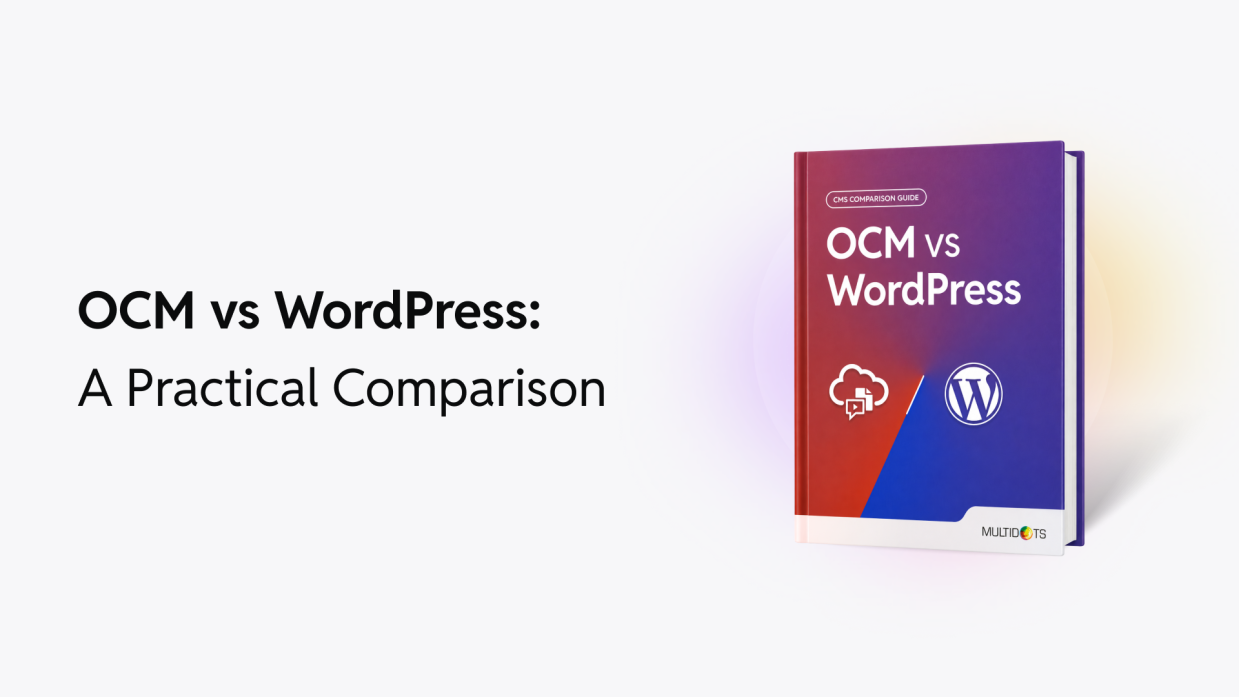
Selecting the right content management system is a critical decision for enterprises building their digital infrastructure. Oracle Content Management (OCM) and WordPress represent fundamentally different approaches—one a proprietary enterprise platform tied to Oracle’s cloud ecosystem, the other an open-source CMS powering over 43% of the internet.
One fact now dominates this comparison: Oracle Content Management Cloud Services was officially discontinued on December 31, 2025. Organizations still evaluating OCM or currently running on Oracle’s content management stack face an urgent decision about their content platform’s future.
This guide provides a comprehensive comparison of OCM and WordPress across every dimension that matters for enterprise decision-makers—from ease of use and customization to security, performance, cost, and long-term viability—so you can chart the right path forward for your organization.
OCM vs WordPress: Brief Overview
When it comes to managing digital content for enterprises, Oracle Content Management and WordPress stand out as two of the most robust and capable platforms in the market.
What is Oracle Content Management?
OCM is a cloud-based enterprise content hub built on Oracle Cloud Infrastructure, designed to support the entire content lifecycle in large organizations. The platform provided digital asset management, document collaboration, workflow automation, content analytics, and both traditional site building and headless CMS capabilities through REST and GraphQL APIs. OCM was the cloud evolution of Oracle’s content management lineage that began with the acquisition of Stellent in 2006. It appealed to enterprises embedded in Oracle’s ecosystem, particularly those in regulated industries requiring stringent compliance and security. However, Oracle discontinued the services on December 31, 2025, and has stated it has no Oracle-managed cloud replacement.

What is WordPress?
WordPress, a veteran in the CMS space, has cemented its reputation as a reliable and powerful platform since its inception in 2003. WordPress thrives as an open-source platform, allowing it unlimited flexibility and customization without the constraints of a subscription-based model. Its real strength lies in its remarkable flexibility, ease of use, extensive community support, and a vast selection of over 60,000 plugins and thousands of themes that allows businesses to deploy and manage everything from blogs to complex e-commerce and enterprise sites. WordPress stands out for delivering an all-inclusive, user-friendly experience, making it the preferred choice for businesses seeking a proven and adaptable web solution that powers over 43% of all websites on the internet.
OCM vs WordPress: Understanding the Differences
The fundamental difference between OCM and WordPress lies in philosophy, licensing, and long-term trajectory. OCM was a proprietary, subscription-based platform tightly integrated with Oracle’s cloud ecosystem. WordPress is an open-source, vendor-independent CMS with the largest ecosystem and community of any content platform in the world.
OCM operated as a “walled garden”—content management, digital asset management, collaboration, and delivery tools were bundled into Oracle’s proprietary cloud. This simplified vendor management for organizations already invested in Oracle but created deep dependency on a single provider. The discontinuation of OCM Cloud Services in 2025 has made this dependency a critical risk for remaining users.
WordPress takes a modular, open approach. The core CMS is free, and organizations build on it using plugins, themes, and custom development. There is no vendor lock-in, no licensing fees, and no single point of failure. The platform is backed by a massive global community that ensures continuous development and support.
Quick Overview
Let’s quickly compare the two CMS in the key aspects:
| Oracle Content Management | WordPress | |
|---|---|---|
| Type of CMS | Cloud-based enterprise content hub (proprietary) | Open-source CMS |
| Licensing | Subscription-based (Oracle Cloud) | Free (GPLv2) |
| Target Audience | Large enterprises in Oracle ecosystem | All industries, all sizes |
| Ease of Use | Complex, requires training | User-friendly admin interface |
| Customization | Modular but rigid (Oracle expertise) | Extensive (60K+ plugins, themes) |
| Performance & Scalability | Oracle Cloud infrastructure | High with enterprise hosting |
| Security | Enterprise-grade (Oracle Cloud) | Secure core + plugins + enterprise hosting |
| Developer Experience | Oracle/Java specialists required | Massive community, abundant resources |
| E-commerce | Limited native capabilities | WooCommerce (36%+ of online stores) |
| Cost Efficiency | High (Oracle subscription + implementation) | Low to moderate (no licensing fees) |
| Long-term Viability | Discontinued (Dec 2025) | 20+ years of continuous development |
The Qualities of an Ideal Enterprise CMS Solution
Before diving into the detailed comparison, it helps to establish what makes a CMS truly enterprise-ready. Regardless of which platform you choose, your CMS should deliver on these core qualities:
- Ease of Use: Content teams should be able to create, edit, and publish without relying on developers for day-to-day tasks.
- Flexibility and Customization: The platform should adapt to your business requirements, not the other way around.
- Security: Enterprise-grade security including regular updates, vulnerability monitoring, access controls, and compliance certifications.
- Support and Community: Access to reliable support channels, documentation, and a talent pool for ongoing development.
- Integrations: Ability to connect with your existing tech stack: CRM, marketing automation, analytics, e-commerce, and more.
- Performance and Scalability: Consistent speed and uptime under high traffic, with the ability to scale without re-platforming.
- SEO-Friendly Architecture: Clean URLs, structured data support, fast page rendering, and tooling for on-page optimization.
- Long-term Viability: Continuous development, a clear product roadmap, and a track record of stability and growth.
Keep these qualities in mind as you evaluate OCM and WordPress across each dimension below.
OCM vs WordPress: Full Comparison
Below is a detailed comparison of Oracle Content Management and WordPress across the dimensions that matter most for enterprise CMS decision-making.
1. Ease of Use and Setup Process
OCM’s interface is feature-rich but complex. The platform was designed for technical teams and large-scale content operations, which means non-technical users often require significant training before they can manage content independently. Implementation typically required Oracle consultants or specialized partners, and initial setup was notoriously involved, often taking months for enterprise deployments.
WordPress is renowned for its ease of use. The intuitive admin dashboard allows non-technical users to create and publish content with minimal training. The Gutenberg block editor provides a visual, drag-and-drop content creation experience that content teams can adopt rapidly. For enterprise deployments, managed hosting providers like WordPress VIP handle the infrastructure complexity, allowing teams to focus on content rather than server management.
Verdict: WordPress wins decisively on ease of use and speed to productivity. OCM’s interface required extensive training and specialized expertise.
2. Customization and Flexibility
OCM offered modular customization capabilities through APIs and SDKs (Java/Android, Swift/iOS), but adapting the platform to new business requirements was often rigid and expensive. Custom development required Oracle-specific expertise, and extending the platform outside of Oracle’s ecosystem was challenging. Users frequently reported that even basic customizations required vendor involvement or specialized consultants.
WordPress, as an open-source platform, offers virtually unlimited customization potential. With over 60,000 free plugins, thousands of themes, custom post types, an extensive hooks and filters system, REST API, and Full Site Editing, organizations can tailor WordPress to meet virtually any requirement. Whether you need a publishing platform, an e-commerce store via WooCommerce, a learning management system, or a multi-site network, WordPress can deliver.
Verdict: WordPress wins. Its open-source nature and massive plugin ecosystem provide far greater flexibility without vendor dependency.
3. Content Management and Editorial Experience
OCM’s content management capabilities were genuinely strong for enterprise use. The platform provided structured content modeling, built-in digital asset management with rights management, workflow automation with approval chains, version control, and collaboration tools. For organizations managing large volumes of documents and digital assets across multiple teams, OCM offered purpose-built tools for these workflows.
WordPress provides a powerful and flexible content management experience through the Gutenberg block editor, which supports reusable blocks, patterns, and a visual editing experience. For collaborative editing, plugins like Multicollab bring Google Docs-style commenting and real-time collaboration directly into the WordPress editor. Custom editorial workflows, media management, revision history, and role-based access control are all available natively or through plugins.
Verdict: OCM had a slight edge in native DAM and document management workflows. WordPress matches it for web content management and wins on editorial flexibility and ease of use.
4. Plugins, Extensions, and Integrations
OCM’s integration ecosystem was largely confined to Oracle’s own product suite. It offered connectors for Dropbox, Google Drive, and Microsoft Office, along with SDKs for custom development. However, there was no public plugin marketplace, and extending the platform beyond Oracle’s ecosystem typically required expensive custom integration work.
WordPress boasts the largest plugin ecosystem of any CMS, with over 60,000 free plugins available on WordPress.org and thousands more premium options. This ecosystem covers virtually every business need: SEO (Yoast, Rank Math), e-commerce (WooCommerce), marketing automation, CRM integrations, analytics, accessibility, multilingual support, and much more. The REST API enables custom integrations with any external system.
Verdict: WordPress wins decisively. The plugin ecosystem is unmatched in both scale and breadth. OCM’s integration options were limited to Oracle’s ecosystem.
5. Security Features
OCM leveraged Oracle Cloud’s enterprise security infrastructure, including automated security updates, encryption in transit and at rest, advanced access controls, and compliance with global data protection regulations. The platform supported integration with enterprise identity management systems and met stringent compliance requirements for regulated industries.
WordPress takes a transparent approach to security. The open-source core is audited by a global community of security researchers. Regular core updates address vulnerabilities promptly. The ecosystem offers robust security plugins (Wordfence, Sucuri, iThemes Security) that provide firewalls, malware scanning, login protection, and vulnerability detection.
Enterprise hosting providers like WordPress VIP add additional security layers, including automated updates, DDoS protection, and code review processes. WordPress VIP is also FedRAMP-authorized, meeting the highest government-grade security standards.
Verdict: Both platforms offered strong enterprise-grade security. However, with OCM now discontinued, security updates and patches are no longer being provided—making WordPress the only viable option for ongoing security maintenance.
6. Performance and Scalability
OCM was hosted on Oracle Cloud Infrastructure with elastic scalability, high availability, and disaster recovery configurations. However, users reported performance degradation with large asset libraries (100+ assets causing API slowdowns), and the platform’s performance was entirely dependent on Oracle’s cloud environment with no ability to choose alternative infrastructure.
WordPress is highly scalable when paired with the right infrastructure. Enterprise hosting providers like WordPress VIP, Pantheon, and WP Engine offer auto-scaling, global CDN integration, edge caching, and performance optimization out of the box. With proper configuration, WordPress can handle billions of page views per month. The platform consistently delivers strong Core Web Vitals scores at enterprise scale.
Verdict: WordPress offers superior performance flexibility. Organizations can choose their hosting infrastructure, optimize with best-of-breed tools, and scale without being locked into a single cloud provider.
7. Ownership Costs and Total Cost of Ownership
OCM used a subscription-based pricing model tied to Oracle Cloud. Pricing was opaque, with enterprise implementations routinely costing $100,000 to $500,000+ for initial setup, plus ongoing subscription fees. The specialized talent required for Oracle development commands premium rates due to the smaller talent pool.
WordPress core software is free and open-source, with no licensing fees. Total costs depend on hosting, development, and premium plugins. Enterprise hosting through WordPress VIP starts at approximately $25,000 per year. The larger WordPress developer talent pool means significantly lower hourly rates compared to Oracle specialists.
Here’s a quick cost-breakdown of the two CMS:
| OCM / Oracle (Estimated) | WordPress (Estimated) | |
|---|---|---|
| CMS License | Subscription-based (Oracle Cloud) | Free (GPLv2) |
| Hosting (Annual) | Oracle Cloud ($50K-$200K+/yr) | $5K-$60K+/yr (VIP from $25K) |
| Implementation | $100,000-$500,000+ | $25,000-$150,000+ |
| Developer Rate (US) | $120-$200/hr (Oracle specialists) | $50-$150/hr |
| Available Talent Pool | Very small (Oracle/Java specialists) | Very large (millions of WP devs) |
| Premium Add-ons | Custom dev in Oracle ecosystem | $500-$5,000/year |
| Maintenance (Annual) | $30,000-$100,000+ | $5,000-$30,000+/year |
| Enterprise 3-Year TCO | $400,000-$1,500,000+ | $100,000-$400,000+ |
Verdict: WordPress offers substantially lower total cost of ownership. The absence of licensing fees, a dramatically larger talent pool, and flexible hosting options create significant savings at every stage.
8. SEO and Marketing Capabilities
OCM offered basic SEO features including SEO-friendly URLs, metadata management, and prerender technology for JavaScript-heavy pages. However, its SEO and marketing tooling was limited compared to dedicated CMS platforms, and organizations typically needed to supplement OCM with third-party marketing tools.
WordPress is widely regarded as one of the most SEO-friendly CMS platforms available. Plugins like Yoast SEO and Rank Math provide comprehensive on-page SEO management, including meta tags, schema markup, XML sitemaps, content analysis, and readability scoring. WordPress’s clean URL structure, fast page rendering, and native support for structured data make it a strong foundation for search visibility. The ecosystem also offers extensive marketing integrations with Google Analytics, Google Tag Manager, HubSpot, Mailchimp, and A/B testing tools.
Verdict: WordPress wins. The SEO and marketing plugin ecosystem is unrivaled. OCM’s built-in SEO features were basic by comparison.
9. Support and Community
OCM was backed by Oracle’s professional support services, including dedicated troubleshooting teams, documentation, and training programs. However, the broader user community was small and insular. Third-party resources, tutorials, and independent documentation were scarce compared to open-source alternatives. With OCM now discontinued, official support has ended, leaving remaining Oracle content management users dependent on Oracle WebCenter’s more limited support channels.
WordPress has the largest CMS community in the world, with millions of developers, designers, and users contributing to forums, documentation, tutorials, and open-source development. WordCamps (community conferences) are held globally. Professional services and agencies specializing in WordPress are abundant. For enterprise clients, WordPress VIP offers dedicated account management and premium support.
Verdict: WordPress wins overwhelmingly. The community size, talent availability, and breadth of support resources are unmatched—and unlike OCM, this support will continue indefinitely.
OCM vs WordPress: Which CMS is Right for Your Business?
Given that OCM Cloud Services has been discontinued, this is no longer a traditional “which should you choose” comparison. The question is now whether remaining OCM or Oracle WebCenter users should migrate to WordPress or explore other options.
Consider staying on Oracle WebCenter Content (on-prem) if:
- You are deeply embedded in Oracle’s enterprise application ecosystem (ERP, HCM, CX)
- You have strict on-premises requirements that prevent cloud or SaaS adoption
- Your primary use case is internal document management rather than web content
- You have in-house Oracle/Java expertise and can manage the platform long-term
- Note: Oracle WebCenter Content v14c is supported until approximately 2032
Choose WordPress if:
- You need an actively developed, future-proof CMS with a clear long-term roadmap
- You want maximum flexibility to customize your platform for any use case
- You need a cost-effective CMS without enterprise licensing fees
- Your content strategy includes web publishing, marketing, e-commerce, or multi-channel delivery
- You want access to the largest developer talent pool in the CMS market
- SEO and marketing capabilities are central to your digital strategy
- You want full ownership of your data and code with no vendor lock-in
- You need a proven enterprise CMS with WordPress VIP, trusted by CNN, TechCrunch, and more
For the vast majority of organizations, WordPress is the clear choice. It offers superior flexibility, a dramatically lower total cost of ownership, the largest ecosystem of any CMS, and a track record of continuous growth and development spanning over two decades.
Why Companies Migrate from OCM to WordPress
The discontinuation of OCM Cloud Services has accelerated what was already a growing trend. Here are the five primary reasons organizations are making the move.
1. End of life and product discontinuation
OCM Cloud Services ceased operations on December 31, 2025. Oracle has explicitly stated it has no Oracle-managed cloud replacement. Organizations that haven’t already migrated are operating without vendor support, security updates, or a product roadmap. This is the most urgent driver of migration.
2. Cost reduction
Oracle’s enterprise pricing—subscription fees, implementation costs, specialized talent—created significant ongoing expenses. Organizations that migrate to WordPress typically report 50-70% reductions in total cost of ownership. For a detailed breakdown of migration costs and optimization strategies, see our OCM to WordPress migration cost guide.
3. Vendor lock-in and limited flexibility
OCM was tightly coupled with Oracle’s ecosystem, making it difficult and expensive to integrate with non-Oracle tools or switch platforms. WordPress’s open-source model provides complete data portability, platform independence, and the freedom to choose any hosting provider, development partner, or integration tool.
4. Broader functionality and ecosystem
OCM excelled at document and asset management but had limited capabilities for modern web experiences like e-commerce, marketing automation, SEO optimization, and community building. WordPress’s 60,000+ plugins provide ready-made solutions for virtually every business need, eliminating expensive custom development.
5. Talent availability
Finding developers with Oracle content management expertise is difficult and expensive. WordPress developers are abundant globally, reducing hiring costs, timelines, and the risk of key-person dependency.
How Multidots Can Help?
Multidots is a WordPress VIP Gold Partner with over 16 years of experience in enterprise WordPress development. We have completed more than 300 successful website migrations from platforms including Oracle Content Management, Sitecore, Drupal, Adobe Experience Manager, and more.
Our services include:
- Platform assessment and CMS migration strategy
- End-to-end OCM to WordPress migration with zero downtime
- SEO preservation during migration to protect your search rankings
- Custom WordPress development for enterprise requirements
- Performance optimization and security hardening
- Ongoing support and maintenance
For a step-by-step walkthrough of how SEO equity is preserved during CMS migration, see our guide on SEO-friendly OCM to WordPress migration. If you’re planning a migration from OCM or Oracle WebCenter to WordPress, we’d love to help. Schedule a free consultation to discuss your project.
OCM vs WordPress: FAQs
Oracle Content Management Cloud Services was officially discontinued on December 31, 2025. Oracle has stated it does not have an Oracle-managed cloud replacement. Organizations were given a 60-day data retrieval window in January 2026. The on-premises alternative, Oracle WebCenter Content, remains supported until approximately 2032.
Yes. WordPress supports enterprise-level content management, editorial workflows, digital asset management, role-based access control, and multi-site management. Plugins like Multicollab add collaborative editing, and enterprise hosting providers like WordPress VIP deliver the security and scalability that large organizations require.
The primary considerations include content structure mapping, URL preservation for SEO equity, workflow retraining, and integration reconfiguration. These are well-understood challenges that experienced migration partners handle routinely. Multidots has completed 300+ enterprise CMS migrations with minimal disruption to operations and SEO performance.
Yes. WordPress core is actively maintained and audited by a global security community. Enterprise hosting providers like WordPress VIP add additional security layers, including automated updates, vulnerability scanning, DDoS protection, and code review. WordPress VIP is FedRAMP-authorized, meeting government-grade security standards.
WordPress is the most widely adopted alternative, offering the largest ecosystem, lowest TCO, and greatest flexibility. Other alternatives include Contentful, Sanity, and CrafterCMS for headless use cases.