
Okay, you’re thinking about migrating from Drupal to WordPress.
Maybe you’re still running Drupal 7 and the reality of its end-of-life in January 2025 has finally hit—no more security patches, no more community support, and a growing list of vulnerabilities that nobody is going to fix. Maybe you’ve looked at the upgrade path to Drupal 10 or 11 and realized it’s not really an upgrade at all—it’s a full rebuild, with new theming systems, new module APIs, and a codebase that bears little resemblance to what you’re running today. Or maybe your content team has spent another week waiting on a developer to make a change that should take five minutes, and someone finally asked: “Why are we still doing this?”
Whatever brought you here, you’re in the right place.
But let’s be honest about something upfront: this isn’t a simple platform swap. Your Drupal implementation has years of custom modules, content types, Views configurations, and taxonomy structures baked into it. Your production environment runs on custom hooks, contributed modules that may or may not have Drupal 10 equivalents, and that Drush script your predecessor wrote that nobody fully understands. None of that shows up in vendor demos.
The gap between “it works in the demo” and “it works in production” is where migrations fail, budgets explode, and platforms get blamed for implementation decisions.
This guide gives you practical frameworks to plan a migration that still makes sense six months after launch—not just on day one. Drawing on 300+ enterprise migrations, we’ll help you navigate the real challenges: hidden costs that surface mid-project, complexity factors that double timelines, and the critical decisions that determine whether you’re set up for long-term success or expensive do-overs.
Here’s a quick roadmap so you can jump to what matters most:
- Start here if you need to validate whether WordPress is actually the right fit for your organization.
- Start here if you’re looking to understand the complexity involved in the migration.
- Start here for a deep dive into how to select the right migration partner for a smooth experience.
- Start here if you want to address common objections people often have about Drupal to WordPress migration.
- Start here for a step-by-step guide on how to handle the migration yourself.
- Start here if you have specific questions about your unique migration needs.
Or skip all of that and schedule a free 30-minute consultation with us. Let’s cut to the chase and tackle your questions head-on.
Ready? Let’s start by making sure this migration actually makes sense for your business.
PART 1: Should You Really Migrate? The Decision Framework
Before you commit to a multi-month migration project, let’s pressure-test the decision. Not every Drupal frustration means WordPress is the answer—and not every Drupal site needs to move. Some problems are platform problems. Others are implementation problems that will follow you to any CMS if you don’t address them first.
This framework helps you validate whether migration makes strategic sense for your specific situation, or whether you’d be better served fixing what you have.
1.1 The 6 Critical Questions
Answer these honestly. If you’re unsure about more than two, you need more discovery before moving forward.
Your answer to this question shapes everything else. The migration calculus is fundamentally different depending on where you’re starting from.
- Running Drupal 7: This is the most urgent scenario. Drupal 7 reached end-of-life in January 2025, meaning no more official security patches or community support. Every day you remain on Drupal 7 is a day your site is exposed to unpatched vulnerabilities. The “upgrade” to Drupal 10 or 11 is effectively a full rebuild anyway—new theming engine (Twig), new module APIs, new configuration management. If you’re facing a rebuild regardless, WordPress deserves serious consideration.
- Running Drupal 8 or 9: Both have also reached end-of-life. The path to Drupal 10/11 is smoother than from Drupal 7, but it still requires updating deprecated code, replacing removed modules, and dealing with breaking changes in dependencies like Symfony and CKEditor. If you’re already investing in a significant update, evaluate whether that investment is better directed toward a platform with lower long-term maintenance costs.
- Running Drupal 10 or 11: Your platform is current. If you’re considering migration, the driver is likely operational—developer costs, content team frustration, or strategic alignment rather than end-of-life urgency. That’s a valid reason, but the calculus is different. You have more time to plan.
- Frustrated with developer dependency: Drupal’s architecture requires PHP developers for tasks that WordPress handles through its admin interface. If your content team can’t publish without filing a dev ticket, that’s a platform design issue, not an implementation bug.
- Rising maintenance costs: Drupal developers command higher rates than WordPress developers because the talent pool is significantly smaller. As Drupal’s market share continues to decline—from 2.0% to 1.6% between 2022 and 2023—this talent gap is widening.
- 1-5 editors: WordPress or a headless CMS make sense. Drupal’s complexity and the overhead of maintaining it are overkill for a small team.
- 6-20 editors: Any platform could work at this scale, but governance and workflow design matter more than the platform itself. WordPress handles this comfortably with role management and editorial workflow plugins.
- 20+ editors across departments: WordPress excels here. Its multisite capabilities, granular role management, and intuitive block editor make it possible for large teams to work independently without developer bottlenecks. Drupal can handle this scale too, but the training overhead is significantly higher because of its steeper learning curve.
- Marketing pages and campaigns: WordPress dominates this use case. Faster deployment, easier A/B testing, and better integration with marketing tools. Drupal’s content modeling flexibility is powerful but often overkill for marketing content.
- News, articles, and editorial content: WordPress was literally built for this. The Gutenberg block editor makes content creation intuitive in a way that Drupal’s admin interface simply doesn’t match for non-technical users.
- Complex product catalogs with frequent updates: Both platforms can handle this. WordPress with WooCommerce or custom post types offers more flexibility at lower cost. Drupal’s entity reference system and Views module are powerful for complex data relationships, but WordPress’s Advanced Custom Fields (ACF) and custom post types can replicate most of this functionality with less development overhead.
- Highly structured content with complex relationships: This is Drupal’s traditional strength—its entity system and field API allow for sophisticated content modeling. However, WordPress has closed much of this gap with ACF, custom post types, and custom taxonomies. Evaluate whether your content complexity genuinely requires Drupal’s architecture or whether it’s been over-engineered.
- Standard contributed modules (Views, Webform, Pathauto): WordPress has mature equivalents for all of these. Views maps to custom queries or plugins like SearchWP. Webform maps to Gravity Forms or WPForms. Pathauto maps to WordPress’s native permalink structure or Yoast SEO.
- CRM and marketing automation (Salesforce, HubSpot, Mailchimp): Both platforms handle these integrations well. WordPress often integrates faster because of its larger plugin ecosystem.
- Custom modules your team built: This is where complexity lives. Every custom module needs analysis—some will map to existing WordPress plugins, others will require custom development. Budget time for a thorough audit.
- Drupal Commerce: If you’re running Drupal Commerce for e-commerce, WooCommerce is a strong equivalent with a significantly larger ecosystem of extensions and payment gateway integrations.
- Multilingual via core or contributed modules: Drupal’s built-in multilingual support is one of its genuine strengths. WordPress handles multilingual through WPML or Polylang, which are mature and capable but add plugin dependency. If you’re running 10+ languages with complex translation workflows, factor in the configuration effort.
- Under $100K: WordPress is your most realistic option. Drupal’s higher development and maintenance costs make it difficult to deliver a quality enterprise site at this budget.
- $100K-$300K: WordPress with enterprise hosting fits comfortably, with room for custom development and design work. A Drupal rebuild at this budget would be tight and leave little contingency.
- $300K+: Both platforms are technically accessible at this budget. The question becomes whether Drupal’s premium in developer costs and maintenance delivers proportional value compared to what you could build on WordPress.
- Under 3 months: Only WordPress is achievable with an experienced partner and well-defined scope. Drupal’s complexity makes this timeline unrealistic for any meaningful migration.
- 3-6 months: WordPress is very doable. A Drupal-to-WordPress migration is realistic with proper planning and an experienced team.
- 6-12 months: Any migration path is achievable. Timeline isn’t a constraint—use the runway to do it right.
- 12+ months: Question why you’re waiting. If you’re on Drupal 7, unnecessary delays mean continued exposure to unpatched security vulnerabilities and accumulating technical debt.
1.2 Interpreting Your Answers
Strong signals to migrate to WordPress:
- You’re running Drupal 7, 8, or 9 and facing an end-of-life situation
- Your content team regularly needs developer help for routine publishing tasks
- You’re paying premium rates for Drupal developers who are increasingly difficult to find
- Your Drupal site has modules that lack maintained equivalents in newer Drupal versions
- Budget is under $300K for year one and you need to maximize value
- You need to launch within 6 months
- Your team’s primary focus is content publishing, marketing, or e-commerce
- You’re spending more time maintaining Drupal than improving your digital presence
Warning patterns that suggest more discovery is needed:
- You’re frustrated with your current site’s performance or design, not the platform itself. A bad implementation looks the same on any CMS. Migrating won’t fix architectural mistakes unless you address them.
- You’re not clear on which Drupal modules your team actually depends on daily. Without a module audit, you can’t accurately scope the migration.
- You haven’t inventoried your content types, taxonomy structures, and custom fields. Drupal’s content modeling can be deeply nested—you need to understand what you have before you can estimate what it takes to move it.
- You’re planning to migrate “because WordPress is cheaper” without understanding total cost of ownership. WordPress is less expensive, but the migration itself has costs that need proper budgeting.
Situations where staying on Drupal might make sense:
- You’re running Drupal 10 or 11 with a well-maintained codebase, and your development team is productive and affordable
- Your site has genuinely complex content relationships that would require significant re-architecture in WordPress
- You have a strong in-house Drupal development team and the cost of retraining them on WordPress exceeds the migration savings
- Your content team is comfortable with Drupal’s admin interface and doesn’t experience productivity bottlenecks
- Your Drupal implementation is working well and total cost of ownership is acceptable
1.3 The Go/No-Go Decision Tree
Answer these five questions with a simple yes or no:
Is your Drupal version at or approaching end-of-life?
- YES: Strong urgency to act. Security risk increases daily.
- NO: Less urgency, but evaluate whether ongoing costs justify staying.
Is your content team frequently blocked waiting for developer assistance?
- YES: WordPress’s self-service model will dramatically improve publishing velocity.
- NO: This might be an implementation issue rather than a platform issue.
Are you using fewer than 50% of Drupal’s advanced capabilities (custom entities, complex Views, advanced access control)?
- YES: You’re likely over-invested in platform complexity you don’t need.
- NO: Drupal’s complexity might be appropriate for your requirements.
Do you have budget for both migration AND 12 months of WordPress hosting and support?
- YES: Proceed with migration planning.
- NO: Budget properly before committing. A poorly funded migration creates more problems than it solves.
Do you have an experienced WordPress VIP partner identified?
- YES: Risk is manageable with proven expertise.
- NO: Finding the right partner is critical. Don’t rush this step.
Decision: If you answered YES to 4 or more of these questions, migration makes strategic sense. If you answered YES to only 2-3, dig deeper into the specific areas before committing. If fewer than 2, Drupal may still be the right platform—focus on optimizing your current implementation instead.
PART 2: Understanding Your Migration Complexity
Migration timelines can swing 50-200% from initial estimates. That’s not because teams can’t plan—it’s because Drupal migrations specifically bring hidden complexity to the surface.
Drupal’s deeply nested content models, custom module dependencies, and hook-based architecture all reveal their true complexity when you try to extract and transform the data underneath them. Legacy workarounds, undocumented Views configurations, and years of accumulated technical debt reveal themselves only when you start pulling things apart.
This section helps you understand what you’re actually signing up for before you sign anything.
2.1 The Migration Complexity Scale
Every Drupal to WordPress migration falls into one of three tiers. Your tier determines your timeline, budget, and the level of expertise you’ll need.
Simple Migration (8-14 weeks, $75K-$200K)
Characteristics:
- Under 10,000 pages and content items
- 3-5 main content types with straightforward field structures
- Standard contributed modules (Views, Webform, Pathauto, Metatag) without heavy customization
- Limited custom code—mostly configuration-driven
- Standard integrations (Google Analytics, basic CRM, email marketing)
- Single language
- Willing to simplify some legacy functionality rather than replicate it exactly
What “simple” means in practice: The content model translates relatively cleanly between platforms. Most Drupal content types map to WordPress posts, pages, or a small number of custom post types. Views can be replaced with native WordPress queries or lightweight plugins. The effort is primarily in moving content and adapting it, not rebuilding complex features from scratch.
Example: A corporate marketing site running Drupal 7 with a blog, service pages, team profiles, and a contact form. Content-heavy but functionally straightforward. The site uses a handful of contributed modules, all of which have clear WordPress equivalents.
Moderate Migration (14-24 weeks, $200K-$450K)
Characteristics:
- 10,000-50,000 content items across multiple content types
- 5-10 content types with entity references and field collections linking them
- Custom modules or heavily configured contributed modules
- Multiple Views with contextual filters, relationships, and custom templates
- Multi-language support (2-5 languages) via i18n, content translation, or Drupal core translation
- Custom user roles beyond the standard Drupal defaults
- E-commerce functionality via Drupal Commerce or Ubercart
- Multiple integrations (CRM, marketing automation, DAM, analytics)
What “moderate” means in practice: You’re translating fundamentally different content architectures. Drupal’s entity-field system and WordPress’s post-meta model think about content differently. Some Drupal concepts—like entity references chaining content types together, or Paragraphs module creating nested content structures—don’t map directly to WordPress. These require rethinking, not just replicating.
Example: A multi-brand publisher running Drupal 8 or 9 with complex editorial workflows managed through Workbench, multiple content types with entity references between them, a custom taxonomy structure powering navigation, and Drupal Commerce handling subscriptions. The site supports three languages and has custom Views powering most of the front-end listing pages.
High Complexity Migration (24-40+ weeks, $450K-$1M+)
Characteristics:
- 50,000+ content items across 10 or more interconnected content types
- Heavy use of Paragraphs module or custom field collections for flexible page layouts
- Extensive custom module development with business logic embedded in code
- Complex taxonomy hierarchies powering navigation, filtering, and content relationships
- Multi-language (5+ languages) with regional content variations
- Advanced access control using modules like Content Access, Organic Groups, or Domain Access
- Complex integration ecosystem (10+ systems) including real-time data synchronization
- Compliance requirements (HIPAA, GDPR, financial regulations)
- Custom Drupal-to-Drupal migrations already layered on top of each other
What “high complexity” means in practice: This is effectively a new platform build. The Drupal implementation has evolved over many years with layers of customization that are deeply interdependent. Content models, access control, and business logic are intertwined in ways that require architectural decisions, not just data mapping. Almost nothing carries over directly—you’re rebuilding the business logic on a different foundation.
Example: A global enterprise running Drupal 7 with multiple subsites managed through Domain Access, extensive Paragraphs-based page building, a complex taxonomy hierarchy that powers both navigation and content access rules, custom modules handling business-specific workflows, and integrations with Salesforce, Marketo, a proprietary PIM, and an internal authentication system. The site supports eight languages with regional content variations and has compliance requirements for user data handling.
2.2 What Adds Time and Cost
These factors compound. If you have three of them, don’t just add the percentages—expect them to interact and multiply.
Content Model Complexity (+25-50% to timeline)
Drupal’s content modeling is its signature strength and its biggest migration challenge. Content types with dozens of fields, entity references creating complex relationships between content, field collections and Paragraphs creating nested structures within nodes, and taxonomy terms that serve double duty as both classification and navigation—all of this needs to be unpacked, understood, and re-implemented in WordPress’s post-type-and-meta model.
Why it matters: Every entity reference, every Paragraphs bundle, and every custom field formatter needs a WordPress equivalent. Some translate cleanly. Others require rethinking how the content is structured. The mapping exercise alone can take weeks for complex sites.
Custom Modules and Business Logic (+30-60% to timeline)
Custom Drupal modules often contain business logic that isn’t documented anywhere except in the code itself. Hook implementations, custom plugins (in Drupal 8+), and event subscribers may handle everything from content validation to integration orchestration. These don’t have direct WordPress equivalents—each one requires analysis, documentation, and either a plugin replacement or custom development.
Why it matters: A site with 15+ custom modules isn’t just a content migration. It’s a business logic migration. Skipping the audit of what these modules actually do is the single most common cause of migration budget overruns.
Views and Display Logic (+20-40% to timeline)
Drupal’s Views module is extraordinarily powerful, and many Drupal sites have dozens or even hundreds of Views configurations powering everything from front-end listing pages to admin dashboards. Each View may have multiple displays, contextual filters, relationships pulling in data from related entities, and custom field formatters controlling output.
Why it matters: There’s no single WordPress equivalent to Drupal Views. Depending on the View’s complexity, you might replace it with a native WordPress query, a plugin like FacetWP or SearchWP, a custom Gutenberg block, or a combination. Each View needs individual assessment, which takes time.
Taxonomy and URL Structure (+15-30% to timeline)
Drupal’s taxonomy system is more flexible than WordPress’s, allowing vocabulary hierarchies, term references across content types, and terms-as-pages patterns that don’t always map cleanly. Combined with Pathauto patterns that may differ from WordPress’s permalink structure, the URL mapping exercise can become substantial.
Why it matters: Taxonomy restructuring affects navigation, filtering, URL patterns, and SEO. Get it wrong and you’ll break internal linking, confuse search engines, and frustrate users who can’t find content through familiar paths.
Multilingual Content (+20-40% to timeline)
If your Drupal site uses multilingual features—whether through Drupal 7’s i18n module or Drupal 8+’s core translation—each piece of content exists in multiple language versions that need to maintain their relationships after migration. Translation memory, language negotiation rules, and locale-specific configurations all need to be mapped to WordPress’s multilingual approach (typically WPML or Polylang).
Why it matters: Multilingual isn’t just “multiply the content by the number of languages.” It’s the relationships between translations, the language fallback logic, and the URL patterns per language that create complexity.
2.3 The 3 Hidden Costs That Wreck Budgets
These don’t show up in initial scoping because vendors either don’t think about them or hope you won’t ask. Every failed Drupal-to-WordPress migration we’ve been brought in to rescue had at least one of these.
Hidden Cost 1: Content Model Translation and Editorial Retraining
What happens: Moving from Drupal’s entity-field architecture to WordPress’s post-types-and-meta model changes how your entire editorial team thinks about content—not just what buttons they press.
In Drupal, editors are accustomed to working with structured content types, field collections, and entity references. In WordPress, the mental model shifts to blocks, custom fields, and a more visual editing experience through Gutenberg. This isn’t just a UI change—it’s a workflow change.
Real impact:
- Expect a 40% productivity drop in month one as editors adjust to new workflows
- 20% drop in month two as they build new habits and discover edge cases
- 10% drop through month three as the team reaches competency
Budget impact: 2-3 months of reduced content output. If you publish daily, you need temporary resources or a reduced publishing schedule during the transition period.
What it actually costs:
- Training program development and delivery: $15K-$40K
- Temporary productivity loss: equivalent of 2-3 FTE months
- Documentation and custom editorial guides: $10K-$20K
- Total: $50K-$100K that most project budgets don’t include
The good news: Most teams become more productive on WordPress within 8-12 weeks because the day-to-day editing experience is significantly more intuitive than Drupal’s admin interface. The short-term productivity dip leads to a long-term productivity gain.
Hidden Cost 2: SEO and Redirect Mapping
What vendors say: “We’ll set up 301 redirects.”
What actually happens: Your Drupal site has years of SEO equity built into its URL structure, Pathauto patterns, metadata managed through the Metatag module, and internal linking. Finding everything that needs redirecting is harder than setting up the redirects themselves.
What breaks:
- Pathauto-generated URL patterns that differ from WordPress permalink structures
- Drupal’s taxonomy term pages (taxonomy/term/[tid]) that need mapping to WordPress taxonomy archives
- Views pages with clean URL aliases that don’t have direct WordPress equivalents
- Node paths with language prefixes in multilingual sites
- PDF and media file links that may have been served through Drupal’s private file system
- Old campaign URLs still receiving traffic from email campaigns and external sites
- Drupal’s RSS feed URLs that subscribers and aggregators depend on
Real example: A media company migrated 50,000 articles from Drupal to WordPress with “all content preserved.” They skipped comprehensive redirect mapping to save $30K. Traffic dropped 35% overnight. Recovery took 8 months and cost $180K in SEO remediation and content optimization.
What it actually costs:
- Comprehensive URL audit and mapping: $20K-$40K
- Redirect implementation and testing: $10K-$20K
- Post-launch monitoring and adjustments (3 months): $10K-$15K
- Total: $40K-$75K for proper execution
- Failure cost: $150K-$500K in lost traffic and emergency remediation
Hidden Cost 3: Module Audit and Functionality Gap Analysis
What vendors say: “WordPress has a plugin for everything.”
What actually happens: While WordPress does have an enormous plugin ecosystem, the assumption that every Drupal module has a drop-in WordPress equivalent is dangerous. Some Drupal modules—particularly custom ones and those deeply integrated with Drupal’s entity system—require careful analysis to determine whether a WordPress plugin can replace them, whether custom development is needed, or whether the functionality should be redesigned entirely.
What gets missed:
- Custom modules with business logic that isn’t documented
- Contributed modules that have been patched or forked for your specific needs
- Module interactions where two or three modules work together to deliver a feature
- Configuration-heavy modules (like Rules or Flag) where the “code” is actually stored in the database as configuration
- Drush commands that your operations team depends on for deployment and maintenance workflows
What it actually costs:
- Thorough module audit and gap analysis: $15K-$30K
- Custom plugin development for functionality gaps: $20K-$60K (varies enormously based on scope)
- Testing and validation: $10K-$20K
- Total: $45K-$110K when done properly
- Budget typically allocated: $10K-$20K under “plugin setup”
2.4 Migration Readiness Checklist
Before signing any migration contract, verify these prerequisites. Missing any item adds 20-40% to timeline and budget.
Strategic Readiness
- Clear business case with measurable success criteria defined
- Executive sponsorship with authority to make decisions and resolve conflicts
- Dedicated product owner with at least 50% time allocation to the migration
- Budget approved with a minimum 20% contingency built in
- Realistic timeline with runway before any hard deadlines (like Drupal 7 security exposure)
Content Readiness
- Complete content inventory: all content types, fields, and their relationships documented
- Full list of Drupal Views and what each one powers on the front end
- Taxonomy vocabularies documented with their hierarchies and usage patterns
- High-value content identified for priority migration
- Clear decision on what NOT to migrate—outdated content, unused content types, legacy fields
Technical Readiness
- Drupal version, all contributed modules, and all custom modules documented with version numbers
- Access to Drupal’s database and file system for exports confirmed
- Custom module functionality documented with business requirements (not just code descriptions)
- Integration list with technical specifications, API endpoints, and authentication methods
- Current hosting environment documented including any Drupal-specific server configurations
Team Readiness
- Subject matter experts identified for each major content type and business workflow
- IT and infrastructure stakeholders engaged and supportive
- Training plan created with time allocated in team schedules
- Internal champions identified who will drive WordPress adoption within their teams
- Communication plan ready for stakeholders during migration (freeze periods, timeline updates)
Risk Management
- Full Drupal backup strategy tested and verified (database and files)
- Rollback plan documented in case of critical issues during migration
- Content freeze plan and communication prepared for the cutover period
- Contingency budget allocated (minimum 15-20% of total project budget)
- Post-launch support plan in place for the first 90 days
2.5 Timeline Reality Check
Here’s what realistic timelines look like when properly resourced, based on our experience with 300+ enterprise migrations.
Simple Migration: 8-14 weeks
- Discovery and planning: 1-2 weeks
- Content model design and mapping: 1-2 weeks
- WordPress environment setup and theme development: 2-3 weeks
- Plugin configuration and custom development: 1-2 weeks
- Content migration and QA: 2-3 weeks
- Training, UAT, and launch prep: 1-2 weeks
- Buffer for issues: 1-2 weeks
Moderate Migration: 14-24 weeks
- Discovery and planning: 2-3 weeks
- Content model and architecture design: 2-3 weeks
- WordPress development and custom features: 4-6 weeks
- Integration development and testing: 2-3 weeks
- Content migration (phased): 3-4 weeks
- Training, UAT, and launch prep: 2-3 weeks
- Buffer for issues: 2-3 weeks
High Complexity Migration: 24-40+ weeks
- Discovery and deep planning: 3-5 weeks
- Architecture and content modeling: 3-4 weeks
- Development (phased sprints): 8-14 weeks
- Integration development and testing: 3-5 weeks
- Content migration (phased): 4-6 weeks
- QA and validation: 2-4 weeks
- Training, UAT, and launch prep: 2-3 weeks
- Buffer for issues: 3-5 weeks
Add 20-30% to these timelines if:
- This is your organization’s first major CMS migration
- You have more than 5 stakeholder groups requiring sign-off
- Decision-making in your organization typically takes more than one week
- Your content team is unfamiliar with WordPress
- You’re migrating from Drupal 7 with extensive custom modules that lack documentation
The data backs this up: Organizations that completed their readiness checklist before signing contracts stayed within 10% of original timeline and budget 87% of the time. Organizations that skipped pre-work exceeded their timeline by 40% or more and their budget by 30% or more 68% of the time.
PART 3: Choosing the Right Migration Partner
Choosing the right migration partner accounts for roughly 80% of your project’s success—and it has nothing to do with platforms. The best WordPress implementation in the world won’t save a project from a partner who underestimates complexity, over-promises timelines, or doesn’t understand the specific challenges of migrating from Drupal.
Drupal-to-WordPress migrations have unique characteristics that generic “website redesign” agencies often miss. The content model translation, module-to-plugin mapping, and Drupal-specific data structures (like serialized field data and entity references) require partners who’ve done this specific type of migration before—not just “enterprise CMS migrations” in general.
3.1 Red Flags in Vendor Evaluation
What happens: They jump straight to talking about WordPress features and themes without asking what Drupal version you’re running, what modules you depend on, or how your content is structured.
What it means: They’re selling WordPress, not solving your migration problem. A partner who doesn’t ask about your Drupal implementation can’t accurately estimate the work required.
What to do: Share your module list and content type structure early. A strong partner will immediately identify the complex areas and ask follow-up questions. A weak one will gloss over it.
What you hear: “We can have this done in 6 weeks” for a site with 20,000+ pages, multiple content types, and custom modules.
What it means: They’re either wildly underestimating the work, planning a bare-minimum implementation that skips content modeling and QA, or they’ll hit you with change orders once they understand the real scope.
What to do: Compare their timeline against the complexity ranges in Part 2. If their estimate is 40% faster than industry norms without a clear, specific justification, that’s a problem.
What you hear: “We’ll use a migration plugin to move everything over” or “We’ll handle the content migration.”
What it means: They haven’t thought about how Drupal’s entity-field system translates to WordPress’s data model. Drupal’s serialized field data, entity references, and field collections don’t export cleanly into WordPress’s wp_posts and wp_postmeta tables. This requires custom migration scripts, not a plugin.
What to do: Ask them to walk you through their content migration methodology for a complex Drupal content type—one with entity references, field collections, and multiple display modes. Their answer will reveal whether they’ve actually done this before.
What you hear: “We have a team of experts who will work on your project.”
What you need: Names. Roles. Specific Drupal migration experience on those people’s resumes. Who is the migration architect? Who writes the content migration scripts? Who handles QA?
What to do: Ask to meet the specific people who will work on your project. If the team changes between the sales process and project kickoff, that’s a secondary red flag.
What happens: The proposal focuses on the new WordPress site’s features and design but doesn’t mention URL mapping, redirect implementation, or SEO monitoring.
What it means: SEO preservation is either an afterthought or something they plan to handle reactively. For a Drupal migration specifically, where Pathauto patterns, taxonomy term URLs, and Views page paths all need careful mapping, this is a critical oversight.
What to do: Ask specifically how they handle Drupal’s URL patterns, taxonomy URLs, and alias system during migration. If the answer is vague, keep looking.
3.2 Questions to Ask Every Vendor
“How many Drupal-to-WordPress migrations have you completed in the past 24 months?”
- Strong answer → A specific number (5+), with references you can contact and details about the Drupal versions involved.
- Weak answer → “We’ve done many enterprise migrations” without Drupal-specific examples.
“Can you walk me through a Drupal migration that went wrong and how you handled it?”
- Strong answer → An honest description of a specific challenge—maybe a custom module that was more complex than expected, or a content model that required mid-project redesign—with a clear explanation of how they resolved it.
- Weak answer → “Our migrations don’t have problems” (dishonest) or they can’t recall a specific example (inexperienced).
“What’s the most complex Drupal content model you’ve migrated, and what made it challenging?”
- Strong answer → Technical details about entity references, Paragraphs bundles, custom field types, or taxonomy structures that required creative solutions in WordPress.
- Weak answer → A vague description without technical specifics about Drupal’s data model.
“Walk me through your migration methodology step by step.”
- Strong answer → Clear phases with specific deliverables and decision points. They should mention content model analysis, module audit, migration script development, staged content migration, and QA—as distinct phases, not a single “migration” step.
- Weak answer → High-level description without detail, or a process that treats migration as a single event rather than a phased approach.
“How do you handle Drupal content types that don’t map cleanly to WordPress?”
- Strong answer → A specific process involving content model analysis, stakeholder workshops to determine the right WordPress architecture, and custom development where needed. They should acknowledge that not everything translates 1:1.
- Weak answer → “WordPress can handle everything” or “we use ACF for that” without nuance.
“What’s your approach to migrating Drupal Views?”
- Strong answer → They acknowledge that Views is one of the biggest migration challenges and describe their approach for different types of Views—some replaced with native queries, some with custom blocks, some with search/filter plugins.
- Weak answer → They don’t mention Views at all, or they trivialize it.
“Who specifically will be working on our project, and what’s their Drupal migration experience?”
- Strong answer → Names, roles, LinkedIn profiles, and specific Drupal-to-WordPress projects they’ve worked on.
- Weak answer → Generic team roles without names or specific experience.
“What happens if a key team member leaves during our project?”
- Strong answer → Documentation practices, knowledge transfer processes, and team backup plans. They should describe how migration scripts, content mappings, and architectural decisions are documented so they’re not locked in any one person’s head.
- Weak answer → “That won’t happen” or no clear answer.
“What does your post-launch support look like?”
- Strong answer → Specific timeframe (60-90 days minimum), defined response time SLAs, clear scope of what’s included versus what’s additional cost, and a handoff plan for transferring knowledge to your internal team.
- Weak answer → “We’ll be available” without structure or commitments.
“What could go wrong with our specific migration, and how do you mitigate those risks?”
- Strong answer → Specific risks based on your Drupal version, module list, and content complexity—not generic risks that apply to any project.
- Weak answer → Generic risks like “content migration can be tricky” without connecting to your specific situation.
“How do you handle scope changes and change orders?”
- Strong answer → A clear change control process with transparent pricing. They should acknowledge that Drupal migrations frequently surface unexpected complexity and explain how they handle those discoveries.
- Weak answer → Defensive about the topic, or a process designed to make change orders as expensive as possible.
3.3 The Reference Check That Actually Matters
Case studies tell you what the agency wants you to know. References tell you how they perform when things get difficult—and every Drupal migration gets difficult at some point.
“What took longer than expected during implementation, and what caused the delay?”
- Strong response → Honest about a specific area—often content migration or custom module replacement—with acknowledgment that the vendor adapted and communicated well.
- Weak response → “Everything went perfectly” (either rehearsed or the reference wasn’t closely involved).
“How did the vendor handle scope changes or discoveries during the migration?”
- Strong response → Describes a transparent process where new complexity was surfaced early, options were presented, and decisions were made collaboratively.
- Weak response → “There were a lot of change orders” or “we were surprised by additional costs.”
“What percentage of the original team stayed with you through launch and into post-launch support?”
- Strong response → Majority of the core team remained consistent, with smooth transitions for any changes.
- Weak response → Key people rotated out mid-project, requiring the client to re-explain context.
“Were there any surprises after launch—functionality gaps, performance issues, or content that didn’t migrate correctly?”
- Strong response → Minor issues that were caught and resolved quickly within the support period.
- Weak response → Significant functionality gaps or content issues that took months to resolve.
“Would you hire them again for a similar migration?”
- Strong response → Enthusiastic yes with specific reasons.
- Weak response → Hesitation, qualifications, or a diplomatic non-answer.
Pro tip: Ask for 3 references from Drupal-to-WordPress migrations specifically, not just general WordPress projects. Call all 3. If they can only provide 1 or resist providing references, that’s a red flag.
3.4 The WordPress VIP Partner Advantage
Not every migration needs a WordPress VIP partner. But for enterprise Drupal migrations—particularly those involving high-traffic sites, complex content models, or compliance requirements—VIP partnership provides meaningful assurance.
What WordPress VIP Partnership means:
- Technical capability vetted by Automattic’s enterprise team
- Proven enterprise experience across multiple large-scale implementations
- Performance standards that ensure sites handle enterprise-level traffic
- Security standards aligned with enterprise requirements
- Direct support channel with WordPress VIP’s engineering team
- Ongoing training and access to VIP’s technology ecosystem
Partnership tiers:
- Gold Partners (like Multidots): Highest tier, extensive VIP experience, demonstrated ability to deliver complex enterprise migrations consistently.
- Silver Partners: Solid VIP experience with a growing enterprise practice.
- Bronze Partners: Emerging VIP capability with fewer enterprise references.
When VIP Partnership matters most:
- Sites handling 10M+ page views monthly
- Multi-site enterprise implementations requiring network-level architecture
- Complex integrations with enterprise systems (Salesforce, SAP, custom ERPs)
- Industries with compliance requirements (healthcare, finance, government)
- Global organizations needing consistent performance across regions
- Organizations currently on Acquia or Pantheon hosting looking for an enterprise WordPress equivalent
When it matters less:
- Smaller implementations under 1M monthly page views
- Single-site migrations with straightforward content
- Organizations not planning to use WordPress VIP hosting
How to verify: Search the WordPress VIP Agency Partner Directory to confirm a vendor’s partnership status and tier.
3.5 Build vs. Buy vs. Partner Decision Matrix
Here’s a quick comparison matrix:
| Factor | Build (Internal Team) | Buy (New Hire) | Partner (Agency) |
|---|---|---|---|
| Best When | Strong WordPress skills already in-house | Long-term need for WordPress expertise | Need expertise fast, limited internal capacity |
| Timeline | Can be fast if team has capacity and WordPress experience | Slow (2-4 months to hire and ramp up) | Fast (start within 2-4 weeks) |
| Cost | Lowest direct cost, highest opportunity cost | Mid-range ongoing cost, but builds permanent capability | Highest direct cost, lowest opportunity cost |
| Risk | High if no prior Drupal-to-WordPress migration experience | Medium, depends heavily on quality of hire | Lowest with an experienced partner |
| Knowledge Transfer | Already internal | Builds permanent internal capability | Requires intentional knowledge transfer planning |
| Post-Launch | Team available for ongoing needs | Permanent resource for maintenance | Requires ongoing engagement or transition plan |
For most enterprise Drupal migrations, a hybrid model delivers the best results. Here’s how it typically works.
Migration partner handles:
- Architecture decisions and content model design
- Custom migration script development for Drupal-specific data structures
- Complex integration development
- Content migration execution and validation
- Launch coordination and immediate post-launch stabilization
Internal team handles:
- Requirements gathering and business logic documentation
- Content strategy, taxonomy decisions, and editorial workflow design
- Stakeholder management and communication
- Training coordination and adoption within teams
- Ongoing content management post-launch
Transition period (30-90 days post-launch):
- Partner provides on-call support for issues
- Internal team gradually takes over day-to-day operations
- Knowledge transfer sessions completed
- Documentation finalized and handed over
- Partner available for escalations but not daily operations
3.6 What Great Partners Do Differently
They challenge your assumptions. When you say “we need to replicate our Drupal site exactly in WordPress,” a great partner asks which features actually drive business outcomes. They often find that 20% of the functionality delivers 80% of the value—and that some Drupal complexity was there because Drupal required it, not because the business needed it.
They’re honest about complexity and timelines. Average partners tell you what you want to hear. Great partners tell you what you need to hear—including when a timeline is unrealistic, when a budget is too tight, or when a requirement would be better addressed differently in WordPress. They’d rather lose the deal than set up a project for failure.
They document obsessively. A great partner produces comprehensive documentation of content model decisions, plugin architecture, migration script logic, and integration specifications. This documentation isn’t just for the project—it’s for your team’s long-term ability to maintain and evolve the WordPress site without the partner.
They plan for you to leave them. The goal of a great migration partner is your team’s independence, not perpetual dependency. Their post-launch plan should include explicit knowledge transfer milestones, training for your team, and a clear timeline for transitioning from active support to self-sufficiency. If a vendor’s post-launch model assumes you’ll keep calling them for basic tasks, that’s a retention strategy, not a partnership.
3.7 Red Flags vs. Green Lights: Quick Reference
Red Flags (Walk Away):
- Can’t provide 3+ references for Drupal-to-WordPress migrations specifically
- Team composition unclear or changes between sales and project kickoff
- Vague about how they’ll handle your content model and Drupal Views
- Timeline is 40%+ faster than industry norms without clear justification
- Defensive when asked about past project challenges
- No clear methodology documentation—”we’ll figure it out as we go”
- Promise “no downtime” or “zero SEO impact” for complex migrations
- Won’t commit to specific people on your project
- No mention of module audit or content model analysis in their proposal
Green Lights (Strong Candidate):
- Multiple verifiable Drupal-to-WordPress migrations in the past 24 months
- WordPress VIP Gold or Silver Partner status
- Can articulate specific risks for YOUR migration based on your Drupal version and module list
- Honest about past challenges and lessons learned from previous Drupal migrations
- Clear, documented methodology with phase gates and decision points
- Team members specified by name with relevant experience on their profiles
- Strong references who speak specifically about Drupal migration challenges and how they were handled
- Transparent about what could go wrong and how they’d handle it
- Detailed proposal that addresses content model translation, module mapping, and SEO preservation
3.8 Making the Final Decision
Use this scoring framework to compare finalists objectively. Rate each criterion on a 1-5 scale:
Technical Capability (25% weight):
- Drupal expertise (understanding of the source platform)
- WordPress enterprise development capability
- Migration-specific tooling and methodology
- Integration development experience
Methodology and Process (20% weight):
- Clarity of project phases and deliverables
- Content model analysis approach
- Testing and QA process
- Risk management and change control
Team and Communication (20% weight):
- Named team members with relevant experience
- Communication plan and cadence
- Escalation process and responsiveness
- Knowledge transfer approach
References and Track Record (20% weight):
- Number and quality of Drupal-to-WordPress references
- Reference enthusiasm and specificity
- Case studies with measurable outcomes
- Partnership credentials (VIP Partner status)
Value and Transparency (15% weight):
- Pricing transparency and detail
- Change order process clarity
- Post-launch support terms
- Long-term value vs. lowest price
Score interpretation:
- 22-25 points → Strong partner. Proceed with confidence.
- 18-21 points → Solid partner. Address any weak areas during contract negotiation.
- 14-17 points → Concerns exist. May be viable with risk mitigation, but explore other options.
- Below 14 points → Look elsewhere. Fundamental gaps in capability or approach.
Remember: the cheapest partner is rarely the best value. A partner who costs 20% more but avoids a single major mistake will save you multiples of that premium in avoided rework, lost traffic, and extended timelines.
PART 4: Why You Should Migrate from Drupal to WordPress
If you’ve already decided to migrate, skip ahead to Part 5. This section is for anyone who needs to build the business case internally, get stakeholder buy-in, or address the skeptics in the room who think WordPress is “just a blogging platform.”
4.1 The Business Case for Migration
The financial argument for migrating from Drupal to WordPress is compelling at every scale. But the real case isn’t just about saving money—it’s about redirecting that spend toward growth instead of platform maintenance.
Drupal’s costs compound in ways that aren’t always visible in a simple line-item comparison. The scarcity of Drupal developers drives up hourly rates. The complexity of Drupal’s architecture means even simple changes require more developer hours. Module compatibility issues between Drupal versions create unexpected upgrade costs. And the end-of-life cycle forces expensive rebuilds every few years.
WordPress, by contrast, offers a more predictable cost structure. The platform is free and open-source. The developer talent pool is the largest in the CMS ecosystem. Plugins handle most functionality without custom development. And backward compatibility is a core WordPress principle, meaning upgrades are incremental rather than rebuild-level events.
4.2 Benefits of Migrating from Drupal to WordPress
The benefits extend beyond cost savings. Each team in your organization experiences distinct improvements when moving to WordPress.
For Editorial and Content Teams
Faster publishing velocity. WordPress’s Gutenberg block editor lets content creators build and publish pages without developer assistance. In Drupal, even routine content tasks often require understanding the admin interface’s complexity or filing a developer ticket. WordPress puts editorial teams in control of their own publishing workflow.
Intuitive content management. WordPress’s admin interface is designed for non-technical users from the ground up. Drupal’s admin panel, while powerful, requires training and familiarity that creates a steep learning curve. New team members can become productive in WordPress within days rather than weeks.
Better editorial workflow tools. Plugins like PublishPress and Multicollab bring Google Docs-style collaboration directly into WordPress. Drupal’s Workbench module handles editorial workflows but with less flexibility and a more complex configuration process.
Rich media handling. WordPress’s media library makes uploading, organizing, and embedding images, videos, and documents straightforward. Drupal’s media handling has improved in recent versions but still requires more configuration to achieve the same ease of use.
For Technical Teams
Larger talent pool. WordPress powers 43.5% of all websites. This means WordPress developers are significantly more available and affordable than Drupal specialists. Hiring, contracting, and scaling your technical team becomes substantially easier.
Faster development cycles. WordPress’s plugin architecture and hook system allow developers to extend functionality quickly. Drupal’s module system is powerful but requires more boilerplate code and deeper platform knowledge to achieve the same results.
Simpler maintenance. WordPress updates are incremental and backward-compatible by design. Drupal’s major version upgrades (particularly from Drupal 7 to 10/11) require significant development effort. WordPress’s approach means you’re never facing a forced rebuild.
Modern development workflow. WordPress supports modern PHP development practices, REST APIs for headless implementations, and integration with CI/CD pipelines. The WordPress VIP platform specifically caters to enterprise development workflows with code review, staging environments, and deployment tooling.
For Marketing Teams
SEO advantage. WordPress’s plugin ecosystem includes the most mature SEO tools available on any CMS—Yoast SEO, Rank Math, and All in One SEO provide capabilities that Drupal requires multiple modules and custom configuration to match. Clean permalinks, schema markup, sitemap generation, and technical SEO controls are all plugin-install-away.
Marketing tool integration. WordPress integrates with virtually every marketing platform through its plugin ecosystem: HubSpot, Salesforce, Mailchimp, ActiveCampaign, Google Analytics, Tag Manager, and hundreds more. Drupal offers many of these integrations too, but with fewer options and often requiring custom development.
Conversion optimization. A/B testing, landing page creation, form builders, and conversion tracking tools are abundant in WordPress’s ecosystem. Plugins like Gravity Forms, OptinMonster, and Google Optimize integrations give marketing teams direct control over conversion funnels.
Faster time to market. Marketing campaigns that require new landing pages, content updates, or feature additions can be deployed significantly faster on WordPress. The combination of a user-friendly editor, extensive plugins, and available developer talent means shorter time from concept to live.
4.3 Why Drupal Might Be Holding You Back
Beyond cost, there are structural reasons why Drupal may be limiting your organization’s digital capabilities.
Shrinking Ecosystem
Drupal’s market share has been declining steadily. While the platform still powers important websites, the shrinking community means fewer contributed modules are being actively maintained, fewer developers are entering the Drupal ecosystem, and the pace of innovation is slowing relative to WordPress.
Of Drupal’s 47,000+ modules, only approximately 10,000 are compatible with Drupal 8 and later versions. This means organizations upgrading from Drupal 7 often find that the modules they depend on don’t have maintained equivalents in newer Drupal versions—requiring custom development to fill the gaps.
Developer Dependency
Drupal’s architecture requires PHP developers for tasks that content teams should be able to handle independently. Creating a new content type, modifying a View, adjusting a taxonomy structure, or changing a page template all typically require developer involvement in Drupal. WordPress’s admin interface, combined with plugins like ACF and page builders, puts many of these capabilities in the hands of site administrators and content creators.
This developer dependency creates bottlenecks. Every content request that requires a developer ticket adds latency to your publishing pipeline. It also creates risk—if your Drupal developer leaves, replacing them is expensive and time-consuming.
Version Upgrade Burden
Drupal’s major version upgrades are effectively rebuilds. Moving from Drupal 7 to Drupal 10 or 11 requires rewriting themes (from PHPTemplate to Twig), replacing deprecated modules, updating custom code to new APIs, and migrating configuration. This isn’t an “upgrade” in any practical sense—it’s a migration to a different platform that happens to share the Drupal name.
WordPress, by contrast, has maintained backward compatibility as a core principle since its early versions. Sites running WordPress from years ago can update to the latest version incrementally, without facing a cliff-edge rebuild. This fundamental difference in upgrade philosophy means WordPress users spend less time and money on platform maintenance over the long term.
Limited Theme Ecosystem
Drupal offers approximately 2,965 themes, of which only 576 are compatible with Drupal 8 and later. WordPress offers 5,000+ free themes in its official directory, plus thousands of premium themes from marketplaces like ThemeForest. This disparity means WordPress sites have more design starting points, more pre-built components, and more visual flexibility without custom development.
4.4 Common Concerns Addressed
Every migration conversation surfaces the same objections. Here’s how we address them, based on 300+ enterprise migrations.
“Can WordPress handle enterprise-scale traffic and complexity?”
Yes. WordPress powers some of the highest-traffic websites on the internet: TechCrunch, CNN, The New York Times, BBC America, Sony Music, and The Walt Disney Company. With enterprise hosting through WordPress VIP or WP Engine, WordPress handles millions of concurrent users, complex content architectures, and demanding performance requirements.
The NAB Show (National Association of Broadcasters) migrated from Drupal to WordPress with Multidots. The result: page load times dropped by 77.51%, and the site launched 3 months ahead of schedule—while maintaining high SEO rankings throughout the migration.
“Is WordPress secure enough for enterprise use?”
WordPress’s security reputation suffers from a misconception: because it powers 43.5% of all websites, it’s a larger target for attacks. This doesn’t make the platform itself insecure—it means security requires intentional management rather than passive reliance on the vendor.
Enterprise WordPress deployments use managed hosting with automated security scanning, WAF protection, DDoS mitigation, and proactive vulnerability patching. WordPress VIP, for instance, performs rigorous code reviews and automatic updates. The WordPress core security team works with leading security researchers to address vulnerabilities rapidly.
Drupal has had its own significant security incidents, including the “Drupalgeddon” vulnerabilities in 2014 and 2018—critical exploits that affected hundreds of thousands of sites.
“What happens to our custom Drupal modules?”
Every custom module needs individual assessment. Some will map directly to existing WordPress plugins. Others will require custom plugin development. And some—particularly those built around Drupal-specific concepts like hook_alter or custom entity types—will need to be rethought from a WordPress architecture perspective.
The module audit in Part 2 is designed to surface these requirements before the project starts, not during it. A thorough audit typically identifies that 60-70% of Drupal module functionality has ready-made WordPress plugin equivalents, 20-30% requires light custom development, and only 10% or less requires significant custom work.
“Will our SEO rankings survive the migration?”
SEO is a real risk in any CMS migration, but it’s a manageable one. With proper redirect mapping, metadata preservation, and sitemap configuration, most enterprise sites recover from any temporary ranking fluctuations within 4-8 weeks—and many see long-term improvements because WordPress offers more granular SEO control than Drupal.
The keys to SEO preservation include: comprehensive 301 redirect mapping from all Drupal URLs to their WordPress equivalents, migrating all title tags, meta descriptions, and structured data, maintaining URL structure as closely as possible, submitting an updated sitemap to Google Search Console, and monitoring rankings closely for the first 90 days post-launch.
For detailed SEO preservation strategies specific to Drupal migrations, see our guide on SEO preservation tips when migrating from Drupal to WordPress.
“Drupal’s content modeling is more powerful. Can WordPress match it?”
Drupal supports 2500+ themes, while WordPressDrupal’s entity-field system is indeed more flexible than WordPress’s default post-type model. But “more flexible” doesn’t always mean “better for your needs.” Many organizations find that Drupal’s content modeling flexibility has led to over-engineered content structures that are harder to maintain and harder for editors to use.
WordPress’s combination of custom post types, Advanced Custom Fields (ACF), custom taxonomies, and the Gutenberg block editor can handle sophisticated content modeling needs. The approach is different—WordPress favors convention over configuration—but the end result for most enterprise use cases is equivalent functionality with a simpler editorial experience.
For truly complex data relationships, WordPress’s REST API also supports headless implementations where the content model can be as sophisticated as needed while keeping the editorial interface simple.
“Our team is trained on Drupal. Won’t retraining be expensive?”
Retraining costs are real but often overstated. WordPress’s admin interface is designed to be intuitive for non-technical users, which means the learning curve is significantly shorter than what your team experienced when they first learned Drupal.
Most editorial teams become proficient in WordPress within 2-4 weeks. Technical teams familiar with PHP can be productive in WordPress development within 1-2 weeks. The training investment is typically $15K-$40K for a comprehensive program, with ongoing resources available through WordPress’s extensive documentation and community.
The retraining cost should be weighed against the ongoing productivity gain. Teams consistently report that routine tasks—publishing content, updating pages, managing media—take less time in WordPress than they did in Drupal.
“We use Drupal’s multilingual features extensively. Can WordPress match them?”
Drupal’s built-in multilingual support is one of its genuine strengths. WordPress handles multilingual content through plugins—primarily WPML and Polylang—rather than core functionality. These plugins are mature, widely used, and support complex translation workflows.
For most multilingual requirements (2-10 languages), WordPress with WPML provides equivalent functionality. For extremely complex multilingual setups (10+ languages with regional variations, right-to-left support, and locale-specific content), the migration requires more careful planning and potentially custom development. The trade-off is typically worth it given the savings in other areas.
“What about Drupal’s taxonomy system? It’s more flexible than WordPress.”
Drupal’s taxonomy system does offer more built-in flexibility—vocabulary hierarchies, unlimited levels, and sophisticated term reference patterns. WordPress’s category and tag system is simpler by default, but custom taxonomies extend it significantly.
For most enterprise use cases, WordPress’s taxonomy capabilities—combined with plugins for enhanced taxonomy management—meet the requirements. The migration process includes a taxonomy mapping exercise to ensure your content classification and filtering capabilities translate cleanly. In some cases, the migration is actually an opportunity to clean up and simplify taxonomy structures that have become overly complex over years of Drupal use.
PART 5: How to Migrate from Drupal to WordPress
You’ve made the decision. Now comes the part where we transform that decision into action. Below is the migration process broken into six clear steps, from initial strategy through to ongoing maintenance.
This section serves two purposes, it’s a hands-on guide if you’re managing the migration internally, and it’s a framework for evaluating what your migration partner should be doing at each stage.
Step 1: High-Level Migration Strategy
Before touching any code or content, align your team on the strategic decisions that shape everything downstream.
1.1 When should we migrate?
Timing your migration correctly can save significant cost and reduce risk. Clear signals that the timing is right include:
- Your Drupal 7 site is running without security updates since the January 2025 end-of-life
- Your Drupal license renewal (for Acquia or other managed hosting) is approaching
- Your development team is spending more time maintaining the Drupal site than improving it
- Content publishing velocity has declined because of platform bottlenecks
- You have a natural business cycle lull (like Q1 for many industries) that provides migration runway
Enterprise-grade migrations typically take 8-40 weeks depending on complexity. Start planning 3-6 months before your ideal go-live date.
1.2 Which CMS should we migrate to?
If you’ve read this far, you’re likely already leaning toward WordPress. Here’s why the data supports that decision:
- WordPress powers 43.5% of all websites globally and 62.7% of sites using a known CMS
- WordPress holds 38% market share among the top 10,000 websites by traffic
- The WordPress plugin directory contains 59,000+ plugins (compared to Drupal’s ~10,000 actively maintained modules for current versions)
- WordPress VIP provides enterprise-grade hosting with security, performance, and support comparable to Acquia
The competitive alternatives (Contentful, Sanity, Strapi) are headless-only CMS platforms that offer flexibility but require custom front-end development for every page. For organizations that want a complete, proven platform rather than a content API that requires custom assembly, WordPress is the strongest choice.
1.3 Design strategy: refresh or replicate?
You have three approaches when migrating from Drupal to WordPress:
- Replicate the existing design. Port your current design as closely as possible to WordPress. Fastest approach, lowest cost, but misses the opportunity to improve.
- Full redesign. Treat the migration as an opportunity for a complete design overhaul. Most expensive and time-consuming, but delivers the biggest improvement in user experience.
- Hybrid approach (recommended). Keep your brand identity and overall structure, but improve specific components—navigation, content layout, mobile experience, conversion paths. This balances cost with improvement and is the approach most enterprises find practical.
Whichever approach you choose, WordPress’s theme and block editor ecosystem gives you significantly more design flexibility than Drupal. The Gutenberg block editor, combined with a well-built theme, lets your team create and modify page layouts without developer involvement.
1.4 Drupal feature audit and WordPress mapping
Before building anything in WordPress, conduct a thorough inventory of what your Drupal site does and map it to WordPress equivalents. Here are the most common Drupal-to-WordPress feature translations:
- Content Types and Fields: Drupal’s content types with custom fields map to WordPress custom post types with Advanced Custom Fields (ACF) or custom meta. The conceptual model is similar, though the implementation differs.
- Views: Drupal’s Views module maps to various WordPress approaches depending on the View’s purpose—native WP_Query for simple listings, custom Gutenberg blocks for editorial listings, SearchWP or FacetWP for search and filtered results, and custom REST API endpoints for headless implementations.
- Taxonomy: Drupal vocabularies map to WordPress taxonomies (built-in categories and tags, plus custom taxonomies). WordPress supports hierarchical and non-hierarchical taxonomies.
- Webform: Drupal’s Webform module maps to WordPress form plugins—Gravity Forms (enterprise-grade), WPForms, or Fluent Forms. All support conditional logic, multi-page forms, and integration with CRMs and email marketing tools.
- Workbench/Editorial Workflow: Drupal’s Workbench module for editorial workflows maps to WordPress plugins like PublishPress or Edit Flow. For Google Docs-style collaboration, Multicollab (built by Multidots) brings real-time collaborative editing to WordPress.
- Pathauto: Drupal’s Pathauto for automatic URL generation maps to WordPress’s native permalink structure, supplemented by Yoast SEO or Rank Math for fine-grained URL control.
- User Roles and Permissions: Drupal’s three default roles (Administrator, Authenticated, Anonymous) plus custom roles map to WordPress’s five built-in roles (Administrator, Editor, Author, Contributor, Subscriber) plus custom roles via the Members or PublishPress Permissions plugins.
- Drush: Drupal’s command-line tool Drush maps to WP-CLI (WordPress Command Line Interface), which supports scripted operations, database management, plugin updates, and deployment automation.
- Drupal Commerce: Drupal’s e-commerce solution maps to WooCommerce, which powers 28% of all online stores and has the largest ecosystem of payment gateways, shipping integrations, and extensions.
- Multilingual (i18n/Core Translation): Drupal’s multilingual system maps to WPML or Polylang in WordPress, both mature plugins that handle content translation, language switching, and locale-specific URL structures.
1.5 Third-party integration planning
Document every integration your Drupal site currently uses, then map each to its WordPress implementation method.
Common integration mappings:
- CRM (Salesforce): Drupal’s Salesforce Suite maps to WP Fusion or the Salesforce for WordPress plugin. Integration method: REST API.
- Marketing Automation (HubSpot, Marketo): Custom Drupal integrations map to native WordPress plugins—HubSpot for WordPress, WP Marketo, or Gravity Forms plus Zapier for complex workflows.
- Analytics (Google Analytics): Drupal’s script injection approach maps to MonsterInsights or Site Kit by Google, both of which provide dashboard integration alongside tracking code.
- Payment Gateways (Stripe, PayPal): Drupal Commerce payment modules map to WooCommerce payment gateway plugins. Stripe integration is native in WooCommerce.
- Email Marketing (Mailchimp, ActiveCampaign): Drupal’s contributed modules map to dedicated WordPress plugins—MC4WP for Mailchimp, ActiveCampaign plugin for AC—with deeper integration through form builders like Gravity Forms.
- DAM Systems: If you’re using a digital asset management system with Drupal, WordPress integrates with most enterprise DAM platforms through REST APIs and dedicated plugins.
WordPress’s integration ecosystem is its strongest differentiator at this level. With 59,000+ plugins and a mature REST API, virtually every enterprise tool has a WordPress integration path—often multiple options ranging from free plugins to premium solutions to custom API development.
1.6 Enterprise hosting strategy
Your hosting choice directly impacts performance, security, scalability, and ongoing costs. Here are the primary options for enterprise WordPress hosting:
- WordPress VIP—Best for large enterprises with critical performance and security needs. Starting at approximately $25K/year. Features include highest-tier security with code review, unlimited scaling, dedicated support, and advanced CDN. This is the enterprise gold standard.
- WP Engine—Best for mid to large organizations. $600-$5K+/month. Excellent performance, dev/staging environments, automated backups, and strong support.
- Kinsta—Best for performance-focused businesses. $400-$2K+/month. Google Cloud infrastructure, excellent developer tools, Git workflow support, and multi-environment testing.
- Pantheon—Best for organizations with active development cycles. $500-$10K+/month. Google Cloud infrastructure, extensive global reach, and strong dev tooling.
- Pagely—Best for enterprise sites with custom hosting needs. $500/month to custom pricing. VPS-based, highly customizable, excellent security.
For most enterprises migrating from Drupal, WordPress VIP or WP Engine provides the closest equivalent to what Acquia or Pantheon offers in the Drupal ecosystem—but typically at a lower cost and with a broader support community.
1.7 Migration team: internal vs. external expertise
Based on the Build vs. Buy vs. Partner analysis in Part 3, decide your team structure. For most enterprise Drupal migrations, a hybrid approach works best: an external migration partner handling architecture, migration scripts, and launch, while your internal team owns requirements, content strategy, and post-launch operations.
If you don’t have an internal WordPress team, consider engaging Multidots. As a WordPress VIP Gold Partner with 300+ enterprise migrations, we specialize in Drupal-to-WordPress transitions for organizations that need the migration done right the first time. Contact us for a free migration assessment.
Step 2: Pre-Migration Preparation
Preparation is where the difference between a smooth migration and a painful one is determined. Invest the time here, and the execution phase becomes predictable.
2.1 Comprehensive backup strategy
Before any migration work begins, create verified backups of everything:
- Database: Full export of your Drupal database (MySQL/MariaDB dump). For Drupal 7, this includes the core tables, field tables, and any custom module tables.
- Files: Complete copy of your Drupal files directory, including all uploaded media, PDFs, and assets. This includes both the public and private file systems.
- Configuration: For Drupal 8+, export your configuration (drush config:export). For Drupal 7, document your module configurations, Views exports, and Features module exports.
- Code: Full repository backup including custom modules, themes, and any patches applied to contributed modules.
Test your backups by restoring them to a development environment. A backup you haven’t tested is a backup that might not work when you need it.
2.2 Content inventory and audit
A thorough content inventory is the foundation of your migration plan. Document:
- All content types with their field structures, entity references, and field formatters
- Content volume per content type (number of nodes, revisions, translations)
- Media assets—count and total size of images, videos, PDFs, and other files
- Taxonomy vocabularies with hierarchy depth, term count, and usage across content types
- Views—every View with its display type (page, block, RSS, REST export), filters, relationships, and contextual filters
- Custom modules with their functionality described in business terms, not just technical terms
- URL patterns generated by Pathauto for each content type
- User accounts—total count, roles, and any custom profile fields
This inventory serves multiple purposes: it scopes the migration accurately, identifies content that shouldn’t be migrated (outdated, redundant, or low-value), and provides the reference for post-migration validation.
2.3 SEO and performance baseline
Capture your current SEO and performance metrics before migration so you can measure the impact and catch any issues quickly post-launch.
Tools and metrics to capture:
- Organic traffic by page: Export from Google Analytics or your analytics platform. Focus on the top 100 pages by organic traffic.
- Keyword rankings: Export from Google Search Console or a rank tracking tool like SEMrush or Ahrefs. Document your top 200 ranking keywords and their current positions.
- Page speed scores: Run Google PageSpeed Insights on your top 20 pages. Record both mobile and desktop scores.
- Core Web Vitals: Document LCP, FID/INP, and CLS for your key page templates.
- Backlink profile: Export from Ahrefs, Moz, or SEMrush. This helps you identify external links that need redirect coverage.
- Indexed pages: Check Google Search Console for the total number of indexed pages and any existing crawl errors.
Store these baselines in a spreadsheet that your team can reference during and after the migration. Post-launch, you’ll compare against these numbers to verify that SEO health has been maintained.
2.4 Drupal content structure analysis
Beyond the content inventory, you need to understand how your Drupal content is structured at a data level.
- Hierarchy mapping: Document how your Drupal content tree is organized. Drupal’s menu system and content hierarchy don’t map directly to WordPress’s flat post structure—you’ll need to plan how to represent parent-child relationships.
- Taxonomy translation: Map each Drupal vocabulary to a WordPress taxonomy. Decide which become WordPress categories (hierarchical), which become tags (non-hierarchical), and which need custom taxonomies.
- Template analysis: Document which Drupal templates (node–type.tpl.php for D7, or Twig templates for D8+) are in use and what custom display logic they contain. This informs your WordPress theme development.
- URL structure planning: Map Drupal’s Pathauto patterns to WordPress permalink structures. Identify where patterns differ and plan your redirect rules accordingly. This is critical for SEO preservation.
Step 3: WordPress Environment Setup
With preparation complete, it’s time to build your WordPress environment. This is where the technical foundation for your new site takes shape.
3.1 Architecture decision: traditional vs. headless WordPress
Traditional WordPress delivers both the editorial backend and the front-end website from a single installation. This is the standard approach and works for the vast majority of enterprise use cases. It’s simpler to set up, simpler to maintain, and gives you the full benefit of WordPress’s theme and plugin ecosystem.
Headless WordPress uses WordPress purely as a content backend, serving content via REST API or GraphQL (through the WPGraphQL plugin) to a separate front-end built in React, Next.js, or similar frameworks. This approach is ideal when you need to serve content to multiple channels (web, mobile app, digital signage) or when your front-end team prefers JavaScript frameworks.
For most Drupal-to-WordPress migrations, traditional WordPress is the right choice. It’s faster to implement, cheaper to maintain, and gives content teams direct control over how pages look and function. Consider headless only if you have a specific multi-channel requirement or a strong front-end engineering team that prefers decoupled architecture.
3.2 Multisite vs. single site strategy
If your Drupal implementation uses Domain Access or Drupal’s native multisite to manage multiple sites from a single codebase, WordPress Multisite is the direct equivalent.
WordPress Multisite lets you run multiple sites from a single WordPress installation. Each site shares the same codebase and resources but maintains separate content, themes (if desired), and user bases. A Super Admin role provides administrative access across all sites in the network.
When to use Multisite:
- You’re managing multiple regional or brand sites that share a common codebase
- You want centralized plugin and theme management
- Your sites share some content or user data
When to use separate installations:
- Sites have fundamentally different functionality requirements
- You don’t want shared database dependencies
- Different sites need different hosting configurations
3.3 User roles and workflow configuration
Translate your Drupal user roles to WordPress’s role system. WordPress provides five built-in roles, and plugins extend this to match any organizational structure.
- Drupal Administrator maps to WordPress Administrator—full access to all site settings, content, and configuration.
- Drupal Content Editor (custom role) maps to WordPress Editor—can publish, edit, and manage all posts and pages, including those of other users.
- Drupal Content Creator (custom role) maps to WordPress Author—can publish and manage their own posts.
- Drupal Authenticated User maps to WordPress Subscriber—basic profile management, can view restricted content.
- Drupal Anonymous maps to custom WordPress roles or no login required, depending on your access control needs.
For enterprise requirements beyond these defaults such as department-specific permissions, content type restrictions, or approval workflows, plugins like Members, PublishPress Permissions, or User Role Editor provide granular control. PublishPress also adds editorial workflow capabilities including custom statuses, editorial comments, and content calendars.
3.4 Custom Gutenberg blocks and page templates
If your Drupal site uses the Paragraphs module for flexible page layouts, WordPress’s Gutenberg block editor is the natural replacement—and in many ways, an improvement.
Custom Gutenberg blocks let your content team build pages from reusable components: hero sections, comparison tables, feature grids, testimonial carousels, CTA sections, pricing tables, FAQ accordions, and any other pattern your design requires. Unlike Drupal Paragraphs, which often require developer involvement for configuration changes, Gutenberg blocks are designed for editorial self-service.
For enterprise implementations, develop a library of custom blocks that matches your content team’s needs. Register these blocks as reusable patterns so editors can insert pre-configured layouts with a single click. This dramatically accelerates content production.
WordPress’s Full Site Editing (FSE) extends block capabilities to headers, footers, sidebars, and template-level design, giving you complete visual control over your site’s structure.
3.5 Essential plugin stack for enterprise
Start with a curated set of enterprise-grade plugins rather than installing everything at once. Here’s the foundational stack:
- SEO: Yoast SEO or Rank Math—comprehensive on-page SEO, sitemap generation, schema markup, and content analysis.
- Performance: WP Rocket (caching, minification, lazy loading) or use your managed hosting’s built-in caching. Cloudflare for CDN and DDoS protection.
- Security: Wordfence or Sucuri for firewall, malware scanning, and login protection. On WordPress VIP, most security is handled at the platform level.
- Backup: UpdraftPlus or WPvivid for automated backups. On managed hosting like VIP or WP Engine, backups are typically included.
- Editorial Workflow: PublishPress for editorial calendars, custom statuses, and content planning. Multicollab for Google Docs-style collaborative editing within WordPress.
- Forms: Gravity Forms for enterprise-grade form building with conditional logic, payment processing, and CRM integration.
- Analytics: MonsterInsights or Site Kit by Google for analytics dashboard integration.
Keep your plugin count lean. Every plugin is a dependency—more plugins means more update management, more potential conflicts, and more attack surface. Choose fewer, better plugins rather than installing a plugin for every small feature.
Step 4: Migration Execution and Launch
With your WordPress environment configured and your content prepared, it’s time to execute the actual migration. This is where meticulous preparation pays off.
4.1 Content Migration with FG Drupal to WordPress Plugin
To kickstart the actual conversion of your Drupal site to WordPress, the first step involves installing the FG Drupal to WordPress plugin in your newly established WordPress website. This is an effective Drupal to WordPress migration tool that ensures seamless transfer of all your content, including images, videos, articles, categories, and tags.
The plugin offers efficient integration with multisite installations and proves to be highly effective with all Drupal versions, making your Drupal to WordPress conversion process smoother. Although the plugin comes for free, the premium version can be a better choice for larger websites as it facilitates the migration of more elements and includes additional add-ons.
After the plugin installation, you can select the ‘Import’ option to initiate the Drupal to WordPress import process.

When you reach the screen below, it’s important to ensure that your content is well-organized and arranged properly.
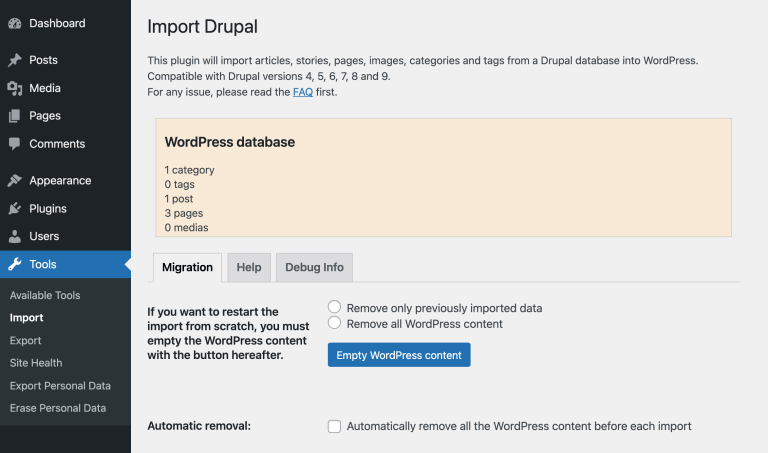
In case you’ve previously attempted to migrate some content or there is some content on WordPress that you don’t want to include in the migration, you can choose to erase it when prompted as below:
If not, you can proceed with the Drupal to WordPress migration until you’re prompted to insert the URL of your existing Drupal website. This is where the content needs to be fetched from. You’ll also have the option to choose the method for downloading your media files.
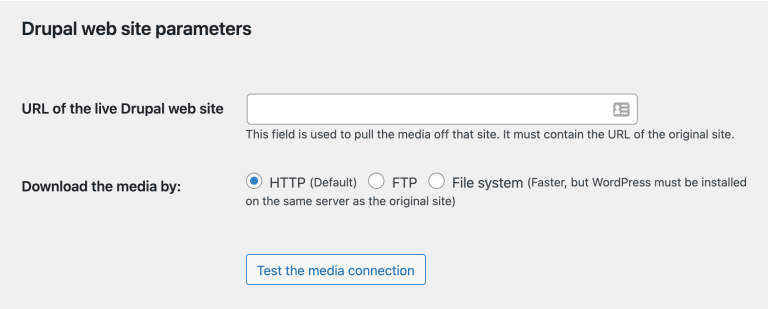
The subsequent step in your Drupal to WordPress conversion process is to extract all the necessary data and content from your existing Drupal website. Opt for the FTP option to handpick and transfer files based on your requirements.
Navigate to the folder where Drupal has been installed. Proceed to Sites > Default, and then select settings.php to open it.
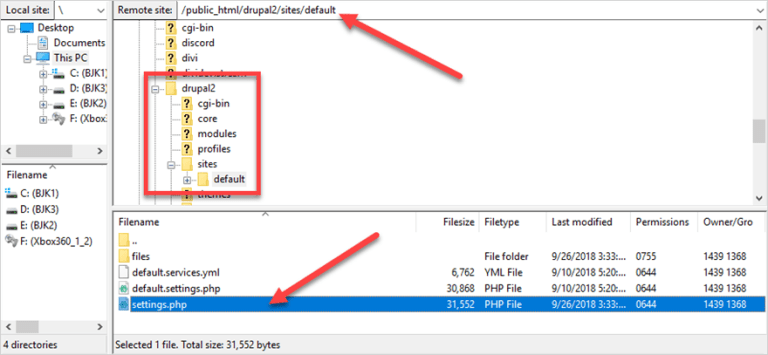
The content of the files will resemble the following:
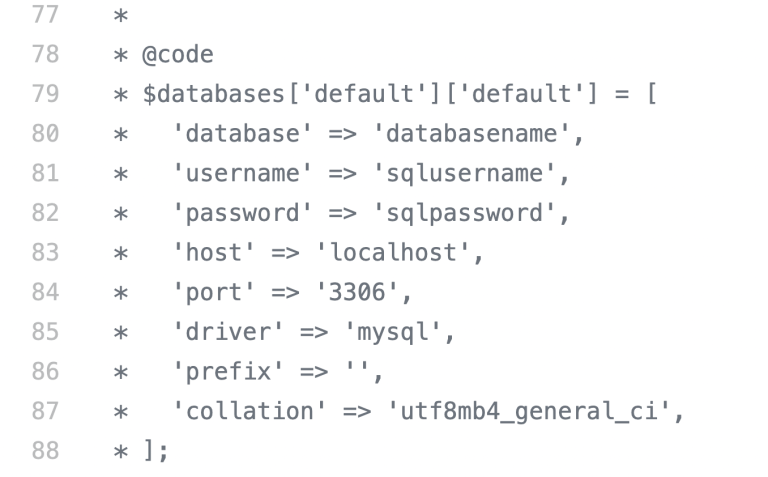
When you see the credentials of your Drupal website as displayed above, it’s time to copy and paste them into the respective fields as prompted by the FG Drupal to WordPress plugin.
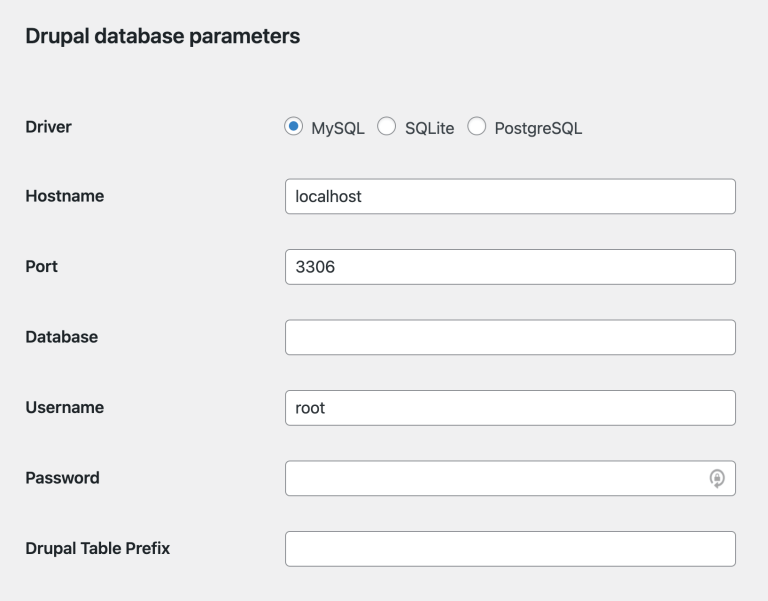
After populating all the fields with their respective values, click the Test the database connection button. Subsequently, you should see a confirmation message in green.
Remember: If you add a prefix in the field Drupal Table Prefix, ensure to append it with an underscore as a postfix.
With the successful completion of the aforementioned steps, the next phase of your Drupal to WordPress import involves setting your behavioral preferences.
The Behavior section reflects your preferences and the options you’d like during the installation process. Once you’ve entered your preferences and chosen the desired options, click on the Start/Resume the Import button.
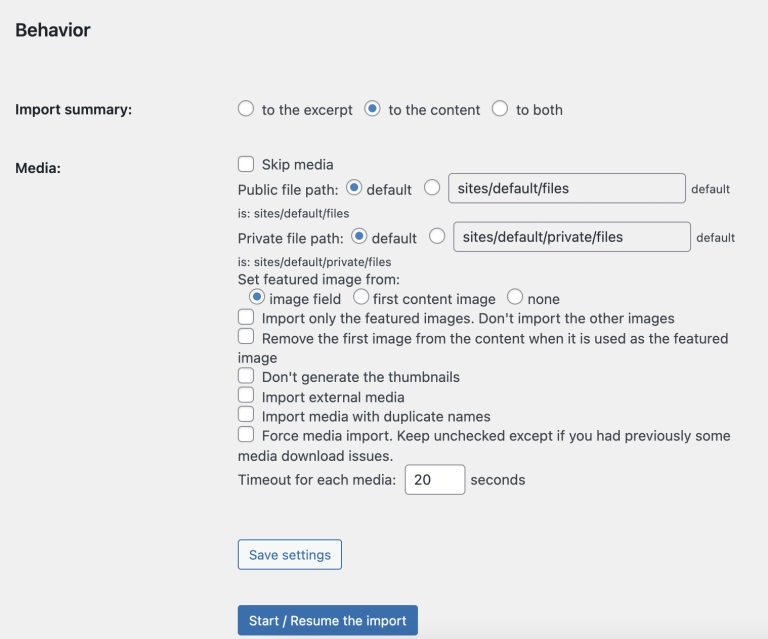
The import process will then initiate, culminating automatically once all the content is transferred to your WordPress website.
Once the Drupal to WordPress migration process is completed following the detailed step-by-step guide above, it’s essential to address a crucial post-migration aspect. If your articles have numerous interconnections through links, you’ll need to modify and update these internal links before finalizing the Drupal to WordPress migration process.

By the end of this step, your WordPress website should now be ready to use, marking the completion of your Drupal site’s transformation into a WordPress site.
4.2 Pre-launch testing and QA
Comprehensive testing prevents post-launch emergencies. Cover these areas systematically:
- Content verification: Spot-check at least 10% of migrated content across all content types. Verify text formatting, images, internal links, taxonomy assignments, and metadata.
- Functionality testing: Test all interactive elements—forms, search, navigation menus, user authentication, e-commerce flows, and any custom functionality. Test on both desktop and mobile.
- Cross-browser testing: Verify display and functionality across Chrome, Firefox, Safari, and Edge. Test on iOS and Android devices. Tools like BrowserStack can simulate environments you don’t have access to.
- Performance testing: Run Google PageSpeed Insights, GTmetrix, and Lighthouse on key page templates. Compare against your pre-migration baseline. Address any performance regressions before launch.
- Security audit: Verify SSL certificate configuration, scan for vulnerabilities with Wordfence or Sucuri, check file permissions, and test access control rules.
- SEO verification: Confirm all redirects work correctly. Verify robots.txt configuration. Check that the XML sitemap is generated correctly and includes all expected URLs. Validate structured data with Google’s Rich Results Test.
- Load testing: For high-traffic sites, run load tests to verify the WordPress environment handles your expected traffic volumes. Simulate peak traffic scenarios.
4.3 Go-live strategy and monitoring
The go-live itself should be an anticlimax if preparation and testing were thorough. Here’s the recommended approach:
Pre-launch checklist (24-48 hours before):
- Final content migration delta (any content created since the last sync)
- Content freeze on the Drupal site
- Final redirect verification
- DNS TTL lowered (to enable faster cutover)
- Monitoring tools configured and baseline established
- Team on standby for immediate post-launch issues
DNS cutover:
- Update DNS records to point to the WordPress hosting environment
- Monitor propagation (this can take up to 48 hours, but typically completes in 1-4 hours)
- Keep the Drupal site accessible via direct IP as a fallback during propagation
Real-time monitoring (first 72 hours):
- Monitor server response times and error rates
- Watch Google Search Console for crawl errors
- Track organic traffic compared to baseline
- Check analytics for 404 errors and broken user paths
- Monitor form submissions and conversion events
Issue response:
- Designate a rapid-response team for the first week
- Prioritize issues that affect user experience or revenue
- Document all issues and resolutions for the post-launch retrospective
Success metrics (first 30 days):
- Organic traffic recovery (target: within 10% of pre-migration baseline by day 30)
- Page load speed (target: equal to or faster than pre-migration)
- Form submission rates (target: equal to pre-migration)
- Crawl errors (target: zero critical errors)
- Core Web Vitals (target: all metrics in “good” range)
Step 5: Post-Migration Optimization and Team Training
The migration isn’t complete when the site launches. The first 90 days post-launch are critical for optimizing performance, training your team, and establishing long-term operational practices.
5.1 Performance optimization and monitoring
With real-world traffic hitting your WordPress site, optimize based on actual data rather than theoretical improvements.
- Caching configuration: Fine-tune your caching strategy based on your content update frequency. Static marketing pages can have longer cache TTLs; dynamic content and logged-in user experiences need shorter TTLs or cache exclusions.
- Image optimization: Implement lazy loading for below-the-fold images. Convert remaining images to WebP format. Use responsive images (WordPress generates multiple sizes by default) to serve appropriate dimensions for each device.
- Database optimization: Clean up post revisions, spam comments, and transient data that accumulate during migration testing. Optimize database tables and implement a regular maintenance schedule.
- CDN fine-tuning: Verify CDN cache hit rates and adjust rules for optimal coverage. Ensure media, CSS, and JavaScript are served from edge servers.
- Continuous monitoring: Set up ongoing monitoring with tools like New Relic, Google PageSpeed Insights API, or Pingdom. Create alerts for performance degradation so issues are caught before they impact users.
5.2 Team training and workflow optimization
Invest in proper training to ensure your team capitalizes on WordPress’s capabilities.
- Content creators: Train on the Gutenberg block editor, media library management, SEO plugin usage (writing meta descriptions, optimizing readability scores), and content scheduling. Create role-specific guides that cover daily workflows.
- Editors and managers: Train on editorial workflow tools (PublishPress), user management, content review processes, and publishing oversight. Focus on how WordPress’s workflow differs from Drupal’s Workbench.
- Technical staff: Train on WordPress development practices, plugin management, WP-CLI operations, deployment workflows, and performance monitoring. Ensure they understand WordPress’s hook system, theme structure, and plugin API.
WordPress offers extensive learning resources through Learn WordPress (learn.wordpress.org), which includes free courses, tutorials, and lesson plans. Supplement these with custom training tailored to your specific WordPress implementation.
For hands-on training from migration specialists, Multidots offers customized training programs that include interactive live sessions, role-based workshops, custom documentation for your specific setup, and 30-day post-training support.
5.3 Long-term success strategy
Set your WordPress site up for continuous improvement, not just migration completion.
- Content strategy evolution: Use WordPress’s analytics integration to make data-driven content decisions. Identify top-performing content, fill content gaps, and develop an editorial calendar that builds on your migration investment.
- Continuous improvement cycle: Schedule quarterly reviews of site performance, plugin health, and user feedback. WordPress’s active development community means new capabilities are regularly available through core updates and plugin improvements.
- Community engagement: Join the WordPress community through local WordCamp events, WordPress meetups, and online forums. The community is a valuable resource for staying current with best practices, discovering new solutions, and connecting with experienced WordPress professionals.
- Scalability planning: As your business grows, plan for WordPress’s scaling capabilities. Multi-site networks for new brands or regions, headless architecture for mobile apps, and WooCommerce for e-commerce expansion are all achievable within the WordPress ecosystem without another platform migration.
Step 6: Ongoing Maintenance and Monitoring
A well-maintained WordPress site continues to perform, stay secure, and serve your business goals long after migration.
6.1 WordPress update management
WordPress, themes, and plugins receive regular updates for security, performance, and features. Manage these systematically:
- Test updates in a staging environment before applying to production
- Schedule monthly update cycles (weekly for security-critical updates)
- Maintain a documented list of all installed plugins with their versions
- Back up your site before every update cycle
- Update in order: plugins first, then themes, then WordPress core
- Monitor your site after each update for any issues
- Read changelogs for any breaking changes before updating
6.2 Performance and security monitoring
Set up continuous monitoring across five areas:
- Uptime monitoring: Pingdom, UptimeRobot, or ManageWP. Alert on any downtime immediately.
- Performance monitoring: New Relic, Google PageSpeed Insights, or GTmetrix. Track load times, server response times, and Core Web Vitals over time.
- Security monitoring: Wordfence or Sucuri for ongoing vulnerability scanning, file integrity monitoring, and firewall protection. Review security logs regularly.
- Database health: Use the Query Monitor plugin during development and WP-CLI for production database optimization. Schedule regular database maintenance.
- Analytics review: Monitor organic traffic, conversion rates, and user behavior weekly. Compare against your pre-migration baseline for the first 6 months to catch any long-term SEO impacts.
6.3 Maintenance service options
For organizations that prefer external support, look for maintenance providers that offer:
- Regular plugin, theme, and core updates with staging-first testing
- Response time SLAs for critical issues (4 hours or less)
- Quarterly security audits
- Daily automated backups with verified restore capability
- Performance optimization as an ongoing service, not a one-time task
- Dedicated developer hours for feature additions and improvements
- Regular reporting on site health, performance, and security
Multidots offers comprehensive WordPress maintenance and support packages designed for enterprise clients. Our services include managed updates, proactive monitoring, dedicated developer hours, performance optimization, and priority support—ensuring your WordPress investment continues delivering value long after migration.
Ready to Explore Your Options?
Multidots delivers the enterprise WordPress redesigns, builds, and replatforming that often follow a Drupal migration and not just the move itself. With 500+ websites delivered and 1000+ CMS migrations completed, the same team can continue modernizing the platform after launch.
Migrating from Drupal to WordPress is a significant undertaking, but with the right planning, the right partner, and the right approach, it’s a transition that consistently delivers long-term value for enterprise organizations.
Whether you’re facing an urgent Drupal 7 end-of-life situation or strategically evaluating your CMS options for the future, we’re here to help.
Contact Multidots for a free migration assessment. We’ll review your Drupal implementation, estimate complexity and timeline, and give you an honest assessment of whether migration makes sense for your specific situation.
Frequently Asked Questions
The migration timeline varies based on the website’s complexity and data volume. A small site may take a few days, while larger, content-heavy sites can take several weeks to complete.
There is always a risk of temporary ranking fluctuations during any CMS migration. However, with proper planning—comprehensive 301 redirect mapping, metadata preservation, sitemap updates, and post-launch monitoring—most sites recover within 4-8 weeks and often see long-term improvements due to WordPress’s superior SEO tooling. The key is investing in thorough URL mapping and redirect implementation.
You can migrate directly from Drupal 7 to WordPress—in fact, this is the recommended approach. There’s no need to first upgrade to Drupal 10 or 11, which would itself be a near-complete rebuild. Migrating directly from Drupal 7 to WordPress is typically faster, less expensive, and delivers a better long-term platform than an intermediate Drupal upgrade.
Each custom module is assessed individually. Typically, 60-70% of custom module functionality has ready-made WordPress plugin equivalents. Another 20-30% requires light custom plugin development. Only about 10% requires significant custom development to replicate. The module audit conducted during the planning phase identifies these categories for accurate scoping.
For most enterprise use cases, yes. WordPress’s combination of custom post types, Advanced Custom Fields, custom taxonomies, and the Gutenberg block editor can handle sophisticated content modeling. While Drupal’s entity-field system offers more built-in flexibility for extremely complex data relationships, WordPress closes this gap through plugins and custom development—typically at lower cost and with a more accessible editorial experience.
WordPress handles multilingual content through plugins like WPML or Polylang. During migration, each language version of your content is mapped and imported separately, maintaining the relationships between translations. WPML supports complex translation workflows, language fallback logic, and locale-specific URL structures. For most multilingual requirements (2-10 languages), the transition is straightforward. For 10+ languages with regional variations, additional planning is needed.
Yes. The migration is conducted on a separate WordPress staging environment while your Drupal site remains live. Content is typically migrated in batches, with a final delta migration during a brief content freeze just before go-live. This approach minimizes disruption to your team’s publishing workflow and ensures business continuity.
We strongly recommend using the migration as a content cleanup opportunity. Most enterprise Drupal sites have accumulated outdated pages, unused content types, redundant taxonomy terms, and legacy functionality that nobody uses. Migrating only what you actually need results in a cleaner, faster, more maintainable WordPress site. The content audit in Step 2 helps identify what should and shouldn’t make the transition.
WordPress’s admin interface is designed to be intuitive for non-technical users, which means the learning curve is significantly shorter than what your team experienced with Drupal. Most editorial teams become proficient within 2-4 weeks. We recommend a training program that includes role-specific workshops, custom documentation for your implementation, and a 30-day support period post-training. WordPress’s extensive online documentation and learning resources (learn.wordpress.org) provide ongoing self-service training.
WordPress VIP is the gold standard for enterprise WordPress hosting, but it’s not the only option. WP Engine, Kinsta, and Pantheon all offer enterprise-grade WordPress hosting with strong performance, security, and support. The choice depends on your traffic volumes, security requirements, budget, and need for specific features like code review processes. For sites with 10M+ monthly page views or strict compliance requirements, VIP provides the highest level of assurance.
WordPress requires regular plugin and theme updates (monthly), security monitoring (continuous), database optimization (quarterly), performance audits (quarterly), and content backups (daily). A managed hosting provider handles much of the infrastructure-level maintenance. For organizations that prefer external support, maintenance retainers typically range from $1K-$3K/month depending on scope. This is typically less than what Drupal maintenance costs due to the larger talent pool and simpler update process.