

Key Takeaways
- Agentic WordPress enables publishers to launch governed, monetisation-ready digital properties from natural-language prompts.
- A robust framework connects agent orchestration, reusable WordPress foundations, structured content, monetisation, and governance.
- Human approval must remain central to editorial strategy, commercial models, security, brand safety, and lifecycle decisions.
- Built-in analytics, consent, advertising, and revenue controls make every publishing experiment measurable and commercially credible.
- Start with a narrow proof of concept, then assess launch speed, reusability, revenue, quality, and risk.
For much of the last two years, the publishing industry’s use of artificial intelligence has concentrated on content production. Newsrooms have experimented with headline suggestions, article summaries, transcription, translation, image tagging, audience analysis and different forms of generative search. These tools can make individual tasks faster, but they mostly operate inside the publishing systems and processes that already exist.
The more significant opportunity is to apply AI to the publishing platform itself.
Imagine a publisher identifying an emerging sports tournament, cultural moment, financial topic or entertainment trend. Instead of opening a development ticket, commissioning a new design, configuring a content management system and coordinating a series of technical integrations, an authorised user describes what is required in natural language.
The system interprets the request, selects an approved design framework, creates the WordPress site, applies the correct brand treatment, proposes a navigation structure, connects relevant content feeds, maps the taxonomy, prepares advertising positions, installs analytics and produces a preview. The user reviews the result, requests any changes through the same conversational interface and approves the site for launch.
The objective is not merely a faster website build. It is a new publishing operating model: centrally governed, commercially ready and capable of turning ideas into digital products at a scale that traditional development processes cannot economically support.
One UK Publisher is exploring precisely this type of agentic WordPress framework. Its ambition is to reduce the journey from concept to live site from days or weeks to as little as 20 to 30 minutes, while creating the foundations to launch potentially hundreds of niche and event-driven properties each year.
That ambition points towards a much wider change in digital publishing.
The publishing opportunity is larger than content generation
Publishers rarely suffer from a shortage of ideas. Every major event, audience interest, personality, location or specialist subject can create the basis for a focused digital proposition. The problem is that the cost and operational friction of launching a new property frequently outweigh the uncertain early-stage return.
A conventional launch can involve designers, developers, product managers, advertising operations, analytics specialists, editorial stakeholders and infrastructure teams. Even when the underlying technology is familiar, each new site can create another cycle of provisioning, configuration, integration, testing and approval.
This makes experimentation expensive. Large opportunities may receive investment, but smaller or time-sensitive ideas often remain unexplored. A publisher might recognise an audience need around an upcoming event but be unable to put a useful product into the market before public interest peaks. A promising niche may never progress beyond a spreadsheet because the cost of validating it is too high.
Agentic publishing changes the economics of that decision.
If a governed platform can create a production-ready site from approved components, the publisher can test more ideas with less upfront investment. It can launch at the speed of the news cycle, measure genuine audience behaviour and expand the concepts that demonstrate demand. Sites that do not perform can be archived, merged or retired through the same controlled framework.
The value therefore comes from more than efficiency. It comes from increasing the number of commercially credible experiments the organisation can run.
What “agentic” means in a WordPress environment
The word agentic is increasingly used to describe any AI-enabled workflow, but the distinction matters. A conventional AI assistant responds to a request by producing an output: a paragraph, an image, a recommendation or a piece of code. An agentic system can interpret a goal, determine the actions needed to achieve it, use approved tools and complete a multi-stage process within defined constraints.
In an agentic WordPress framework, the AI does not simply suggest how a site might look. It orchestrates the practical work required to create it.
For example, an instruction such as “Create a website for this summer’s major football tournament, using our sports design profile and content tagged to the participating teams” could initiate a controlled sequence of actions:
- Confirm the site’s purpose, audience, working title and intended lifespan.
- Select the most appropriate approved template and component set.
- Apply design tokens covering typography, colour, spacing and visual hierarchy.
- Request any assets that cannot be generated or selected safely, such as an approved logo.
- Propose the information architecture and primary navigation.
- Provision the WordPress environment and configure the required plugins.
- Connect approved editorial feeds, media sources and taxonomy mappings.
- Create advertising placements and configure the selected monetisation profile.
- Enable analytics, consent management and performance monitoring.
- Populate the site with permitted content or realistic preview material.
- Return a front-end preview for human review.
- Apply requested amendments and move the approved site towards launch.
The AI becomes an orchestration layer between human intent and the publisher’s technology estate. Crucially, it acts through known capabilities and policies. It should not be given unrestricted access to improvise across production systems.
Why WordPress is well suited to this model
Agentic publishing depends on composability. The platform needs reusable themes, predictable content structures, mature APIs, a broad integration layer and the flexibility to support different audience propositions without rebuilding the foundations every time.
WordPress is particularly well suited to this role because it can provide both standardisation and extensibility. A publisher can define a controlled collection of block patterns, components, templates, plugins and configuration profiles, while still supporting a wide range of editorial formats and commercial models.
The important shift is to treat WordPress not as a collection of individually built websites, but as a programmable publishing framework.
Within that framework, each new property is assembled from governed building blocks. A video-led entertainment site may use a different presentation layer from a finance publication or a live event hub, but they can share the same underlying security controls, analytics conventions, advertising technology, consent framework, deployment process and operational tooling.
WordPress Multisite may be appropriate where close central control and shared services are priorities. Containerised or separately provisioned WordPress instances may be preferable where sites require greater isolation, independent scaling or a different lifecycle. The right architecture depends on the publisher’s infrastructure, security model and commercial requirements. The agent should be able to work with the chosen deployment pattern rather than predetermine it.
As standardised AI interfaces and Model Context Protocol-style connections mature, the orchestration layer can gain a more consistent way to discover and use authorised WordPress and enterprise capabilities. The strategic objective is not to expose every administrative action to an AI model. It is to make an approved set of actions machine-readable, permissioned, auditable and safe to combine.
A five-layer model for agentic publishing
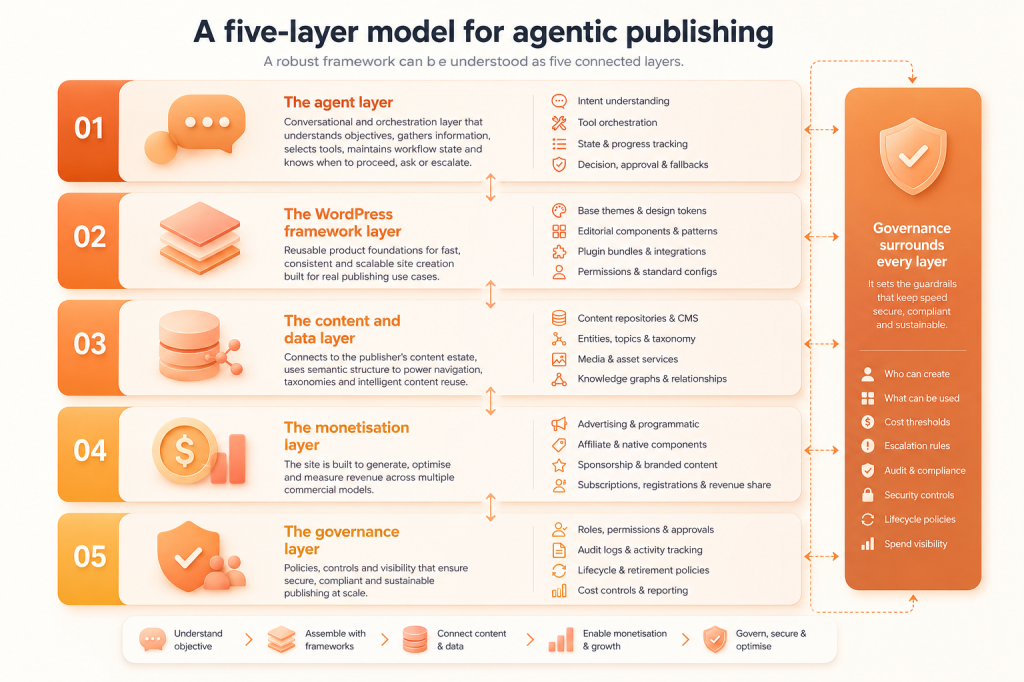
A robust framework can be understood as five connected layers.
1. The agent layer
This is the conversational and orchestration layer. It interprets the user’s objective, gathers missing information, proposes an appropriate configuration and calls the tools needed to create the site. It also maintains the state of the workflow, explaining what has been completed and what still requires a decision.
The quality of this layer depends on more than the language model. The agent needs a clearly defined catalogue of permitted actions, validation rules, approval gates, fallbacks and error handling. A useful agent should know when it can proceed automatically, when it needs more information and when it must stop for specialist approval.
2. The WordPress framework layer
This contains the reusable product foundations: base themes, design tokens, editorial components, page patterns, plugin bundles, permissions and standard configurations.
Templates should reflect genuine publishing use cases rather than generic visual styles. A breaking-news hub, a list-led entertainment property, a data-rich finance site and a video-first creator channel require different content hierarchies and engagement patterns. Each can still be built from a shared system that protects accessibility, performance and maintainability.
3. The content and data layer
For a large publisher, the new site will rarely be an isolated editorial destination. It needs to connect with existing journalist tools, content repositories, knowledge graphs, entity systems, image services and media pipelines.
This is where semantic structure becomes especially valuable. If content, people, places, topics and events are already represented consistently, the agent can connect a new property to the right information without relying on brittle keyword rules. It can also propose taxonomies and navigation based on known relationships within the publisher’s content estate.
4. The monetisation layer
A publishing site is not complete when the pages render correctly. It must be capable of generating and measuring revenue.
The framework should therefore include approved advertising placements, programmatic configuration, affiliate components, native content modules, sponsorship options and, where relevant, revenue-sharing logic. Different commercial profiles can be attached to different types of site. A short-lived event hub may prioritise programmatic reach and sponsorship, while a specialist evergreen property may rely more heavily on affiliate journeys, registrations or subscriptions.
5. The governance layer
Governance surrounds every other layer. It determines who can create a site, which templates and integrations they may use, the cost thresholds they can approve and the conditions that require escalation.
It also provides audit logs, security controls, publishing permissions, lifecycle policies and visibility of expenditure by property. Without this layer, rapid site creation can simply produce rapid platform sprawl. With it, speed becomes manageable.
From one prompt to a live publishing product
The most useful way to understand the model is to follow a potential launch.
An authorised editorial or product user asks the platform to create a site around a forthcoming event. The agent confirms the intended audience, tone and content sources, then recommends an approved event template. It requests a transparent logo file and asks the user to select or describe an appropriate colourway within the organisation’s accessibility rules.
Next, the platform provisions the WordPress site and proposes its main navigation. The user might approve sections based on teams, personalities, fixtures, results and analysis. Behind the interface, the agent translates those decisions into taxonomy rules and maps them to the publisher’s content feed and knowledge graph.
The system checks which images are authorised for the relevant articles and media formats. It creates standard advertising positions and asks whether the site should use an approved automated advertising profile or be handed to the commercial team for manual management.
Once the initial configuration is complete, the agent returns a front-end preview. The user reviews the site as a reader would, rather than working through multiple CMS administration screens. Changes can be requested conversationally: make the lead story more prominent, simplify the navigation, change the accent colour, introduce a video rail or remove an unused module.
When the user is satisfied, the agent runs the required pre-launch checks. Depending on the publisher’s policies, this may include accessibility, performance, broken links, analytics validation, advertising configuration, consent behaviour, SEO controls and security checks. The user then approves the launch. Domain and DNS changes can either be automated through an authorised integration or passed to the relevant operations team as a controlled task.
The target is a complete second site in 20 to 30 minutes, without requiring the user to write code or navigate the conventional WordPress administration experience. More importantly, the same prompt could create several related sites or regional variants while retaining a consistent technical and governance model.
Monetisation must be part of the product definition
Many rapid publishing experiments fail because commercial considerations arrive too late. The editorial concept is validated, the site is designed and content begins to flow before anyone addresses viewability, ad density, affiliate journeys, consent, reporting or sponsorship requirements.
An agentic framework can make monetisation ready by default without making every site commercially identical.
Advertising positions can be embedded in approved layout patterns and adjusted according to the chosen commercial profile. Affiliate modules can be included only where the topic and content policy allow them. Native placements can be clearly labelled and constrained by brand-safety rules. Analytics can use consistent events and naming conventions across the entire network, making comparisons between new properties far easier.
For creator-led sites, the platform can also record the rules required for revenue sharing. That does not mean the agent should decide contractual terms. It means the agreed commercial model can be implemented consistently, with the relevant reporting made available to the publisher and creator.
This creates a far more useful measure of success than launch volume alone. The publisher can evaluate revenue per site, revenue per thousand impressions, acquisition efficiency, time to commercial return and the relationship between development cost and audience value. Publishers weighing which revenue models to build into a new property will want that decision made before the first template is chosen, not after launch.
Download a Free Actionable Guide: 30 Practical AI Strategies for WordPress Websites
Creating a platform for external contributors
The same foundations used to create niche and event sites can support a broader creator ecosystem.
Creators often bring specialist knowledge, loyal communities and formats that feel more personal than institutional publishing. Large publishers bring distribution, archives, production capability, video and audio infrastructure, advertising relationships, brand credibility and operational support. An agentic creator platform can connect those strengths without forcing contributors to become CMS experts.
A creator could be onboarded into a pre-approved site or channel, given a deliberately limited set of publishing tools and connected to relevant archive, video or audio resources. The platform could guide them through content structure, media selection, disclosure requirements and brand-safety checks. Analytics and revenue-share reporting could be provided through a simplified dashboard.
The central principle is controlled autonomy. Creators need enough flexibility to establish a distinctive voice and audience proposition, while the publisher needs confidence that every property meets its legal, commercial, accessibility and brand standards.
Brand safety cannot be an afterthought
The faster a platform can create and populate sites, the more important its safeguards become.
Brand safety in this context extends beyond filtering prohibited words. It includes whether a topic is suitable for advertising, whether the source material may be reused, whether images are correctly licensed, whether an affiliate relationship is disclosed, whether a creator has the right permissions and whether an automatically assembled page creates a misleading association between content and advertiser.
Existing knowledge graphs and contextual systems can provide an important foundation. The agent can use entity and topic information to apply site-specific suitability rules, prevent inappropriate monetisation combinations and flag decisions that need human review.
Every significant action should also be auditable. The organisation should be able to establish who requested a site, which prompt and configuration were used, what the agent changed, which approvals were granted and which version was launched. When the system cannot explain its actions, it should not be allowed to execute high-impact changes autonomously.
What should remain under human control
An effective agentic platform does not remove human judgement. It concentrates that judgement at the points where it matters most.
Editorial leaders should retain control of audience strategy, tone, editorial policy and sensitive coverage. Design teams should define the system within which visual variations can be produced. Commercial teams should approve monetisation models and exceptional advertising arrangements. Security and platform specialists should determine which capabilities are exposed to the agent. Legal and compliance teams should set the policies governing rights, privacy, disclosure and data use.
The agent can then automate repeatable execution within those decisions.
This division of responsibility is essential. Asking AI to choose a colour from an accessible approved palette is very different from allowing it to invent a new visual identity. Connecting content carrying a known taxonomy is different from allowing a model to republish material based on a guessed relationship. Creating standard ad placeholders is different from changing a live commercial configuration without approval.
Good automation makes these boundaries explicit.
Avoiding the trap of automated website sprawl
The ability to launch hundreds of sites does not mean hundreds of sites should remain live indefinitely.
Every property has an operational cost: hosting, security maintenance, content moderation, privacy management, analytics, commercial oversight and reputational exposure. Automation reduces the marginal cost of creation, but it does not make the lifecycle free.
The platform therefore needs a defined lifecycle from the beginning. Each site should have an owner, purpose, expected lifespan, budget profile and success criteria. Event properties may be archived automatically after traffic falls below a threshold. Overlapping niche sites may be merged. High-performing experiments may move into a more permanent product tier with additional investment.
Central dashboards should show traffic, revenue, cost, publishing activity, technical health and policy status across the portfolio. The agent may recommend that a site be reviewed or retired, but a responsible owner should approve material lifecycle decisions.
In this model, sunset automation is as important as launch automation.
Start with a narrow proof of concept
The strategic vision is expansive, but the first implementation should be deliberately focused.
A strong proof of concept would select one repeatable use case, such as a time-bound event site, and support a small number of approved variations. It would demonstrate the complete journey from prompt to preview while relying on a tightly controlled catalogue of components and integrations.
The proof of concept does not need to solve every future requirement. Its purpose is to validate the most important assumptions:
- Can a non-technical authorised user create a credible site through a guided conversation?
- Can the system translate intent into a reliable WordPress configuration?
- Can content, images and taxonomy be connected without manual rework?
- Can commercial and analytics foundations be applied consistently?
- Can the platform enforce approval, security and brand-safety boundaries?
- Can the resulting site meet performance, accessibility and editorial quality expectations?
- Can a second site be launched in 20 to 30 minutes or less?
The final question is especially important. The first generated site may still benefit from work invested in the underlying template and integrations. The real proof of reusability comes when the platform can create the next property quickly without requiring the development team to reconstruct the workflow.
A practical path from prototype to publishing platform
The framework can evolve through four broad stages.
Phase one: establish the foundation
The publisher defines its core WordPress architecture, templates, design tokens, components, plugin bundles, permissions and deployment conventions. The initial site type and content integration are implemented manually enough to make every decision visible and testable.
Phase two: introduce agentic orchestration
Prompt-based provisioning is added around the stable framework. The agent can select from approved configurations, gather required inputs, create the environment, connect feeds and prepare monetisation. Human approval remains prominent while the organisation learns where automation is reliable.
Phase three: extend into creator enablement
The platform introduces controlled creator onboarding, simplified publishing tools, reporting and revenue-sharing support. Permissions and brand-safety policies become more granular to reflect different contributor relationships.
Phase four: optimise and personalise
Once the platform has sufficient operational data, it can support deeper optimisation. That may include AI-assisted layout experiments, audience-specific modules, contextual recommendations and controlled hyper-personalisation. The most successful site patterns can be identified and reused, while underperforming configurations are improved or retired.
The sequencing matters. Hyper-personalisation is far more valuable when the underlying content structure, measurement and governance are already dependable.
Measure value across speed, revenue and control
The most obvious metric is time to launch, but it should not be the only one.
Publishers should track the number of sites created, the proportion that reach launch, developer hours saved and the cost per experiment. They should also measure audience engagement, revenue per property, advertising performance, affiliate contribution, creator retention and the time required for a site to recover its setup and operating cost.
Quality and risk indicators are equally important. These include accessibility results, performance scores, publishing errors, security exceptions, brand-safety incidents and the percentage of agent actions that require human correction.
Together, these measures show whether the platform is simply producing more websites or creating better publishing outcomes.
The bigger shift: websites become configurable products
The most profound consequence of agentic WordPress is not that a website can be generated from a prompt. It is that the publisher’s accumulated digital capability becomes available as a reusable, configurable product.
Design knowledge is captured in templates and tokens. Editorial knowledge is represented through content models, taxonomies and workflows. Commercial knowledge is embedded in monetisation profiles. Operational knowledge appears in deployment rules, permissions and lifecycle controls. Brand and legal knowledge become machine-enforceable policies.
The prompt is simply the new point of access to that system.
This is why the strongest agentic platforms will not be those with the most impressive demonstrations of generative design. They will be those that have done the less visible work of standardising components, structuring content, clarifying permissions, defining safe actions and integrating the systems on which publishing already depends.
AI can then make that capability faster and easier to use, but it cannot replace the foundations.
From publishing bottleneck to experimentation engine
For a UK Publisher seeking to serve fragmented audiences, respond to live events, test specialist propositions and work with a wider creator community, the opportunity is substantial.
An agentic WordPress framework can reduce dependency on repetitive development, shorten the distance between an idea and a live product, and make monetisation part of the launch process rather than a later addition. It can give editorial and product teams greater autonomy while preserving central control over security, brand safety, cost and quality.
The goal should not be to automate website production for its own sake. It should be to build a publishing experimentation engine: one that allows the organisation to act quickly, learn from real audience behaviour and invest with greater confidence.
The future of AI in publishing will involve content generation, but it will not end there. The more transformative question is what happens when an organisation can describe a publishing opportunity and safely turn it into a working, measurable and revenue-ready product before that opportunity passes.
Planning an enterprise publishing platform that can turn ideas into live products at this speed? Talk to our team about the architecture, governance and monetisation foundations that have to come first.