
WooCommerce Audit for Performance, Security & Revenue Growth
Find the conversion leaks, checkout friction, PCI exposure, and scalability bottlenecks costing your store revenue today. Run by VIP-certified engineers with a dedicated WooCommerce practice, our audit gives you a prioritized roadmap to recover the orders you’re losing right now.
Trusted by some of the world’s leading brands






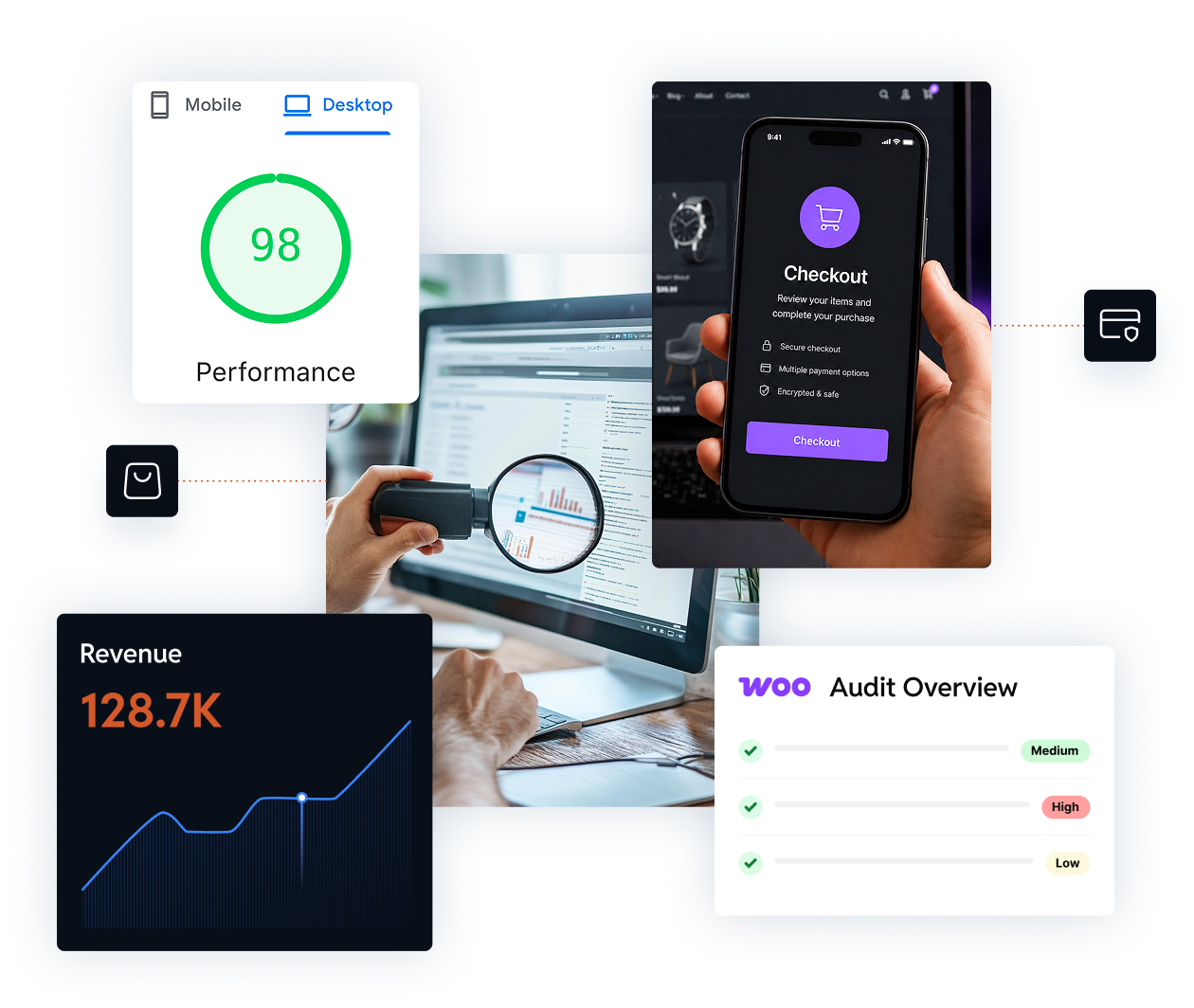
Where Your WooCommerce Store Is Quietly Losing Money
Most enterprise WooCommerce stores aren’t broken. They’re leaking. A 400ms slower checkout on mobile, a failed payment retry that never fired, a tax rule that’s been off by 2% for six months, a product schema gap that’s quietly cost you category visibility. The audit surfaces what your team has stopped seeing because they look at it every day.

Cart and Checkout Abandonment Risk
The average store loses 70% of carts. Most leaks are on-page (slow checkout, friction fields, missing express payment options) and fixable inside a single sprint.

Slow Core Web Vitals on Revenue Templates
Product and category pages convert when they load fast. Slow LCP on revenue templates costs both rankings and direct conversions every day.

PCI Exposure and Security Gaps
WooCommerce stores carry payment data, customer PII, and regulatory exposure. Outdated gateways, weak tokenization, and unhardened admin access turn small issues into breach territory.

Failed Payments and Integration Drift
Failed payment retry logic, broken tax calculations, miscalibrated shipping rules, and broken subscription renewals leak revenue without anyone noticing.

Scalability Failures at Peak
Action Scheduler backlogs, order-table bloat, and slow query chains turn sale-day traffic into downtime. Most stores discover this on Black Friday.
Each of these maps to a measurable business outcome: lost orders, lost AOV, refund and chargeback exposure, compliance risk, or operational drag on your engineering team.
What Our WooCommerce Audit Covers
WooCommerce audits cover everything a standard WordPress audit covers, plus the commerce-specific layers that decide whether your store actually converts and scales. Each pillar below maps to a deep-dive section further down the page.
Checkout, Cart, and Conversion
Performance and Stability
Security and PCI Compliance
Payments, Tax, and Shipping Integrations
Order Lifecycle and Database Health
SEO and Discoverability
Conversion and Analytics Accuracy
Plugins, Themes, and Custom Code
Checkout, Cart, and Conversion Audit
The checkout is where every other audit finding either pays off or doesn’t. We treat it as its own discipline. Most stores find 3 to 5 changes that move conversion within a sprint.
What We Examine:
- Checkout page performance (LCP, INP, TTI) on mobile and desktop
- Field count, form friction, and required-vs-optional input balance
- Guest checkout availability and friction
- Express payment options (Apple Pay, Google Pay, PayPal Express, Shop Pay, Link)
- Cart abandonment patterns and recovery email setup
- One-click upsell, cross-sell, and order-bump logic
- Mobile checkout parity (this is where most stores lose the most revenue)
- Address autocomplete and validation behavior
- Coupon, discount, and gift card flow friction
- Trust signals at checkout (badges, reviews, returns policy proximity)
- Error handling and form validation UX
Outcomes:
- Checkout-specific findings report with mobile and desktop scored separately
- Prioritized list of changes mapped to expected conversion lift
- Abandonment funnel diagnosis with stage-by-stage drop-off analysis
- Sprint-ready ticket list (3 to 5 quick wins typically identified)
Performance and Core Web Vitals Audit
Ecommerce performance is unforgiving. The store needs to hold up at peak, every time. This pillar gives you a benchmark and a roadmap ranked by revenue impact, not just technical severity.
What We Examine:
- Core Web Vitals (LCP, INP, CLS) across product, category, cart, and checkout templates
- Time to first byte (TTFB) and server response under load
- Caching layers and the WooCommerce-specific cache exclusions that have to be right
- Object cache, full-page cache, fragment cache, and CDN configuration
- Database health: order tables, post meta bloat, autoload size, slow query log
- WP-Cron and Action Scheduler health (pending, failed, stuck queues)
- Product image delivery, lazy loading, and image format strategy (WebP, AVIF)
- Third-party script impact (analytics, chat, reviews, recommendations)
- Mobile performance parity for product and category templates
- Load testing at 5x and 10x baseline traffic for stores with seasonal peaks
Outcomes:
- Performance benchmark pack covering every revenue-critical template
- Peak-load readiness assessment with concrete capacity findings
- Performance roadmap ranked by revenue impact and effort
- Quick-win list for sub-sprint improvements
Security and PCI Compliance Audit
WooCommerce stores carry payment data, customer PII, and regulatory exposure. The bar is higher than a content site. This pillar gives you a risk register with PCI-relevant items flagged separately for compliance review.
What We Examine:
- WordPress core, WooCommerce core, and extension versions against known CVEs
- Payment data handling and PCI-DSS scope assessment
- Gateway integration security (tokenization, redirect, hosted vs direct integration)
- Customer account security, authentication, and password policies
- Admin access hardening, 2FA enforcement, and session management
- File system hardening, wp-config security, and write permissions
- Outgoing data flows and PII exposure across third-party integrations (CRM, ERP, ESP)
- GDPR, CCPA, and regional regulatory alignment
- Bot, fraud, and chargeback protection posture
- Logging, audit trails, and incident readiness
Outcomes:
- Severity-scored risk register with exploitability ratings
- PCI-DSS scope map with remediation paths for in-scope findings
- PII data flow diagram and compliance gap report
- Hardening checklist your engineering team can execute against
Payments, Tax, and Shipping Integrations Audit
The integration layer is where revenue most often leaks without anyone noticing. This pillar tells you whether your store is leaking money on failed payments, miscalculated tax, miscalibrated shipping, or broken subscription renewals.
What We Examine:
- Active payment gateways, fallback behavior, and routing logic
- Failed payment handling, retry logic, and dunning configuration
- Tokenization, saved card management, and PCI offloading
- Tax engine setup (Avalara, TaxJar, built-in WooCommerce tax) and accuracy across regions
- Shipping plugin configuration and carrier integration health (UPS, FedEx, DHL, USPS, regional carriers)
- Real-time rate calculation reliability and fallback rates
- Order routing for multi-warehouse or drop-ship stores
- Subscription renewal logic, retry windows, and customer notification flow
- Multi-currency pricing accuracy and FX update cadence
- B2B wholesale rules, account-based pricing, and net terms logic where present
Outcomes:
- Failed payment recovery opportunity quantified in monthly revenue terms
- Tax accuracy report flagging miscalculations by region or product class
- Shipping rate calibration audit with carrier-by-carrier accuracy scores
- Subscription health report (active, paused, failed renewals)
Order Lifecycle and Database Health Audit
The order pipeline is where WooCommerce stores most often hit their scaling ceiling. This pillar gives you the optimizations that let you scale order volume without re-platforming.
What We Examine:
- Order processing from add-to-cart through thank-you page
- Database load: order tables, order meta, post meta hygiene, autoload size
- High Performance Order Storage (HPOS) status and migration readiness
- Action Scheduler health: pending actions, failed actions, queue depth, stuck tasks
- Email notification reliability and deliverability
- Inventory sync accuracy across channels and warehouses
- Refund, cancellation, and partial fulfillment handling
- Backorder and pre-order workflows
- Reporting query performance for back-office and admin workflows
- Webhook reliability for downstream integrations (3PL, ERP, accounting)
Outcomes:
- Order pipeline health score with bottleneck identification
- HPOS migration readiness report and extension compatibility map
- Action Scheduler optimization plan
- Operational backbone scalability assessment (orders per hour at peak)
SEO and Discoverability Audit
Ecommerce SEO has its own rules. Generic SEO audits miss most of them. This pillar gives you the technical fixes that drive product-page visibility and category-level rankings.
What We Examine:
- Product schema (Product, Offer, Review, AggregateRating) coverage and validity
- Category architecture, breadcrumbs, and parent-child URL structure
- Faceted navigation indexation (filter pages that should and shouldn’t index)
- Out-of-stock and discontinued product handling (this quietly kills SEO when wrong)
- Canonicalization across product variants and pagination
- Internal linking from category to product and cross-sell linking
- Site search functionality and search result indexation
- Image SEO for product imagery (alt text, file names, structured data)
- International SEO setup (hreflang, geo-targeting, currency selectors)
- Editorial SEO hygiene on category and product copy
Outcomes:
- Product schema implementation plan with coverage gaps mapped
- Indexation health report at category and product level
- Out-of-stock handling playbook (redirect, replace, no-index logic)
- International SEO posture assessment with country-by-country findings
Conversion and Analytics Accuracy Audit
If the data is wrong, every optimization decision downstream is wrong. We make sure the data is right first.
What We Examine:
- GA4 ecommerce implementation (every event, every parameter, every item-level field)
- GTM container hygiene, trigger discipline, and tag deduplication
- Server-side tracking parity and event reconciliation
- Funnel measurement from product view through purchase
- Attribution model fit and revenue reconciliation against actual order records
- Cross-domain and subdomain tracking (especially headless or multi-site setups)
- Consent management impact on data quality (CMP setup, regional gating)
- Marketing pixel deduplication (Meta, Google Ads, TikTok, Pinterest)
- Refund and cancellation tracking parity
- Cohort and LTV measurement readiness
Outcomes:
- Analytics implementation audit with tag-level findings
- Funnel data accuracy report (where it’s missing, where it’s double-counting)
- Revenue reconciliation between analytics and actual orders
- Tracking remediation roadmap with sprint-ready tickets
Plugins, Themes, and Custom Code Audit
Every WooCommerce store carries an extension stack. Most carry too much of one. This pillar gives you a clear picture of where your technical debt sits and how much engineering effort the store really demands going forward.
What We Examine:
- Active plugin and extension inventory (necessary, redundant, conflicting, or risky)
- Paid extension license status and update coverage
- Code quality across custom themes, child themes, and mu-plugins
- Custom WooCommerce hook usage and override patterns
- WordPress and WooCommerce coding standards adherence (WPCS, PHPCS)
- PHP version compatibility and deprecated function usage
- HPOS compatibility across the full extension stack
- Custom Gutenberg block and product block implementations
- Test coverage and CI/CD integration
- Maintainability and onboarding cost for new engineers
Outcomes:
- Plugin retirement, replacement, and refactor list
- HPOS compatibility map across the extension stack
- Maintainability score with engineering-hours-per-month estimate
- Technical debt prioritized backlog
What You Receive at the End of the Audit
A structured set of deliverables your engineering, ecommerce, and leadership teams can each pick up and act on within their own remit. Not a 200-page PDF and a vague follow-up.
Executive Summary
Non-technical, business-level read of where your store stands, what’s at risk, and what to fix first. Built for leadership review and budget conversations.
Technical Audit Findings Report
The full technical picture across every audit pillar: issues, evidence, severity, and remediation paths. Engineering teams use this as the working document.
Security and PCI Risk Register
Every security and compliance finding is scored by severity and exploitability, with PCI-relevant items flagged for compliance review.
Performance Benchmark Pack
Core Web Vitals across product, category, cart, and checkout templates. Load test results, database health metrics, and infrastructure benchmarks. The baseline you measure improvements against.
Checkout and Conversion Findings Report
Standalone deliverable focused on the checkout funnel: friction points, mobile-specific issues, and the sequenced changes that recover abandoned revenue.
SEO and Accessibility Audit Report
Combined report covering ecommerce-specific technical SEO findings, product schema validity, indexation health, WCAG conformance, and prioritized fixes.
Analytics Accuracy Report
What your data is actually saying versus what it should be saying. Specific implementation gaps, double-counted events, and the fixes that restore funnel accuracy.
Action Plan and Prioritized Roadmap
Every finding turned into a sequenced delivery plan. Quick wins separated from structural work, with effort estimates so your engineering leads can resource it.
DevOps and Governance Recommendations
Where your release process, environment management, monitoring, and editorial governance need investment, mapped to operational maturity stages.
Mapped Backlog (Optional Add-On)
Audit findings handed over as ticket-ready backlog items, formatted for Jira, Linear, or your tracker of choice.
Why Multidots Runs WooCommerce Audits Differently
Most WooCommerce “audits” are a free plugin scan with a sales call attached. Ours is run by engineers who build and scale the WooCommerce platforms they’re auditing, with in-house WooCommerce products and case studies that include 80x sales growth on an audit-driven rebuild.
Audited by VIP-Certified WordPress and WooCommerce Engineers
28 WordPress Core contributors and 23 VIP-certified developers, with deep WooCommerce specialization across high-volume catalogs, subscriptions, multi-region stores, and B2B / B2C hybrids. As the 5th largest global contributor to WordPress Core in 2024, we audit the platform we help build.
Built on Real WooCommerce Builds, Not Theory
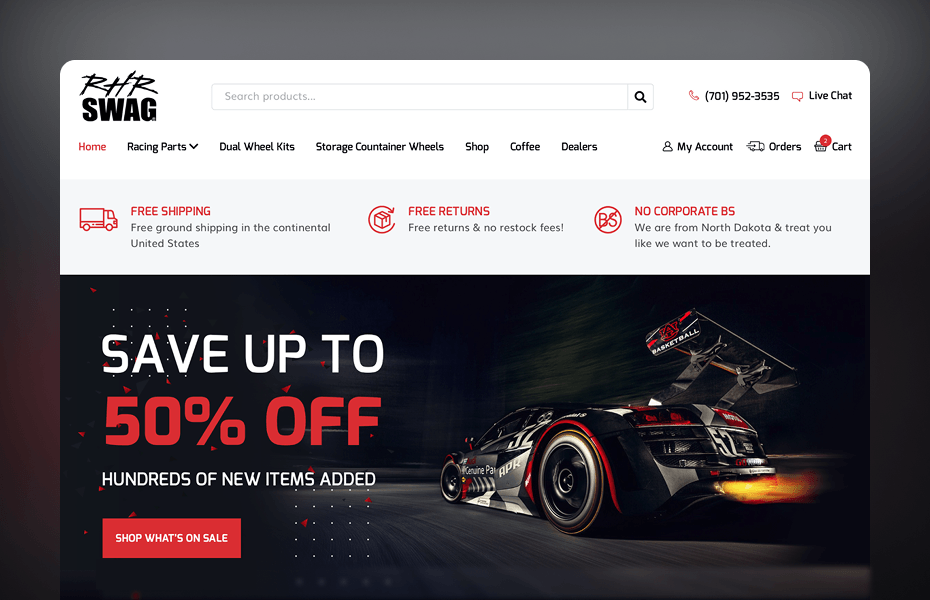
We ship our own WooCommerce products (Salsi Sync for Salsify integration) and have rebuilt stores from the ground up. For RHR Swag, an audit-driven rebuild drove 80x sales growth, 58x traffic, and a 145% conversion lift. We bring that operating lens to every audit.
Every Finding Tied to Revenue
Engineering findings without commercial framing waste leadership time. Every finding is mapped to the business outcome it affects: cart conversion, AOV, abandoned revenue, refund rate, or operational cost. Your team can prioritize without translating tech into commercial language.
Outputs Your Team Can Actually Ship
Every audit ships with a sequenced roadmap your engineering team can execute, not a deck that sits in a folder. Where useful, findings are handed over as ticket-ready backlog items mapped for your tracker of choice.
Is a Multidots WooCommerce Audit Right for You?
A Good Fit If You Run:
- High-revenue WooCommerce stores with significant order volume
- Stores with complex catalogs, custom logic, or multi-channel selling
- B2B or B2B / B2C hybrid stores with account-specific rules and pricing
- International stores with multi-currency, multi-region, or multi-language requirements
- Subscription, membership, or recurring revenue stores
- Stores preparing for major events: peak season, replatforming, or rapid scale
Probably Not the Right Fit If You Have:
- A small store running stock themes and fewer than 50 orders a month
- A low-budget DIY setup with no plans for ongoing engineering investment
- A store with no commercial dependency on the platform
Our Five-Phase Audit Process
Discovery and Access
Agree on scope, get read access to the environments, gateway dashboards, and analytics tools we need, and align on the templates and customer flows that matter most.
Automated Diagnostics
Run our full diagnostic stack across performance, security, SEO, accessibility, code quality, and ecommerce-specific checks. The data layer.
Manual Deep-Dive
Our engineers, ecommerce leads, and analytics specialists go where the tools can’t: code review, integration review, checkout flow review, funnel data review.
Analysis and Prioritization
Synthesize findings, score them by revenue impact and effort, and build the prioritized roadmap.
Stakeholder-Ready Reporting and Walkthrough
You receive the full deliverable pack plus a live walkthrough with your team to align on next steps.
Most engagements take 1 to 2 weeks from kickoff to final walkthrough. Larger or multi-region stores can extend to 3 weeks.
Multidots has been our long-time technology partner. As we scaled, Multidots delivered big time with rapid development and consulting on the right enterprise hosting. Our sales skyrocketed, and we achieved significant improvement in page load speed, sessions, and visitors.

Get a Clear, Prioritized Roadmap for Your WooCommerce Store
Find the conversion leaks, security gaps, and scaling bottlenecks costing you revenue today, and leave with a sequenced plan to fix them. Most audits start within 7 days of a scoping call.
Frequently Asked Questions
Most audits run 1 to 2 weeks from kickoff to final walkthrough. Larger or multi-region stores can extend to 3 weeks.
Read access to staging or production WordPress (admin role, or a custom audit role), the hosting control panel or server, your analytics setup, and any monitoring tools you use. We send a scoped access checklist before kickoff.
No. Our diagnostics are non-disruptive. Load testing, where relevant, is run against staging or scheduled for low-traffic windows. We never test against live payment flows.
Both, on your call. The deliverables are designed so your in-house team or current agency can execute them. If you want us to deliver the fixes, we scope the remediation engagement separately.
Yes. We audit subscription stores including renewal logic, dunning configuration, retry windows, and integration with billing and CRM systems.
Yes. We audit HPOS-enabled stores and assess HPOS migration readiness for stores still on legacy order storage. Extension compatibility is part of the code review.
Automated scanners cover surface-level checks. Generic audit tools don’t understand the WooCommerce-specific layers: extension stacks, order pipeline, checkout customizations, payment integrations. Our audit combines automated data with manual code review, integration review, and a revenue-impact analysis. The deliverable is a roadmap, not a checklist.
We assess your PCI exposure and flag findings relevant to PCI-DSS scope, but we are not a QSA and the audit is not a formal PCI assessment. PCI-relevant findings are scoped so you can take them into a formal compliance review.