

Key Takeaways
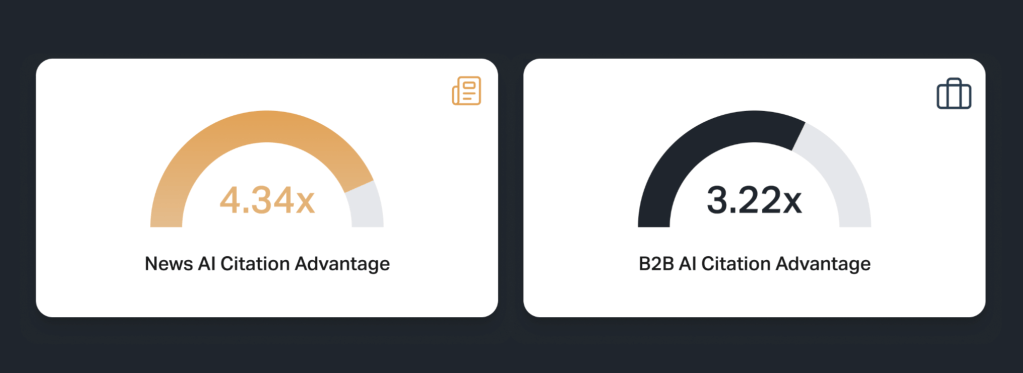
- News and media publishing showed the strongest result in the study, a 4.34x WordPress citation advantage; B2B followed at 3.22x.
- AI search shapes decisions before the click, often before a buyer knows your name, so an invisible citation rate leaves no analytics trace.
- The effect is vertical-specific. Health and finance showed statistical parity; the platform advantage concentrates where freshness and publisher credibility drive visibility.
- The structural fixes (datestamps, OG metadata) are immediate; the compounding advantage comes from an editorial environment built around publishing.
Not every industry is feeling AI search the same way. The averages flatten a story that is actually sharply uneven, and two verticals are absorbing the change well ahead of everyone else: news and media publishing, and B2B technology.
If you lead content or marketing in either of those worlds, this is not a trend to monitor. It is already shaping whether your audience finds you, and the gap between platforms is widest in exactly the content types you produce.
Here is what the data shows about where AI search is reshaping visibility first, and why the publishers and B2B brands that move now will be hard to catch later.
AI Search Shapes the Decision Before the Click
Start with the mechanic, because it explains the urgency.
AI search now influences buying and research decisions before a user ever clicks a link, often before they visit your site, and increasingly before they know your name. Someone researching a category opens ChatGPT or reads a Google AI Overview, and the answer they get is assembled from whichever sources the engine decided to cite. If you are not in that set, you were not part of the consideration, and you have no analytics event to even tell you it happened.
For content-driven businesses, that is a structural shift in where discovery happens. And it lands hardest on the two verticals whose entire model depends on being the source people find.
Why News and Media Feel It First
News and media publishing delivered the strongest result in our entire study. WordPress showed a 4.34x citation advantage in this vertical, and the result was statistically robust.
The reason is structural. AI engines lean on freshness and source credibility when they assemble answers, and news is the purest test of both. A media operation publishes constantly, competes on being current, and lives or dies on whether it gets named as the source. Every structural signal that makes a source look fresh and trustworthy to an AI engine is amplified in a news context.
That cuts both ways. If your editorial team is producing news, analysis, or industry coverage on an enterprise CMS whose defaults work against those signals, the platform gap is working against every story you publish.
At the volume a newsroom operates, a structural disadvantage does not stay small. It compounds across thousands of pieces. It is the same pressure driving the broader digital publishing trends reshaping how media brands build and run their platforms, and why so many are rethinking the stack underneath their newsroom. For a closer look at how a major title approaches it, see our breakdown of The New York Times.
Why B2B Technology Is Right Behind
B2B content followed closely, with a 3.22x citation advantage for WordPress, and it is directly relevant to any organization using content as a demand-generation channel.
Think about what B2B content actually is: thought leadership, research reports, product comparisons, and buyer guides. Those are precisely the content types AI engines cite when they answer research-intent queries, and research-intent queries are where your buyers begin. When a prospect asks ChatGPT to compare solutions in your category or to recommend resources on a problem you solve, your citation rate is a direct input to your top-of-funnel reach.
This is the part B2B marketers underrate. You can be winning at traditional SEO and still be invisible in the answer a buyer reads first. The two are no longer the same game, and for technology brands treating content as a growth channel, that gap is a direct hit to pipeline.
Where the Effect Is Not Significant
It would be easy to overclaim here, so the honest boundary matters.
The advantage was not universal across verticals. Health and finance showed statistical parity, with no meaningful platform advantage either way. That makes sense when you look at how those sectors behave online: citation share is heavily dominated by institutional authorities, regulators, and major medical publishers, largely regardless of CMS. Lifestyle and sports leaned slightly away from WordPress, though not strongly enough to be significant.
One pattern held across every vertical: broad informational searches overwhelmingly favored authority domains like Wikipedia and .gov and .edu sources, entirely independent of CMS choice. Where the platform actually pulls ahead is in environments where publisher credibility and content freshness drive visibility, which is exactly the dynamic in news and B2B.
So the claim is specific, not sweeping: if you are in news, media, or B2B technology, the platform effect is real and it favors you or works against you depending on what you run. If you are in health or finance, the lever is elsewhere.
Download the Enterprise CMS AI Visibility Report
The complete findings cover vertical breakdowns, all 22 structural signals tested, and a tier-by-tier comparison of every major enterprise CMS platform.

Two Engines, Same Conclusion
A skeptic would ask whether this is just an artifact of one AI engine’s quirks. It is not.
We saw the same direction across two engines built by two different companies. ChatGPT showed a 3.05x advantage for the WordPress stack overall, and Google AI Overviews came in at 2.12x. The raw numbers differ, which is what you would expect from different retrieval systems, but both pointed the same way. When two independent systems agree, the result is much harder to dismiss as a fluke of one platform’s logic.
What Publisher-Grade Structure Looks Like
The encouraging part is that the structural side of this is fixable, and you do not need a re-platform to start.
- Surface your datestamps. Freshness is the currency of news and a trust cue for B2B. If your CMS strips publish or update dates, you are hiding a signal AI engines reward.
- Complete your Open Graph metadata. Make sure your key pages carry full OG tags. It is a clean machine-readable summary of what each page is.
- Audit your own citation rate. Run the questions your content is built to answer through ChatGPT and Google AI Overviews, and see how often you appear. Then benchmark against the traffic-tier data in the report.
Those are the immediate moves. The larger advantage, the part that compounds, comes from operating in an editorial environment built around publishing, which is exactly what we build for enterprise publishers, and it is the deeper story the full report tells.
The Window Is Open Now
The verticals absorbing AI search first are the ones where being the cited source has always been the whole game. That is why news and B2B are the leading edge, and it is why the brands in those categories that fix their structural baseline now will be the ones AI engines keep reaching for as the rest of the market catches on.
If you are a publisher or a B2B brand, the most useful next step is to see exactly where your vertical and your traffic tier land in the data.
Ready to transform your digital presence without the risk? Book your CMS consultation with Multidots today to learn how our AI-powered migration services can help you achieve a flawless and efficient transition.