
Key Takeaways
- At equivalent traffic, WordPress sites are cited by AI search engines 2.22x more often than enterprise CMS platforms (p = 2.6×10⁻⁶), a result that held across six stress tests and two AI engines.
- The comparison is traffic-controlled. Organic traffic is still the strongest predictor of citation, so the platform effect shows only when traffic is held constant.
- Above one million monthly visitors the gap narrows and every platform gets found (WordPress VIP 30.6% down to Drupal 14.9%).
- CMS choice is most commercially consequential in the 100,000 to 1 million visitor range, where most enterprise content operations sit.
- A migration changes your structural baseline from day one but does not close the gap overnight, because part of it is editorial, not technical.
For two decades, the enterprise CMS decision was about governance, security, scale, and editorial control. Those still matter. But a new question has quietly joined the list, and most platform evaluations have not caught up to it: which CMS gets your content cited by AI search engines?
It is a fair question to be skeptical of. A content management system is plumbing. It should not determine whether ChatGPT or Google AI Overviews names you in an answer. And yet when we held traffic constant and measured citation rates across five CMS platforms, the platform itself turned out to be a real, statistically significant predictor.
Here is how WordPress, AEM, Sitecore, and Drupal actually compare in AI search, what the numbers mean, and where the gap is most expensive.
Why CMS Choice Suddenly Affects AI Visibility
A few years ago, your CMS had almost no bearing on how discoverable your content was. Search ranked pages on signals that were mostly platform-agnostic.
AI search changed the mechanics. ChatGPT, Google AI Overviews, and similar engines do not just rank links. They read sources, evaluate them, and decide which ones to cite inside a generated answer. That evaluation leans on structural signals, and structural signals are exactly where CMS platforms differ, because each one ships with its own defaults for how content is marked up, dated, and described. (If you are still mapping out how to choose a CMS for an enterprise content operation, this is now part of the calculation.)
In other words, the layer AI engines use to decide who to trust is the same layer your CMS quietly configures for you out of the box. That is why platform choice now shows up in the data.
What “Equivalent Traffic” Means Here
Before the numbers, one clarification that matters more than any single figure.
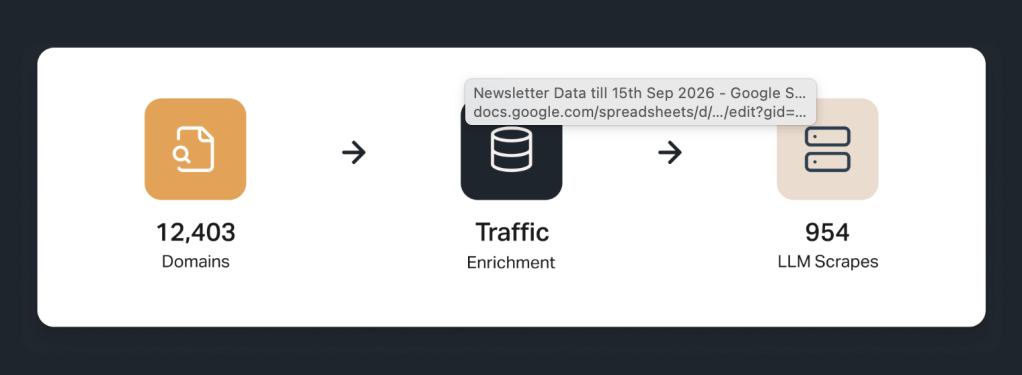
This is not a story about WordPress sites getting more visitors. The comparison was traffic-controlled, meaning platforms were measured against each other within the same traffic bands. We are not comparing a high-traffic WordPress site to a low-traffic AEM site. We are asking: at the same level of traffic, which platform gets cited more often?
That distinction matters because organic traffic is still the single strongest predictor of AI citation by a wide margin. A high-traffic AEM site will out-cite a low-traffic WordPress site every time. The platform effect is real but secondary. It shows up clearly only when you hold traffic constant, which is exactly what this study did.
The Headline: WordPress Gets Cited 2.22x More
Across the full dataset, WordPress sites were cited by AI search engines 2.22 times more often than enterprise CMS platforms at equivalent traffic levels. This was not a marginal result. The p-value was 2.6×10⁻⁶, and the confidence intervals did not overlap.
The result also held up under pressure. We stress-tested it six different ways, including removing the highest-traffic domains, matching pairs of sites by traffic, and resampling the prompts. WordPress stayed ahead in every test. We ran it across two AI engines built by two different companies, ChatGPT and Google AI Overviews, and both showed the same direction.
When two retrieval systems built on entirely different architectures reach the same conclusion, it is hard to write the result off as a quirk of one engine.
Where Every Platform Gets Found: The 1M+ Tier
The gap is not uniform. It depends heavily on how much traffic a site already has, and the clearest way to see that is at the top of the distribution.
Once a publisher crosses one million monthly visitors, citation rates climb across every platform and the gap narrows:
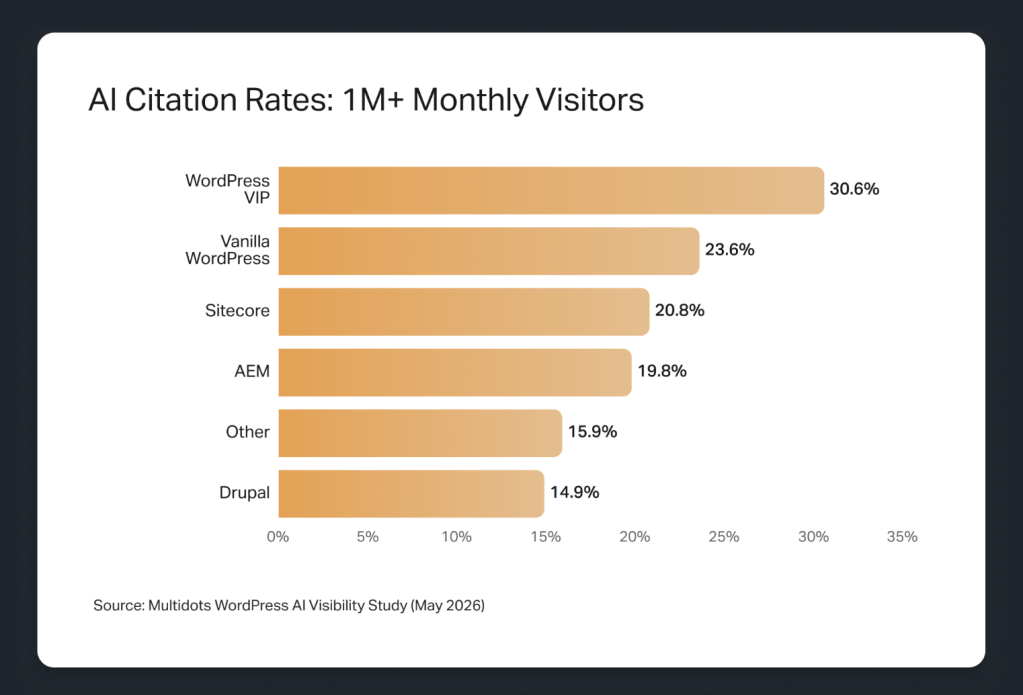
- WordPress VIP: 30.6%
- WordPress: 23.6%
- Sitecore: 20.8%
- AEM: 19.8%
- Drupal: 14.9%
At this scale, WordPress VIP still leads and Drupal still trails, but every platform is getting found. Traffic and topical authority start to outweigh CMS choice. If you are a million-visitor brand, your platform matters less than your content strategy, though it still matters.
Download the Enterprise CMS AI Visibility Report
The complete findings cover vertical breakdowns, all 22 structural signals tested, and a tier-by-tier comparison of every major enterprise CMS platform.

Where CMS Choice Is Most Expensive
The interesting story is not at the top. It is in the middle, in the 100,000 to 1 million monthly visitor range, which is where most enterprise content operations actually sit.
At this tier, the platform effect is at its most commercially consequential. A torso-tier site on AEM or Sitecore is being surfaced in AI responses at a small fraction of the rate of a comparable WordPress site. This is the band where the structural defaults your platform ships with translate most directly into whether your buyers encounter your content inside an AI answer or a competitor’s.
The full platform-by-platform breakdown at this tier is in the report, and it is the chart worth studying if your organization lives in this range. It is the difference between a site that shows up when AI engines assemble an answer and one that does not, holding everything else equal.
What a Migration Actually Changes
The honest answer is that switching platforms is not a magic switch for AI visibility.
A CMS migration does not instantly close the entire gap, because a meaningful portion of it traces to editorial culture and publishing habits that no platform can manufacture overnight. Any team expecting an overnight transformation will be disappointed.
What migration does change, starting on day one, is your structural baseline. On WordPress, datestamps are on by default and Open Graph metadata is complete by default. The structural signals our regression identified as citation-predictive are in place before your team publishes a single post. On AEM, Sitecore, and Drupal, those defaults often require additional implementation work or custom configuration, and across thousands of existing pages, they frequently were never added.
Multidots has completed 1000+ enterprise platform migrations from AEM, Sitecore, and Drupal to WordPress. The consistent operational story is that teams spend less time fighting their CMS and more time improving their content, and that shift compounds over time in ways that show up in search and AI visibility.
So Which CMS Is Best for AI Search?
On the data, at equivalent traffic, WordPress and WordPress VIP get cited more often than AEM, Sitecore, and Drupal, and the advantage is largest exactly where most enterprise publishers operate. That is the finding. It is correlation, not a causal guarantee, and the report is careful about that distinction.
But if you are running one of the major enterprise CMS platforms in the 100,000 to 1 million visitor range and your AI citation rate looks weak, the platform is a reasonable place to look, not because your current CMS is a bad product, but because its default configuration may not be aligned with how AI engines decide who to cite.
Ready to transform your digital presence without the risk? Book your CMS consultation with Multidots today to learn how our AI-powered migration services can help you achieve a flawless and efficient transition.