Key Takeaways
- Pick for resilience, not just price. In multisite, one problem can ripple across every site.
- Keep an eye on your busiest subsite. It’s often the first sign you’ve outgrown budget hosting.
- Let compliance narrow the field. Regulated data rules out more hosts than most teams expect.
- Look beyond basic hosting features. Multisite needs network-level staging, automated patching, and plugin governance to scale safely.
- Match the platform to your team’s skills. More control is only an advantage if you have the expertise to use it.
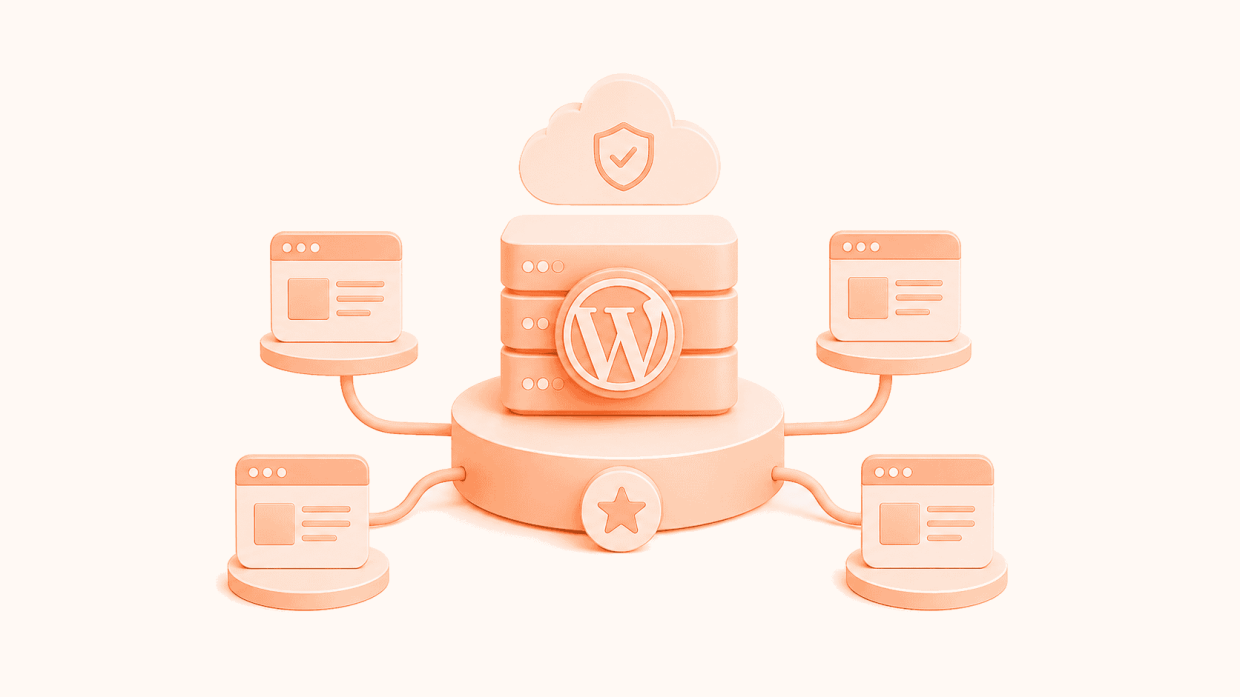
WordPress multisite is a single WordPress install running multiple sites that share one database, one file system, and one plugin pool. For franchise networks, school districts, multi-brand publishers, and higher education, it’s often exactly the right setup because those sites share infrastructure.
But the same shared foundation that makes multisite so powerful also means that a vulnerable plugin or traffic spike impacts every site on the network, making the hosting decision even more important.
In this guide, we’ll cover the five hosting providers that meet those requirements, which pricing tier fits different network sizes, and what to look for before committing. If you’re still deciding whether multisite is the right architecture for your situation at all, the pros and cons breakdown is the better starting point.
What WordPress Multisite Hosting Requires
Although generic shared hosting can run WordPress multisite, whether it should is another matter.
Key Features
- Wildcard SSL automation: Domain mapping needs a certificate for every custom domain. Manual provisioning doesn’t scale beyond a handful of sites.
- PHP worker isolation: Workers handle concurrent requests, while containers isolate infrastructure resources so one busy site doesn’t affect the rest.
- Network-level plugin management: Super-admin controls that govern plugins across every subsite at once, rather than managing them individually.
- Staging and atomic deploys: If a plugin update breaks one subsite, it breaks them all. Network-level staging isn’t optional once your network scales.
- Automated patching: Plugin vulnerabilities affect every subsite simultaneously, making a consistent patching cadence far more important than on a single-site install.
Use Cases
- Franchise networks.
- Higher education departments.
- Multi-brand publishers.
- Government and NGO workloads.
- Agency networks where sites share meaningful infrastructure.
WP Engine as a Multisite Host
Features
Smart Plugin Manager monitors WordPress plugins for updates and security vulnerabilities against its vulnerability detection system, directly addressing the shared blast-radius risk that makes multisite hosting decisions consequential. Atomic deploys and WordPress-specific staging are built in. The gap is per-site container isolation. The result is noisy-neighbor risk remains at the network level, which matters once individual subsite traffic becomes unpredictable.
Best Fit
Agencies running multiple client multisites that want a single managed WordPress hosting provider. Less suitable where per-site traffic isolation is a technical or compliance requirement.
Kinsta as a Multisite Host
Features
Kinsta’s containerized infrastructure isolates each WordPress installation, although individual subsites within the same Multisite network share that installation’s resources. This provides some of the strongest noisy-neighbor protection you’ll find in managed hosting, with PHP workers allocated at the installation level rather than independently to every subsite. Kinsta‘s MyKinsta dashboard scans each plugin and theme daily to identify security vulnerabilities, while Kinsta Automatic Updates launched in March 2025, adding visual regression testing and rollback protection for plugin and theme updates. Wildcard SSL is included free on all plans via Cloudflare, so there’s no additional cost for unlimited custom domains.
Best Fit
Networks where individual subsite performance isolation matters more than network-wide cost optimization. A strong fit for GDPR workloads where per-site container isolation is a compliance requirement rather than a nice-to-have.
Cloudways as a Multisite Host
Features
The lower price comes with trade-offs. Mid-sized multisite networks tend to need more hands-on agency support than equivalent Kinsta or WP Engine setups, and there’s no WordPress-specific plugin governance, which means you’ll be managing that yourself. On the plus side, choosing your own cloud provider offers flexibility if your organization already favors AWS or Google Cloud.
Best Fit
Teams comfortable managing technical complexity that want managed cloud without enterprise hosting prices. Not a strong fit for regulated workloads – FERPA, HIPAA, or GDPR – without significant additional configuration.
Pantheon as a Multisite Host
Features
Custom Upstreams let you roll code changes across every subsite at once, making plugin governance and deployment consistency dramatically easier. Multidev branching requires a Gold account or above and is built into the workflow, with each site limited to 10 Multidev environments. Per-site containers satisfy isolation requirements for compliance-focused environments.
Best Fit
Large organizations with mature development workflows that want version control embedded into the hosting platform. Franchise networks built around shared templates are an especially natural fit.
WordPress VIP as a Multisite Host
Disclosure: Multidots is one of a select number of WordPress VIP Gold Partners globally. We recommend this tier where appropriate, and we’re disclosing that relationship so you can weigh it accordingly.
Features
Per-site container isolation is backed by SOC 2 compliance, enterprise hardening, observability, audit logging, and built-in security review. Together, they provide infrastructure features that support FERPA, HIPAA, and GDPR compliance without additional configuration, which is why heavily regulated organizations often favor this option.
Best Fit
Enterprise content teams where uptime SLAs and premium support matter more than keeping hosting costs down. Global publishers and government workloads are obvious candidates. For smaller networks, though, the price only makes sense if you’ll use everything the platform offers.
For networks we’ve operated at 10M+ monthly page views, see our enterprise WordPress multisite case studies.
WordPress for Enterprises: Learn the Secret Sauce of Big Enterprise WordPress Websites
An In-Depth Look at the Engineering and Design Behind Billion-Dollar Enterprises’ WordPress Websites



Specialty and Budget Options
SiteGround and WPMU DEV
SiteGround keeps costs low for smaller multisites, while WPMU DEV combines hosting with its plugin suite – good value if you’d already be paying for those plugins. Neither is designed for networks where individual subsites attract significant traffic.
Best for education, nonprofits, or franchise networks where budgets are tight and traffic remains modest.
GreenGeeks
LiteSpeed caching delivers better performance than you’d expect at this price, and the company’s environmental credentials are a meaningful differentiator for some buyers. It’s still shared infrastructure, though, so traffic spikes can affect the wider network.
Best for smaller multisite deployments where sustainability and cost outweigh the need for extra performance headroom.
How WordPress Multisite Hosts Compare
| Host | PHP isolation | Plugin governance | Compliance fit | Best for |
|---|---|---|---|---|
| WP Engine | Network-level | Smart Plugin Manager | Mid-market | Agencies, multi-client networks |
| Kinsta | Per-site containers | Manual + scanning | GDPR, mid-market | Performance-critical networks |
| Cloudways | Network-level | Manual | Not regulated | Technical teams, budget-conscious |
| Pantheon | Per-site containers | Custom Upstreams | FERPA, HIPAA, GDPR | Enterprises with DevOps workflows |
| WordPress VIP | Per-site containers | Full + SOC 2 | FERPA, HIPAA, GDPR | Enterprise publishers, government |
| SiteGround | Shared | Minimal | None | Small networks, education, nonprofits |
| WPMU DEV | Shared | Plugin bundle | None | Small networks buying plugins anyway |
| GreenGeeks | Shared | Minimal | None | Small networks, eco-conscious buyers |
| Hostinger Bluehost DreamHost | Shared | None | None | Prototypes only |
* Based on Cloudways’ entry-level DigitalOcean server. Cloudways pricing varies by infrastructure provider and server size. Most WordPress multisite deployments will require a larger server.
Select Your Host and Migrate With Us
Choosing a host can feel like a maze. Thankfully, the decision really comes down to 4 questions. Answer them in order, and the shortlist gets much smaller.
Network shape. How many sites are you running? Which subsite gets the most traffic? And how fast is the network growing? Smaller, lower-traffic networks are usually well served by budget hosting. Mid-sized networks fit managed cloud. Enterprise-scale traffic and sprawling multisite estates point toward WordPress VIP.
Compliance posture. If you’re handling regulated data – student records, health information, or data belonging to EU residents – you’ll need per-site container isolation and Business Associate Agreements (BAAs). That narrows the field to Kinsta, Pantheon, and WordPress VIP almost immediately.
Resilience and recovery. How quickly could you restore your network if an update, deployment, or infrastructure failure took it offline? Look for automated snapshot backups and a robust disaster recovery process, with recovery options that match how business-critical your WordPress estate is.
Operational style. Are you simply choosing a host, or do you also need an enterprise WordPress agency to handle deployment and long-term governance? They’re separate decisions, but they influence each other more than most teams expect.
If you’re stuck deciding on the right architecture or host, that’s exactly the kind of challenge Multidots helps solve. We work host-agnostic across every tier above – from managed cloud through WordPress VIP – so our recommendations follow your requirements, not our vendor relationships. Book a call with us today.