
Key Takeaways
- Contentstack’s six-figure pricing and permanent front-end maintenance can outweigh its value for teams with limited omnichannel needs.
- WordPress removes headless overhead, strengthens editorial autonomy, and delivers lower long-term TCO for most enterprise websites.
- Sanity suits developer-led teams seeking flexible structured content, lower costs, and a leaner composable architecture.
- Storyblok combines headless delivery with visual editing, while Contentful offers enterprise maturity and broad integrations.
- The right platform depends on architecture, editorial independence, migration complexity, SEO requirements, and total cost of ownership.
Most teams reconsidering Contentstack are not unhappy with the software. They are unhappy with the equation. Contentstack sits at the premium end of the enterprise headless market, with contracts that often run into six figures a year, and that price buys a powerful composable platform built for organizations operating at real scale. The question more and more teams are asking is whether they are that organization, or whether they are paying enterprise-platform money for capability they rarely use.
The pressure with Contentstack is a renewal quote that climbs each cycle, a content team that still files developer tickets for routine changes, and a front-end application your engineers build and maintain indefinitely. For a brand running dozens of channels with a dedicated platform team, that overhead is justified. For most teams, it is more architecture than the job requires.
Contentstack is genuinely strong software. But it is a content backend, not a full CMS, and it is priced and built for the high end of the market. This guide breaks down four enterprise-grade alternatives, WordPress, Sanity, Storyblok, and Contentful, covering real costs, features, migration complexity, and where each one fits, so you can decide with the full picture.
What Contentstack Offers (And Why Companies Are Looking Elsewhere)
Contentstack is an enterprise headless CMS, positioned by the company as a Content Experience Platform. It was co-founded by Neha Sampat and launched as its own entity in 2018, growing out of the Built.io engineering business. As a founding member of the MACH Alliance, Contentstack is built on the microservices-based, API-first, cloud-native, headless philosophy, and it has leaned further into composable architecture with moves like its acquisition of the Lytics customer data platform.
Core features
Contentstack’s strengths center on enterprise-grade, composable content delivery.
- Composable, API-first architecture: Built to slot into a MACH stack alongside other best-of-breed services rather than act as a single monolith.
- Multi-channel delivery: Content served through APIs to websites, apps, kiosks, and connected experiences from one backend.
- Enterprise governance: Granular roles, workflows, and approval chains designed for large, distributed content teams.
- Localization at scale: Robust multi-language and multi-region handling for global brands.
- Add-on ecosystem: Personalization, customer data, and automation capabilities layered on through the broader Contentstack platform.
Pricing and costs
Contentstack does not publish prices. Its pricing page offers a demo request and a free trial, with everything else quoted by sales. Third-party procurement data from Vendr puts entry deals around $3,500 per month, mid-tier Scale contracts in the $100,000 to $200,000+ per year range, and Enterprise agreements frequently above $200,000, reaching $300,000 to $500,000+ when bundled with add-ons. Costs are driven by the number of stacks, API call volume, user count, and support tier, so the bill grows as your usage does. The opacity itself is a planning problem, since you cannot benchmark what you are paying against an open market.
Where Contentstack falls short
Contentstack’s challenges are less about quality and more about cost, model, and fit.
- It is a content backend, not a website. There are no themes and no out-of-the-box site. Your engineers build and maintain a separate front-end application, and everything a visitor sees is your code.
- Developer dependency and composable complexity. The MACH approach is powerful, but it concentrates change in engineering. Content teams often wait on developers for anything beyond filling existing fields, and a composable stack is more moving parts to integrate and maintain.
- Vendor and ecosystem lock-in. Content lives in Contentstack’s cloud with no self-hosting, and leaning into its composable add-ons deepens dependence on a single vendor’s roadmap.
- No built-in SEO or marketing tooling. SEO, redirects, structured data, and analytics wiring all live in the front-end layer rather than the platform.
- Overkill for many teams. The architecture is built for omnichannel scale. Organizations that mainly run a marketing site and a few channels pay for a platform far larger than their need.
When staying on Contentstack still makes sense
Contentstack earns its price for genuine enterprise composable use cases: many brands, many channels, strict governance, and a dedicated platform team that can run a MACH stack. If you are delivering content to a dozen surfaces, coordinating large distributed editorial teams, and already investing in best-of-breed composable services, Contentstack is built for exactly that. The mismatch shows up when an organization buys that capability and then uses a fraction of it.
Why Enterprises Are Migrating from Contentstack
Here are the core reasons teams move off Contentstack, each grounded in how the platform actually works.
1. The Cost Does Not Match the Use
The most common driver is a value gap. A team signs an enterprise composable contract, then realizes most of what it actually does is run a website and feed a couple of channels, work that does not require six figures a year and a full MACH stack. When the renewal quote arrives and climbs, the question becomes sharp: what is this platform doing that a leaner option could not do for a fraction of the cost? For many, the honest answer reframes the whole decision.
2. Content Teams Want Autonomy
Composable architecture draws a hard line between engineering and editorial. Developers build and integrate, content teams fill predefined fields, and anything genuinely new becomes an engineering task. For organizations that need to publish and iterate quickly, that dependency is a recurring drag. Platforms with strong native editing, whether WordPress with its block editor or a headless tool with a true visual editor, give content teams far more room to move without a sprint.
3. Headless Overhead You Carry Forever
A headless backend means you own the front end permanently. That is an application to build, host, secure, and maintain on top of the platform subscription, and it is a cost that never goes away. Teams that adopted Contentstack for flexibility often find the decoupled architecture solved a problem they did not have while adding maintenance they now live with every quarter. Moving to a full CMS removes that burden, and a platform like WordPress can still run headless later if the need is real.
4. Lock-In and a Narrowing Stack
Contentstack’s composable model is appealing until you notice how much it ties you in. Content sits in its cloud with no self-host option, and each add-on you adopt deepens reliance on one vendor’s ecosystem and roadmap. The leverage sits with the platform, especially at renewal. By contrast, WordPress powers 41.5% of all websites and holds a 59.3% share of the known-CMS market per W3Techs, an open-source platform with the largest talent pool and ecosystem in the industry and no single vendor holding the keys.
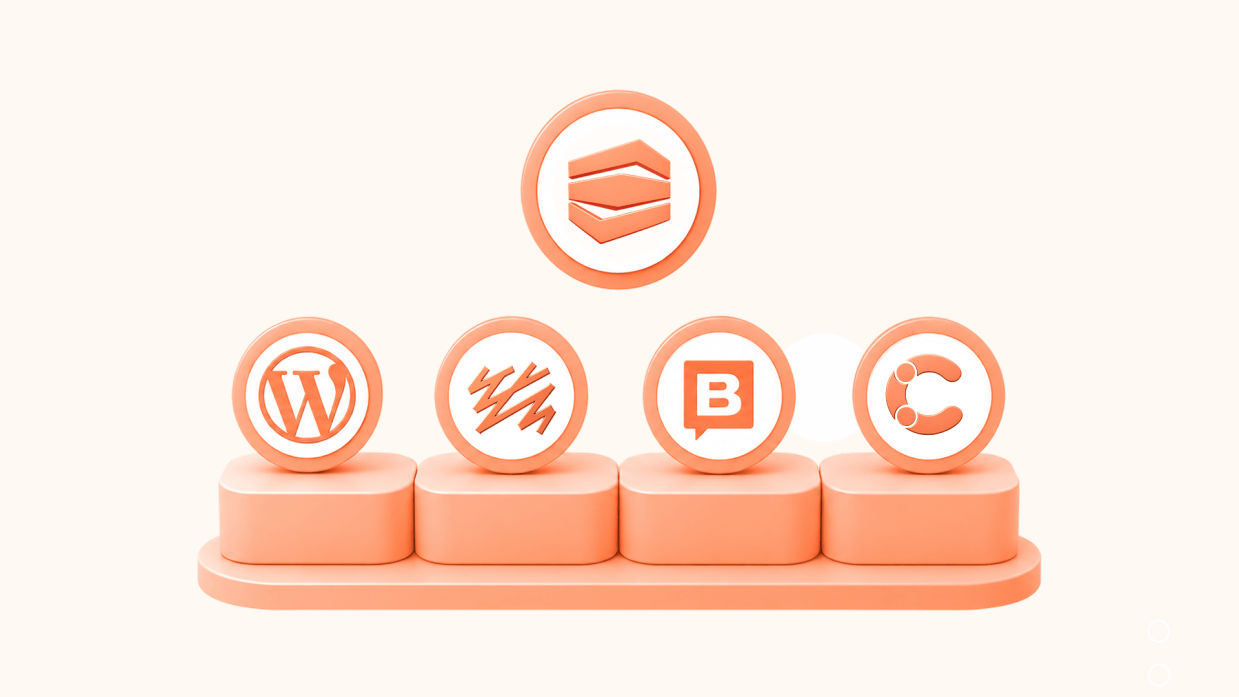
The 4 Enterprise Alternatives to Contentstack
Here are the four platforms teams most often evaluate when reconsidering Contentstack.
1. WordPress
The world’s most widely adopted CMS now runs enterprise publishers, Fortune 500 brands, and global marketing sites through platforms like WordPress VIP. Its block editor (Gutenberg) gives content teams a modern, component-style visual experience without developer dependency, and its plugin ecosystem covers virtually every requirement. WordPress can also run headless via REST and GraphQL, so it removes Contentstack’s overhead while keeping the decoupled option available.
2. Sanity
Sanity is a headless CMS built around structured content and omnichannel delivery. Content lives as structured data in a real-time, globally distributed Content Lake, making it portable across websites, apps, and connected experiences. For teams that want to keep a composable, API-first architecture but shed Contentstack’s cost and weight, Sanity offers a lighter, more transparent, developer-flexible backend.
3. Storyblok
Storyblok is a headless CMS with a genuine visual editor, letting content teams edit pages in a live preview rather than abstract fields. It keeps the API-first, multi-channel benefits of headless while giving marketers far more autonomy than a developer-centric platform, and its pricing is public and substantially lower than Contentstack’s.
4. Contentful
Contentful is a cloud-native headless CMS trusted by thousands of enterprise customers. It is the closest enterprise-headless peer to Contentstack, pairing structured content modeling with a marketer-friendly editor and a deep integration marketplace, so teams that want to stay on a comparable enterprise platform can gain a more polished editorial experience and, often, more transparent entry pricing.
The critical difference
These four solve the Contentstack problem in different ways:
- WordPress is a full, self-contained CMS that removes the headless overhead entirely and gives content teams the most autonomy.
- Sanity, Storyblok, and Contentful keep you headless but lighter or more transparent, with Sanity favoring deep developer flexibility, Storyblok favoring marketer-friendly visual editing, and Contentful favoring enterprise maturity and a broad integration marketplace.
Your choice depends on whether you want to leave headless behind or move to a headless platform that fits how your team actually works.
Alternative 1: WordPress (Recommended for Most Enterprises)
WordPress addresses the core Contentstack frustrations directly: it collapses the cost, removes the separate front end, and hands content teams autonomy, while keeping headless available if you genuinely need it.
Cost Comparison
Contentstack’s cost is a six-figure subscription plus the engineering to build and maintain a front end. WordPress changes both.
Year 1 Total Cost: WordPress draws on an open, competitive market for development and hosting, and a self-contained platform means you are not separately funding a bespoke front end the way Contentstack requires.
- Licensing: WordPress core is free and open source, against Contentstack’s custom enterprise contracts that commonly run into six figures annually.
- Front-end build: WordPress themes and the block editor make the site part of the platform. With Contentstack, the front end is a separate application your team owns indefinitely.
- Development: WordPress taps the largest global talent pool of any CMS, with senior salaries of $100,000 to $150,000 and deep freelance and agency markets.
- Hosting: Open market, with WordPress VIP available for enterprise-grade needs.
Average savings: Teams moving from premium enterprise headless to WordPress typically see substantial TCO reduction over three years, driven by eliminating six-figure platform fees and the ongoing cost of maintaining a separate front end.
Key Features for Enterprise Teams
WordPress covers what Contentstack does for most teams and adds the full-CMS capabilities a headless backend leaves out.
- Block editor (Gutenberg): A visual, component-based editor that lets content teams build and publish pages without developer involvement.
- Reusable patterns and blocks: Component-style building blocks that content teams can create and modify directly.
- Headless when you want it: Full REST API and GraphQL support for decoupled delivery, so the option Contentstack forces stays available on your terms.
- Massive plugin ecosystem: 59,000+ plugins covering SEO, multilingual, integrations, and security, so fewer requirements become custom front-end code.
- Built-in SEO and marketing tooling: Deep SEO capabilities and marketing integrations native to the platform.
- Enterprise governance and hosting: Granular roles and workflows, with WordPress VIP providing enterprise-grade hosting, security scanning, and code review.
- Commerce and scale: WooCommerce and a mature performance stack for teams that need more than content.
When WordPress Makes Sense
WordPress is the strongest Contentstack alternative when:
- Your real need is a marketing site and a few channels, not a full MACH stack
- Content and marketing teams need to publish without developer tickets
- You want to remove a separate front end and the cost of maintaining it
- Predictable, open-market costs matter more than composable breadth you rarely use
- SEO and organic traffic are primary growth channels
- You want the option to go headless later without committing to it now
Migration Complexity: Low to Moderate
Contentstack to WordPress is a well-understood move, and because Contentstack stores content as structured data, the content itself maps cleanly into WordPress structures.
Timeline: 8 to 16 weeks for most enterprise migrations.
Risk level: Low to moderate, owing to mature tooling and a large talent pool. The core work involves migrating content from Contentstack’s API into WordPress content types and blocks, rebuilding the front end as a WordPress theme, URL mapping and 301 redirects, replacing front-end-coded SEO with native tooling, integration rebuilds, and team training on the block editor.
Important Consideration: The main effort is reproducing in WordPress the integrations, governance, and front-end behaviors that previously lived across your composable stack, and preserving SEO equity through a clean redirect map. Handled well, content teams gain autonomy immediately and the migration is invisible to visitors.
As a WordPress VIP Gold Partner with 1000+ migrations completed, Multidots brings proven enterprise platform migration methodology to transitions like this. You can see examples of our work in our case studies.
WordPress for Enterprises: Learn the Secret Sauce of Big Enterprise WordPress Websites
An In-Depth Look at the Engineering and Design Behind Billion-Dollar Enterprises’ WordPress Websites



Alternative 2: Sanity (Best for Staying Headless With Lower Cost)
Sanity is a content operating system built API-first for the modern web. It stores content as structured data in a real-time, globally distributed Content Lake, making it portable across websites, mobile apps, and connected experiences.
For teams that genuinely want a composable, API-first architecture but find Contentstack too heavy and too expensive, Sanity is the natural step. You keep headless, on a more transparent and developer-flexible backend.
Key Features for Enterprise Teams
Sanity’s feature set is built around content portability and developer flexibility, with every capability designed API-first.
- Real-time collaborative editing: Sanity Studio supports simultaneous editing with presence indicators and conflict resolution.
- Structured content modeling: Content is stored as structured data, not bound to page layouts, making it truly portable across channels.
- GROQ query language: A precise, developer-friendly query language for fetching exactly the content each surface needs.
- Fully customizable Studio: Sanity Studio is built in React and can be tailored to your editorial workflow with custom components and validation.
- Content Lake: A hosted backend that handles scaling, CDN distribution, and API delivery without infrastructure management.
- Portable Text: A specification for rich text stored as structured data, enabling consistent rendering on any front end.
When Sanity Makes Sense
Sanity is the strongest Contentstack alternative when:
- You have a real composable, omnichannel need but want lower cost and more transparency
- Your team has strong React, Next.js, or modern JavaScript capability
- Deep structured-content modeling and a customizable editing environment are priorities
- Real-time collaborative editing across distributed teams is a core requirement
- You are comfortable owning the front end in exchange for flexibility
Migration Complexity: Low to Moderate
Because both Contentstack and Sanity are structured-content, headless platforms, the conceptual mapping is familiar, and you can often keep much of your existing front-end framework.
Timeline: 10 to 18 weeks for enterprise migrations.
Risk level: Low to moderate, since the headless architecture carries over and the main work is remodeling content and rewiring the front end to Sanity’s APIs. The core work involves redesigning content into Sanity document schemas, scripted content migration from Contentstack, adapting the front-end data layer, API and query development, URL preservation, SEO implementation in the front-end layer, and team training on Sanity Studio.
Important Consideration: Moving from Contentstack to Sanity keeps you in the headless model, so it lowers cost and adds flexibility but does not remove front-end maintenance or developer dependency. Pricing is transparent: Free at $0, Growth at $15 per seat per month, and custom Enterprise contracts that typically land well below Contentstack’s at comparable scale. Choose Sanity when headless is genuinely right and you want a leaner platform.
Alternative 3: Storyblok (Best for Marketer-Friendly Headless)
Storyblok is a headless CMS built around a real visual editor. Instead of editing abstract fields, content teams work in a live preview of the page, which closes much of the autonomy gap that developer-centric headless platforms create. For teams migrating from Contentstack, Storyblok keeps the API-first, multi-channel architecture while giving marketers far more independence, at a fraction of the price.
Key Features for Enterprise Teams
Storyblok pairs headless delivery with an editing experience built for non-developers.
- Visual editor: A live, in-context editing experience available across all plans, so content teams see changes as they make them.
- Component-based content blocks: Reusable blocks that developers define and content teams assemble visually.
- API-first delivery: REST and GraphQL APIs for delivering content to any front end or channel.
- Localization and workflows: Multi-language support and editorial workflows for distributed teams.
- App directory and integrations: A growing marketplace connecting Storyblok to the wider martech and commerce stack.
- Transparent, public pricing: Clear published tiers, a sharp contrast to Contentstack’s quote-only model.
When Storyblok Makes Sense
Storyblok is the strongest Contentstack alternative when:
- You want to stay headless but give content teams visual, autonomous editing
- Marketer independence and speed to publish are priorities
- Multi-channel delivery via APIs is a core requirement
- You want transparent, predictable pricing rather than custom enterprise quotes
- Your team values a balance between developer control and editorial freedom
Migration Complexity: Moderate
Migrating from Contentstack to Storyblok keeps the headless architecture, and Storyblok’s component model and import tooling ease the content move.
Timeline: 10 to 18 weeks for enterprise migrations.
Risk level: Moderate. The core work involves modeling content into Storyblok components, scripted content migration from Contentstack, adapting the front-end data layer, configuring the visual editor and workflows, API integration, SEO implementation in the front-end layer, and team training.
Important Consideration: Storyblok is still a headless backend, so you own a separate front end and front-end-level SEO. What it changes is the editorial experience and the cost: public pricing runs from a free Starter tier to Growth at €99 per month and Growth Plus at €349 per month, with custom Premium and Elite plans for enterprise needs, per the Storyblok pricing page. Choose Storyblok when headless is right but editorial autonomy and transparent cost are non-negotiable.
Alternative 4: Contentful (Best for Staying on a Comparable Enterprise Platform)
Contentful is a cloud-native headless CMS trusted by thousands of enterprise customers, and it is the closest peer to Contentstack in the enterprise-headless category. For teams that want to stay on a comparable composable platform rather than change their architecture, Contentful offers a familiar API-first model with a more polished, marketer-friendly editor and a deep integration marketplace.
Key Features for Enterprise Teams
Contentful combines structured content modeling with a polished editing experience accessible to both developers and content strategists.
- Structured content model: Content types, fields, and relationships defined in a visual interface, accessible to non-developers.
- Compose and Launch: Page-building and orchestration on top of the headless architecture, plus scheduled releases for campaign-driven teams.
- GraphQL and REST APIs: Both API formats supported natively, giving front-end teams flexibility.
- App Marketplace: A broad marketplace of integrations across martech, commerce, and analytics.
- Environments and Releases: Built-in content staging with environment branching and scheduled releases.
- Localization: Native multi-locale support with per-field localization.
- Enterprise security and compliance: SOC 2 Type II certification and enterprise-grade controls.
When Contentful Makes Sense
Contentful is the strongest Contentstack alternative when:
- You want to stay on a comparable enterprise-headless platform without re-architecting
- Content delivery across web, mobile, and other channels via APIs is a core requirement
- You need a deep marketplace of integrations across commerce and martech
- Content teams want a more polished editor than a developer-led composable stack
- Robust localization and structured content modeling at enterprise scale matter
Migration Complexity: Moderate
Migrating from Contentstack to Contentful keeps the headless architecture, and Contentful’s familiar content-type model and import tooling ease the content move.
Timeline: 12 to 20 weeks for enterprise migrations.
Risk level: Moderate. The core work involves redesigning content into Contentful content types, content migration via Contentful’s import APIs, adapting the front-end data layer, integrations through the marketplace, localization and workflow configuration, SEO implementation in the front-end layer, and team training on Contentful’s editor.
Important Consideration: Contentful is a content backend like Contentstack, so the front end and front-end-level SEO remain yours to own. The gains are a more polished editor and a broad integration marketplace, and pricing that is more transparent at entry: Free at $0, Lite at $300 per month, and custom Premium contracts per the Contentful pricing page, which still scale with usage into six figures at enterprise scale, so model your needs before committing.
Final Comparison: Contentstack vs WordPress vs Sanity vs Storyblok vs Contentful
Here is how the alternatives compare across the factors that matter most when leaving Contentstack.
| Dimension | Contentstack | WordPress | Sanity | Storyblok | Contentful |
|---|---|---|---|---|---|
| Best For | Enterprise composable, omnichannel at scale | Content-driven sites, marketing autonomy, multi-purpose | Lean headless, developer flexibility | Marketer-friendly headless with visual editing | Enterprise headless with broad integrations |
| Architecture | Headless (backend only) | Full CMS, optional headless | Headless (backend only) | Headless (backend only) | Headless (backend only) |
| Implementation Time | — | 8 to 16 weeks | 10 to 18 weeks | 10 to 18 weeks | 12 to 20 weeks |
| Editorial Experience | Field-based, developer-led | Intuitive block editor, full autonomy | Customizable, developer-configured | Visual editor, marketer-friendly | Polished, marketer-friendly |
| Front-End | You build and maintain it | Included (themes), or headless | You build and maintain it | You build and maintain it | You build and maintain it |
| Pricing Model | Custom, quote-only, six-figure | Open source + hosting/dev | Per-seat + usage, transparent | Public tiers, transparent | Usage-based, scales with growth |
| SEO & Marketing | Hand-built in front end | Excellent (native tooling) | Depends on front-end build | Depends on front-end build | Depends on front-end build |
| Vendor Lock-in | High (proprietary, composable) | Low (open source, portable) | Moderate (Content Lake) | Moderate (cloud-hosted) | Moderate (cloud-hosted) |
| Talent Pool | Niche | Largest of any CMS | Modern JS developers | Modern JS developers | Modern JS developers |
| Ecosystem | Composable add-ons | 59,000+ plugins | App ecosystem | App directory | App marketplace |
Making Your Decision: Which Alternative Is Right for You?
After working with hundreds of enterprise teams over 17 years, I have noticed clear patterns in which alternatives work best for which scenarios.
Choose WordPress if:
- Your real need is a marketing site and a few channels, not a full composable stack
- Content and marketing teams need autonomy to publish without developer tickets
- You want to remove the separate front end and the collapse platform cost
- SEO, organic traffic, and a large ecosystem matter to your long-term plan
- You want the option to go headless later without committing to it now
Choose Sanity if:
- You have a genuine composable, omnichannel need but want lower cost and more transparency
- Your team has strong React/JavaScript capability and wants deep flexibility
- Structured-content modeling and a customizable Studio are priorities
- Real-time collaborative editing and content portability are core requirements
Choose Storyblok if:
- You want to stay headless but give content teams visual, autonomous editing
- Marketer independence and speed to publish are priorities
- Transparent, predictable pricing matters more than custom enterprise contracts
- You want a balance between developer control and editorial freedom
Choose Contentful if:
- You want to stay on a comparable enterprise-headless platform without re-architecting
- You need a deep marketplace of integrations across commerce and martech
- Content teams want a more polished editor than a developer-led composable stack
- Robust localization and structured content modeling at enterprise scale matter
The right choice comes down to your priorities. If removing headless overhead and giving content teams autonomy on a full CMS matters most, WordPress fits that profile. If a composable, API-first architecture is genuinely what you need, Sanity, Storyblok, and Contentful each suit a different one, Sanity for developer depth, Storyblok for marketer-friendly visual editing, and Contentful for enterprise maturity and integration breadth. The comparison above lines each platform up against the factors that usually drive the decision, cost, editorial autonomy, architecture, and ecosystem, so you can weigh them against what your team needs most.
Ready to Explore Your Options?
If your team is rethinking Contentstack, the first step is understanding exactly what a move involves: content audit, integration and governance mapping, SEO and redirect planning, and a realistic timeline. From there, you can weigh a clear, costed plan against your next renewal quote.
Multidots is a WordPress VIP Premier Partner with 17+ years of enterprise WordPress experience and 1000+ successful migrations, including transitions from headless and composable platforms. Our methodology preserves your SEO equity, maps your content architecture precisely, and rebuilds your front end and integrations as native WordPress.
Get in touch with our team for a free migration assessment. We will review your current Contentstack setup, identify risks and opportunities, and send back a written recommendation with timeline and cost estimates.