
Key Takeaways
- Drupal’s declining market share and Drupal 7 EOL are forcing enterprises to reassess CMS strategy.
- WordPress offers the lowest-risk Drupal migration path with stronger editorial workflows and lower long-term TCO.
- Sanity fits enterprises needing structured content, omnichannel delivery, and developer-controlled composable architecture.
- Contentful suits API-first teams needing enterprise headless CMS capabilities with marketer-friendly editorial tools.
- CMS selection should align with migration complexity, editorial autonomy, talent availability, and long-term platform costs.
For over a decade, Drupal has been the default choice for enterprise content management. Government agencies, universities, and large publishers built their digital infrastructure on Drupal’s flexible, developer-driven architecture. Acquia, the commercial platform built around Drupal, added enterprise hosting, cloud tools, and support contracts that made the ecosystem feel complete.
But the landscape has shifted. Drupal 7 reached end of life in January 2025, leaving over 400,000 websites facing urgent migration decisions. Drupal’s overall CMS market share has dropped to roughly 1% of the global CMS market, down significantly from a decade ago. Meanwhile, the platforms competing for enterprise attention have matured significantly, offering better editorial experiences, lower total cost of ownership, and larger talent pools.
The result is that enterprise teams are no longer asking “How do we upgrade Drupal?” They are asking “Should we still be on Drupal at all?” This is a fair question, and it deserves a thorough answer.
This guide breaks down three enterprise-grade alternatives to Drupal: WordPress, Sanity, and Contentful. For each, we cover real cost comparisons, feature analysis, migration complexity, and the scenarios where each platform makes the most sense. Whether you are a CTO evaluating options, a marketing director frustrated with editorial workflows, or an IT lead planning your next three years, this analysis will give you the data you need.
What Drupal Offers (And Why Companies Are Looking Elsewhere)
Drupal is an open-source CMS known for its flexibility, granular permission systems, and ability to handle complex content architectures.
Core features of the Drupal stack
Drupal’s strengths center on technical flexibility and enterprise-grade infrastructure.
- Custom content types and taxonomies: Drupal’s entity system allows developers to model virtually any content structure without plugins or extensions.
- Granular access control: Role-based permissions can be configured down to individual field-level access, critical for government and healthcare use cases.
- Multilingual support: Built-in translation workflows with support for right-to-left languages and complex locale configurations.
- API-first architecture: Drupal’s JSON:API and GraphQL modules support headless and decoupled delivery models.
- Enterprise security: Regular security advisories, a dedicated security team, and compliance-ready configurations for FedRAMP, HIPAA, and SOC 2.
Pricing and costs
Drupal itself is free and open source, but the real costs lie in development, hosting, and maintenance. When you factor in Drupal-specialized development talent (averaging $110,000 to $155,000 per year for senior developers in the US), the total cost of ownership for an enterprise Drupal implementation frequently exceeds $200,000 in Year 1 alone.
Where Drupal falls short
Despite its technical capabilities, Drupal presents several challenges that are increasingly pushing enterprise teams to evaluate alternatives.
- Restricted for non-developers: Drupal’s admin interface and content editing experience remain complex. Layout Builder has improved visual editing, but it still requires training and often leads to layout inconsistencies. The Experience Builder, Drupal’s answer to modern page builders, is still in alpha as of early 2026.
- Complex architecture: Drupal’s flexibility is a double-edged sword. The module ecosystem, hook system, and configuration management require specialized knowledge that general PHP developers often lack.
- Declining market share: At ~1% of the CMS market (down significantly), the Drupal ecosystem is shrinking. Fewer agencies specialize in it, fewer modules get maintained, and community momentum has slowed.
- Difficult upgrades: Drupal 8 introduced a complete architectural overhaul from Drupal 7. Migrating from Drupal 7 to Drupal 10 or 11 is closer to a full rebuild than a version upgrade, often requiring 8 to 16+ weeks of development work.
When staying on Drupal still makes sense
Drupal remains a strong choice for organizations with deeply custom content models, strict compliance requirements (government, healthcare), and dedicated in-house Drupal development teams. If your team has the expertise and your content architecture genuinely requires Drupal’s entity system, the platform still delivers. But for most enterprise teams, the cost-benefit calculation has shifted.
Why Enterprises Are Migrating from Drupal
Here are a few reasons why enterprises and organizations are moving away from Drupal.
1. Complex Upgrade Cycles and Mounting Technical Debt
Drupal 7’s end of life in January 2025 forced a reckoning for over 400,000 websites. But the migration path is not a simple version bump. Moving from Drupal 7 to Drupal 10 or 11 means rebuilding themes, rewriting custom modules, and restructuring content. For many organizations, the effort required to stay on Drupal is comparable to the effort required to move to a different platform entirely.
Extended security support for Drupal 7 is available through certified vendors until January 2027, but this is a temporary bandage, not a solution. Organizations paying for extended support are essentially paying twice: once for support on a deprecated platform and again for the eventual migration that still lies ahead.
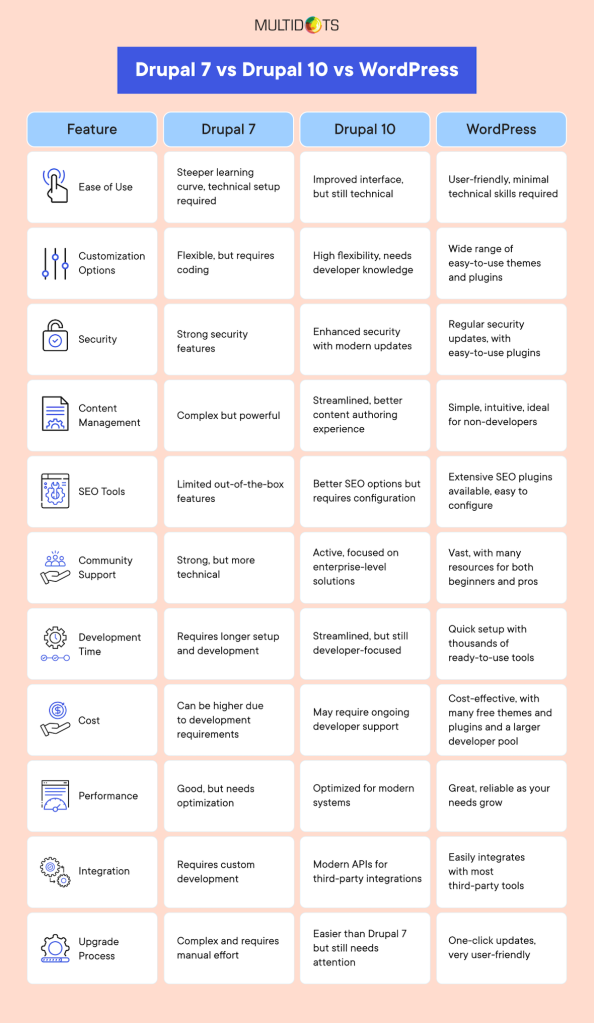
Here’s a quick comparison table on Drupal 7 vs 10:
2. Shrinking Developer Talent Pool
Drupal’s declining market share has a direct impact on talent availability. Senior Drupal developers in the US command average salaries of $155,000 to $167,000 per year, while freelance rates run $61 to $80+ per hour. The premium reflects scarcity, not just skill. As fewer developers enter the Drupal ecosystem and experienced developers move to higher-demand platforms, hiring and retaining Drupal talent becomes harder and more expensive each year.
By contrast, WordPress developers are available at a much wider range of experience levels, with senior salaries averaging $100,000 to $150,000 and a global freelance market that dwarfs Drupal’s. The talent pool difference is not marginal; WordPress powers 42.6% of all websites, creating a self-reinforcing cycle of developer investment, training resources, and community support.
3. Editorial Experience That Falls Behind
Content editors and marketing teams consistently cite Drupal’s authoring interface as a pain point. While Layout Builder and CKEditor 5 have improved things, the editing experience still requires training, frequently results in layout inconsistencies, and lacks the intuitive drag-and-drop simplicity that platforms like WordPress (with Gutenberg) now offer out of the box.
For marketing teams that need to publish quickly, run A/B tests, and iterate on landing pages without developer involvement, Drupal’s editorial workflow creates bottlenecks. Every hour a content editor spends navigating Drupal’s admin interface is an hour not spent on content strategy and execution.
The 3 Enterprise Alternatives to Drupal
Here are the alternatives of Drupal for enterprises and organizations.
1. WordPress
WordPress powers 42.6% of all websites and holds nearly 60% market share among sites using a known CMS. Far from its blogging origins, WordPress now serves enterprise publishers, Fortune 500 companies, and government agencies through platforms like WordPress VIP. Its block editor (Gutenberg) provides a modern visual editing experience, and its plugin ecosystem of 60,000+ extensions covers virtually every enterprise requirement.
2. Sanity
Sanity is a headless CMS built for structured content and omnichannel delivery. Its real-time collaborative editing environment (Sanity Studio) is fully customizable, and its API-first architecture makes it ideal for teams delivering content across websites, mobile apps, IoT devices, and digital signage simultaneously. Sanity’s GROQ query language and portable text format give developers precise control over content delivery.
3. Contentful
Contentful is a cloud-native headless CMS used by over 4,000 enterprise customers, including Vodafone, Chanel, Spotify, and Staples. Unlike Sanity’s developer-focused approach, Contentful emphasizes a polished, marketer-friendly editing experience alongside its API-first architecture. Pricing ranges from free for small projects to custom enterprise contracts typically between $5,000 and $70,000+ per year.
The critical difference
These three alternatives represent fundamentally different approaches. WordPress is a full-featured CMS that handles both content management and delivery. Sanity and Contentful are headless content backends that require a separate frontend, with Contentful offering a more marketer-friendly editing experience and Sanity providing deeper developer customization.
Your choice depends on your team’s capabilities, your content delivery requirements, and your budget.
Alternative 1: WordPress (Recommended for Most Enterprises)
WordPress is the world’s most widely adopted CMS, powering 43% of all websites including enterprise publishers like TechCrunch, TIME, and CNN.
For teams migrating from Drupal, WordPress offers the most familiar transition path – both are open-source, PHP-based platforms – with a dramatically larger ecosystem, lower total cost of ownership, and a content editing experience that doesn’t require developer involvement for day-to-day publishing.
Key Features for Enterprise
WordPress delivers enterprise capabilities that match or exceed Drupal in most areas, with significantly lower implementation effort.
- Block editor (Gutenberg): A visual, component-based editor that lets content teams build pages without touching code. Supports reusable block patterns, full-site editing, and real-time previews.
- Multisite management: WordPress Multisite supports hundreds of sites from a single installation, ideal for organizations managing multiple brands, regions, or languages.
- REST API and GraphQL: Full headless and decoupled capabilities for teams that need to deliver content to multiple frontends.
- WooCommerce for commerce: Enterprise e-commerce with custom product types, subscription models, and marketplace configurations.
- Security and compliance: WordPress VIP provides FedRAMP-ready hosting, automated security scanning, and code review processes that meet enterprise compliance requirements.
- Performance optimization: With proper performance tuning, WordPress consistently achieves sub-second page loads and strong Core Web Vitals scores.
- SEO and marketing tools: Deep SEO capabilities through plugins like Yoast SEO and RankMath, plus native integration with every major marketing automation platform.
When WordPress Makes Sense
WordPress is the strongest Drupal alternative when:
- Your content team needs to publish and iterate quickly without developer involvement
- You manage multiple websites or brands from a central platform
- SEO and organic traffic are primary growth channels
- You need e-commerce capabilities alongside content management
- Your organization wants to reduce vendor lock-in while maintaining enterprise-grade hosting
- You are migrating from Drupal 7 and want the lowest-risk path to a modern CMS
Migration Complexity: Low to Moderate
Drupal to WordPress is one of the most well-documented enterprise migration paths, with mature tooling and a large talent pool experienced in both platforms.
Typical timelines run 6 to 14 weeks for most enterprise migrations, with low overall risk due to mature tooling and well-documented migration paths. The core work involves content migration (posts, pages, custom content types, taxonomies, media), URL structure mapping and 301 redirects, theme rebuild or adaptation to WordPress block architecture, custom module replacement through plugins or custom development, SEO preservation including metadata and schema markup, and user account migration with role mapping.
Important consideration: The most common mistakes in Drupal-to-WordPress migration involve losing SEO equity through broken redirects, failing to map custom content types properly, and underestimating the effort needed for custom module replacement. You can take a look at our detailed Drupal to WordPress migration guide.
As a WordPress VIP Gold Partner with 1000+ website migrations completed, Multidots brings proven migration methodology to enterprise transitions. Our team handles content mapping, SEO preservation, custom development, and post-migration support. You can see examples of our work in our case studies.
WordPress for Enterprises: Learn the Secret Sauce of Big Enterprise WordPress Websites
An In-Depth Look at the Engineering and Design Behind Billion-Dollar Enterprises’ WordPress Websites


Alternative 2: Sanity (Best for Omnichannel Content Delivery)
Sanity is a content operating system built API-first for the modern web. It treats content as structured data stored in a real-time, globally distributed Content Lake, making it truly portable across websites, mobile apps, digital signage, and AI applications.
For Drupal teams already comfortable with custom content modeling and developer-driven workflows, Sanity offers a conceptually familiar approach rebuilt for today’s composable architecture demands.
Key Features for Enterprise
Sanity’s feature set is built around content portability and developer flexibility, with every capability designed API-first.
- Real-time collaborative editing: Sanity Studio supports Google Docs-style simultaneous editing with presence indicators and conflict resolution.
- Structured content modeling: Content is stored as structured data (not HTML blobs), making it truly portable across channels and devices.
- GROQ query language: A powerful, developer-friendly query language that provides precise control over content fetching without the complexity of GraphQL.
- Customizable editing environment: Sanity Studio is built in React and can be fully customized to match your editorial workflow, including custom input components, validation rules, and preview configurations.
- Content Lake: Sanity’s hosted content backend handles scaling, CDN distribution, and API delivery without infrastructure management.
- Portable text: A specification for rich text that stores content as structured data rather than HTML, enabling consistent rendering across any frontend.
When Sanity Makes Sense
Sanity is the strongest Drupal alternative when:
- Your content needs to be delivered to 3+ channels (web, mobile app, digital signage, IoT)
- Your development team is already proficient in React, Next.js, or modern JavaScript frameworks
- You need real-time collaborative editing across distributed teams
- Content structure and portability matter more than out-of-the-box website features
- You are building a composable architecture where the CMS is one component in a broader tech stack
Migration Complexity: Moderate to High
Migrating from Drupal to Sanity requires rethinking your content architecture and building a new frontend from scratch, making it a larger undertaking than a WordPress migration.
Typical timelines run 10 to 20 weeks for enterprise migrations, with moderate risk due to the need to build a separate frontend application. The core work involves content model redesign from Drupal entities to Sanity document schemas, content migration via scripts, a complete frontend rebuild in a JavaScript framework (this is the largest effort), API integration and query development, URL structure preservation through the new frontend routing, SEO implementation in the frontend layer, and team training on Sanity Studio and the new editorial workflow.
Important consideration: Sanity is not a drop-in replacement for Drupal. It is a content backend, not a complete website platform. You will need a separate frontend application, a hosting provider for that frontend, and developers comfortable with modern JavaScript. The total implementation effort is often higher than WordPress, but the payoff is significant for teams with genuine omnichannel requirements.
Alternative 3: Contentful (Best for API-First Enterprise Content)
Contentful is a cloud-native headless CMS trusted by over 4,000 enterprise customers, including Vodafone, Chanel, Spotify, and Staples. For teams migrating from Drupal, Contentful offers a familiar structured content model delivered through modern APIs, with a polished editing experience that content teams can adopt quickly.
Key Features for Enterprise
Contentful combines structured content modeling with a polished editing experience, making it accessible to both developers and content strategists.
- Structured content model: Content types, fields, and relationships are defined in a visual interface, making it accessible to both developers and content strategists. Drupal teams familiar with content types and taxonomies will find the concepts directly translatable.
- Compose and Launch: Page-building capabilities on top of the headless architecture, plus scheduled releases and content orchestration for campaign-driven teams.
- GraphQL and REST APIs: Both API formats are supported natively, giving frontend teams flexibility in how they consume content.
- Environments and Releases: Built-in content staging with environment branching and scheduled releases, similar to Git-based development workflows.
- Localization: Native multi-locale support with per-field localization, familiar to teams coming from Drupal’s multilingual capabilities.
- App Marketplace: A growing marketplace of integrations with tools like Cloudinary, Bynder, Commercetools, and marketing automation platforms.
- SOC 2 Type II Certified: Enterprise-grade security and compliance.
Some of the brands using Contentful are Vodafone, Chanel, Spotify, Staples, Urban Outfitters.
When Contentful Makes Sense
Contentful is the strongest Drupal alternative when:
- You need a mature, enterprise-proven headless CMS with strong editorial tooling
- Your team wants a managed SaaS platform without infrastructure management
- Content needs to be delivered across web, mobile, and other channels via APIs
- You value a polished editor experience alongside API-first delivery (compared to Sanity’s more developer-centric approach)
- Your development team works in JavaScript/React/Next.js
- You need robust localization features comparable to what Drupal offers
Migration Complexity: Moderate to High
Migrating from Drupal to Contentful involves rebuilding both your content model and frontend layer, though Contentful’s Import/Export APIs and familiar content type structure ease the content migration itself.
Typical timelines run 12 to 22 weeks for enterprise migrations, with moderate risk. The core work involves content model redesign from Drupal entities to Contentful content types, content migration via Contentful’s Import/Export APIs, a complete frontend rebuild in a JavaScript framework, localization and workflow configuration, API integration and query development, SEO implementation in the frontend layer, and team training on Contentful’s editing interface.
Important consideration: Like Sanity, Contentful is a content backend, not a complete website platform. You will need a separate frontend application and hosting. Contentful’s editing experience is generally considered more accessible to non-technical users than Sanity’s, making it a better fit for teams where content editors need maximum autonomy.
Final Comparison: Drupal vs WordPress vs Sanity vs Contentful
Here’s how the alternatives compare across key decision factors:
| Dimension | Drupal | WordPress | Sanity | Contentful |
|---|---|---|---|---|
| Best For | Complex custom content models, government/ compliance | Content-driven websites, marketing teams, multi-site | Omnichannel content delivery, composable architectures | API-first enterprise content, marketer-friendly headless |
| Implementation Time | — | 6 to 14 weeks | 10 to 20 weeks | 12 to 22 weeks |
| Editorial Experience | Complex, requires training | Intuitive block editor, low learning curve | Customizable, collaborative, developer-configured | Clean, marketer-friendly interface |
| E-commerce | Limited (Drupal Commerce) | Strong (WooCommerce, extensive ecosystem) | Requires custom frontend integration | Via Commercetools and other integrations |
| SEO and Marketing | Good with modules | Excellent (Yoast, RankMath, native tools) | Depends on frontend implementation | Depends on frontend implementation |
| Vendor Lock-in | Moderate | Low (open source, portable) | Moderate (Content Lake is proprietary) | Moderate (cloud-hosted, API-exportable) |
Making Your Decision: Which Alternative is Right for You?
After working with hundreds of enterprise teams over 16 years, I’ve noticed clear patterns in which alternatives work best for different scenarios.
Choose WordPress if:
- You want the lowest-risk migration path with the fastest time to launch
- Your primary channels are web-based (corporate sites, blogs, landing pages, e-commerce)
- Marketing and editorial teams need autonomy to publish without developer tickets
- Budget optimization is a priority, and you want the broadest talent pool for ongoing development
- You need a proven platform with enterprise hosting options like WordPress VIP
For a deeper comparison of Drupal and WordPress, including feature-by-feature analysis, see our detailed guide.
Choose Sanity if:
- You are delivering content to three or more distinct channels (web, native apps, kiosks, IoT)
- Your team already has strong React/JavaScript capabilities
- Real-time collaborative editing is a core workflow requirement
- You are building a composable, API-first architecture and want maximum flexibility in your content backend
- You do not need built-in website features (routing, SEO, themes) and prefer to build them yourself
Choose Contentful if:
- You need an enterprise-proven headless CMS with a polished editing experience
- Content delivery to multiple channels (web, mobile, IoT) is a core requirement
- Your team works in JavaScript/React and wants a managed SaaS content platform
- You value strong localization features and structured content modeling
- You want a headless approach without the deep developer customization that Sanity requires
For most enterprise teams migrating from Drupal, WordPress delivers the strongest combination of editorial experience, ecosystem maturity, cost efficiency, and migration simplicity. Sanity and Contentful are strong options for teams with genuine headless and omnichannel requirements, but for the majority of use cases, WordPress is the recommendation we make most often, and the results from enterprise WordPress implementations consistently validate that position.
Ready to Explore Your Options?
If your team is evaluating alternatives to Drupal, the first step is understanding exactly what your migration involves: content audit, SEO risk assessment, custom functionality mapping, and timeline planning.
Multidots is a WordPress VIP Gold Partner with 17+ years of enterprise WordPress experience and 1000+ successful migrations, including complex Drupal-to-WordPress transitions for publishers, enterprises, and global brands. Our migration methodology preserves your SEO equity, maps your content architecture precisely, and gets your team productive on the new platform quickly.
Get in touch with our team for a free migration assessment. We will review your current Drupal setup, identify risks and opportunities, and provide a detailed migration plan with timeline and cost estimates—no commitment required.