

Key Takeaways
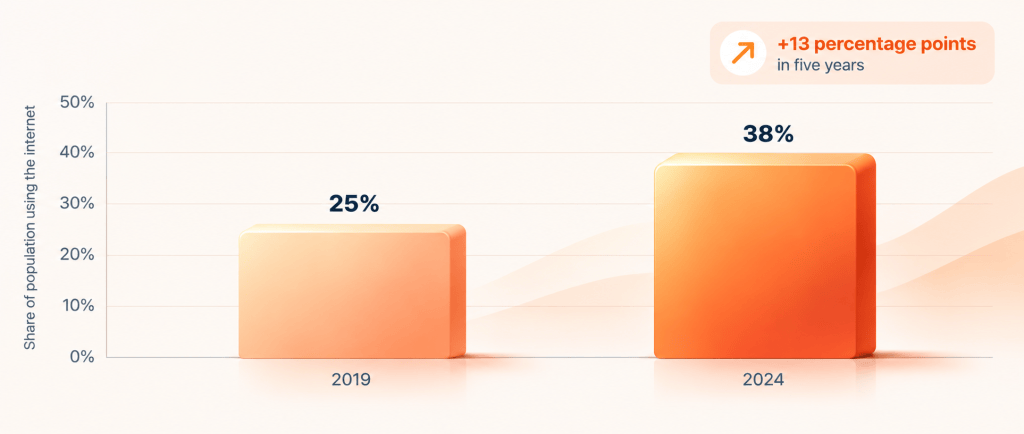
- Internet use in sub-Saharan Africa grew from 25% to 38% between 2019 and 2024, creating new digital publishing opportunities.
- Configurable e-paper plugins help African publishers build direct digital channels while retaining control over content, audiences, and monetization.
- Publishers can manage multiple titles through shared infrastructure with configurable branding, editorial workflows, access models, and local payment options.
- Mobile-first design, low-data experiences, and offline reading are essential for reaching audiences with limited connectivity.
- A phased rollout, starting with one pilot title, helps publishers validate reader engagement, subscription conversions, and commercial performance.
Africa’s online audience is growing every year. For a newspaper or magazine with a brand readers already trust, that growth is a chance to reach readers where they already spend time, on a product the publisher owns, while keeping the familiar feel of an edition.
A configurable e-paper plugin is a practical way to do it. It connects the existing editorial and print workflow to a digital edition that the publisher can measure and monetize. The sections below cover the market data, what each title should be able to configure, and a five-step route from one pilot title to a full rollout.
How Fast Is Africa’s Online Audience Growing?
The State of Broadband in Africa 2025 report from ITU and UNESCO found that internet use in sub-Saharan Africa rose from 25% of the population in 2019 to 38% in 2024. That is 13 percentage points in five years.
The room left to grow is larger still. GSMA’s Mobile Economy Africa 2026 re/port puts mobile internet use at 28% of Africa’s population in 2024. Another 63% lived within mobile broadband coverage but were not online, which GSMA counts as nearly 1 billion people. GSMA says they are held back by the cost of devices and data, limited digital skills and, in many cases, social barriers.
Those averages hide wide differences. Device prices, data costs, electricity, coverage, language and digital confidence vary between countries and within them.
Why Is Print Getting Harder to Fund?
Print still has a job to do. It serves readers who prefer a physical paper, advertisers who value its context, and communities with patchy connectivity. The pressure comes from cost: printing and distribution stay expensive while circulation and print advertising shrink in some markets.
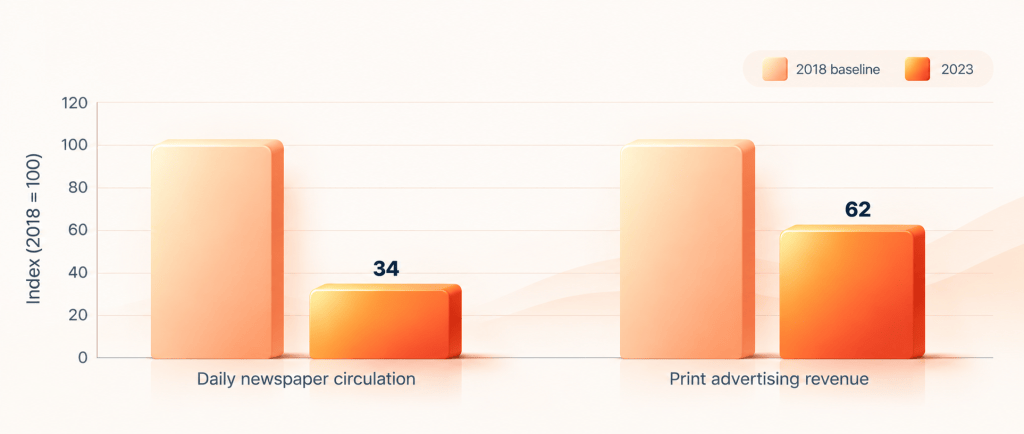
South Africa has the clearest public data. The Competition Commission’s Media and Digital Platforms Market Inquiry found that daily newspaper circulation fell 66% between 2018 and 2023, or 55% once weekend papers are included. Print advertising revenue across three large publishers fell 38% over the same five years.
These figures come from one market and measure the decline without pinning it on any single cause. For publishers who still rely mostly on print, they show how quickly that model can lose ground. The same pressure sits behind the move to direct reader revenue in our roundup of digital publishing trends.
What Does a Digital Edition Give the Publisher?
Most publishers already have what a digital edition needs: a newsroom, an established print product, a content management system, a recognized brand and a distribution footprint. An e-paper plugin presents each issue as a digital edition that works on a phone, tablet or desktop.
Readers get the familiar, browsable paper. The publisher gets a direct route to subscriptions, advertising, membership and first-party audience data, without handing the reader experience to a third-party platform.
The plugin model fits best when one group runs several titles, countries or business models. Each newsroom decides how its edition looks, what readers can access and how it charges, all from one shared product. For publishers on WordPress, the edition can sit inside the CMS the newsroom already uses, so articles, metadata and rights information carry straight into each issue. Our session on WordPress for publishers in 2026 covers how modern publishing stacks are set up around that kind of workflow.
What Should an E-Paper Plugin Let Publishers Configure?
Each item below is a setting a publisher should be able to change per title, without asking a developer to rebuild the product.
- Edition design: Each title sets its own page layouts, colors, masthead, navigation, article view, cover and branding.
- Publishing workflow: Editors import print-ready PDFs or assemble editions from CMS content, then schedule publication, corrections and archive access, with approvals and edition closing times built in.
- Reading experience: Readers switch between page-turn and article views, resize text, search, bookmark and share links in a light interface built for small screens.
- Access and pricing: Publishers set free, metered, subscriber-only or mixed access by title, issue, section or article, and connect local payment providers, cards, mobile money or an existing subscription system.
- Language and market: Each edition carries its own language, date and number formats, currency, time zone and regional versions, including right-to-left layouts where needed.
- Advertising and sponsorship: Sales teams sell edition sponsorships, page placements and campaign packages, with reports on delivery and engagement.
- Analytics and data: The plugin tracks issue opens, reading time, page and article engagement, search terms, subscription conversion and churn, subject to consent and local privacy law.
- Connectivity resilience: Pages stay light, images are compressed and interrupted reading picks up where it stopped.
- Governance and security: Admins manage roles across titles, keep an audit trail of publication actions, protect paid content and apply retention, consent and access rules for each market.
How Do You Design for Mobile Readers on Patchy Connections?
A digital edition has to work on a modest phone over a variable connection. In sub-Saharan Africa, GSMA puts the cost of an entry-level internet-enabled handset at 24% of monthly income on average in low- and middle-income countries. That means responsive layouts, compressed images, a low-data mode, a fast first load and clean recovery when the connection drops.
Offline reading helps regular subscribers, and it should be a deliberate product choice. Downloaded issues need expiry dates, account rules and content protection that the publisher can configure, along with limits that respect device storage.
Payments need the same care. The plugin should not assume every reader has an international credit card or wants a recurring subscription. Publishers may want single-issue purchases, bundles, institutional access, sponsored access or the payment methods people use locally.
Test on real devices before launch. A design that loads well on a flagship phone over fiber can fail on a budget handset with intermittent mobile data.
How Do You Move From Print Workflow to Digital Product?
We recommend five steps, starting with one title and adding the rest through configuration.
- Start with the audience: Map the devices, languages, connectivity patterns and payment preferences of your readers, and the needs of existing print subscribers.
- Connect to the source of truth: Integrate with the CMS and production process so each edition reuses existing content, metadata and rights information.
- Pilot one title: Launch with a representative publication and test it with readers, editors, circulation teams and advertisers.
- Measure commercial and editorial outcomes: Track activation, repeat reading, paid conversion, ad performance, support requests and the effect on print subscriptions.
- Expand by configuration: Add publications and countries through reusable settings, integrations and design options, so no title needs its own rebuild.
What Should Publishers Do Next?
An e-paper plugin will not solve every problem a publisher faces, and digital advertising alone may not replace print revenue. South Africa’s inquiry found that between 2018 and 2023, publishers’ losses in traditional advertising were 4 to 5 times larger than their gains in digital advertising and subscriptions.
That gap is the reason to build a wider reader relationship around the edition: subscriptions, newsletters, memberships, events, commerce or other services that fit the title and its community. Publishers worldwide are already moving this way. In WAN-IFRA’s World Press Trends Outlook 2024-2025 survey of more than 240 media executives, print circulation and advertising made up almost 45% of revenue on average, and revenue from other sources reached 23.8%, up 5 percentage points in a year. Our guide to publisher monetization covers more of those revenue streams.
As internet and mobile access keep growing across Africa, a configurable e-paper lets publishers make their journalism easier to reach and keep control of how readers experience it. The edition keeps what audiences value about print and adds the speed, convenience and commercial options of digital, in a channel each publisher can adjust as its readers change.
Multidots has 17+ years in enterprise WordPress, builds platforms for publishers and media brands, and is a WordPress VIP Premier Partner. If you are planning a digital edition for one title or a whole group, book 30-minute call with our team to talk through the build.
