

Key Takeaways
- Article and NewsArticle schema, JSON-LD, SEO plugins (Yoast, RankMath, AIOSEO), publish cadence, and page structure all showed no predictive value for AI citation.
- Out of 22 signals tested, only two survived: visible datestamps and complete Open Graph metadata.
- The signals you can template or game carry little trust value, because any site can fabricate them. The two that worked are harder to fake and proxy a genuinely maintained site.
- Even those two signals only explain part of the WordPress advantage. The rest traces to editorial culture no single tag can capture.
- If your AI visibility plan is built primarily on more structured markup, the data does not support it as your first move.
If your plan to get cited by AI search engines is “add more schema,” you are about to spend a quarter optimizing the wrong thing.
That is an uncomfortable claim, because structured data has been the reflexive answer to almost every visibility question for years. Want rich results? Add schema. Want AI engines to understand your content? Add more schema. It feels right. It is technical, it is measurable, and it gives a content team something concrete to ship.
We tested whether it actually works. Across 12,403 publisher domains and two AI engines, we measured 22 structural signals to see which ones predict AI citations. Schema was one of them. It did not survive.
Here is what the data actually showed, and what to do instead.
What Every SEO Team Is Investing In
Walk into most enterprise content operations and you will find a roadmap full of structured data work: Article and NewsArticle schema, JSON-LD across templates, SEO plugin configuration, breadcrumb markup, and a steady cadence of new posts because “freshness helps.”
Every one of those feels like it should improve how AI engines read and cite your content. They are the standard playbook, much of it carried over straight from traditional enterprise SEO. And the standard playbook is mostly built on assumption, not measurement, because until recently there was no clean way to measure what AI engines reward.
So we measured it.
What Showed No Effect
When we ran the regression controlling for traffic, a long list of the usual levers showed no meaningful predictive value for AI citation:
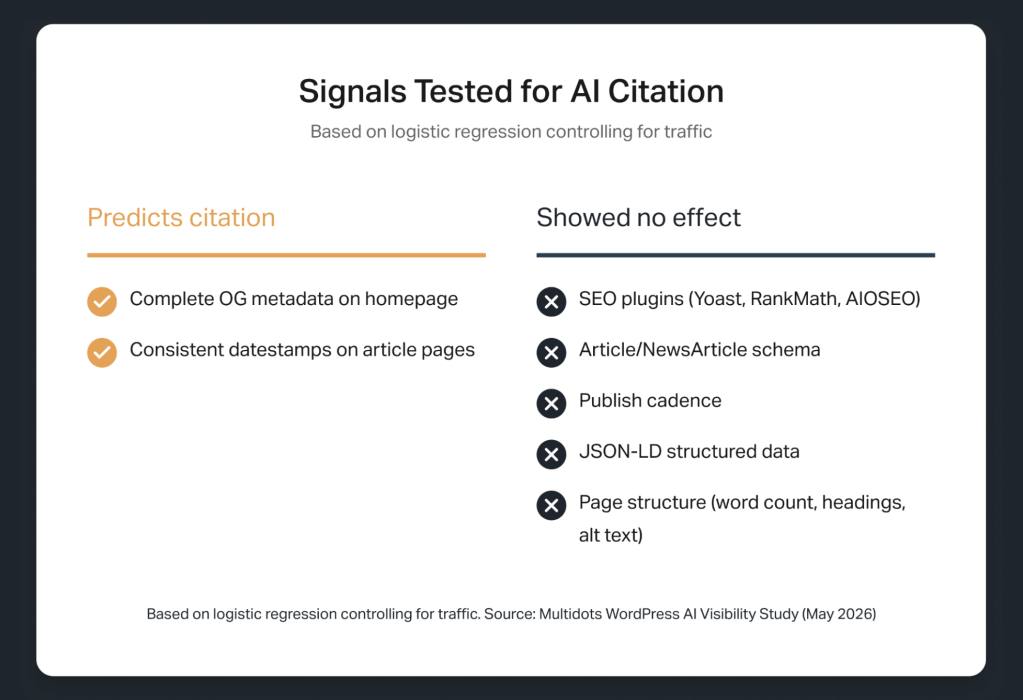
- SEO plugins (Yoast, RankMath, AIOSEO): no measurable effect.
- Article and NewsArticle schema markup: null.
- JSON-LD structured data: null.
- Publish cadence: null.
- Page structure (word count, headings, alt text): null.
- Crawl hygiene: null.
Read that list again, because it is most of what gets sold as AI visibility work. The signals you can see on the page, the ones that are easy to audit and easy to bill for, are largely not the signals moving the needle.
This does not mean schema is useless. Structured data still does real work for traditional rich results and for general machine readability, and it belongs in any healthy technical SEO setup. The point is narrower and more important: as a lever for getting cited by AI search engines, the data does not support treating it as your primary move. If you are pouring resources into schema specifically for AI visibility, you are optimizing a signal that did not correlate with the outcome you want.
Download the Enterprise CMS AI Visibility Report
The complete findings cover vertical breakdowns, all 22 structural signals tested, and a tier-by-tier comparison of every major enterprise CMS platform.

What Actually Predicted Citations
Out of 22 signals, only two survived with statistical significance. Neither is glamorous.
Visible datestamps on article pages. Whether a publish or update date is shown to readers and present in the markup. WordPress themes apply this by default. Many enterprise CMS builds strip it during implementation. To an AI engine, it is a freshness signal, and removing it removes a cue the model uses to decide whether to trust your content.
Complete Open Graph metadata. Whether your homepage and key pages carry the full set of OG tags. Complete OG metadata reliably predicted a higher citation probability. It is a clean, machine-readable summary of what a page is, and the platforms that ship it complete by default got cited more.
That is the whole list of structural winners. Two unglamorous defaults, both of which most teams ignore because they are too simple to feel like strategy.
Why the Obvious Signals Lose to the Boring Ones
There is a reason the page-level signals everyone optimizes did not predict citations, while two quiet defaults did.
The signals you can stuff, template, and game are exactly the ones that carry little trust value, because everyone can produce them. Schema can be generated automatically. Word counts can be padded. Headings can be added. An AI retrieval system trying to decide which sources are credible cannot lean heavily on signals that any site can fabricate.
Datestamps and complete OG metadata are weaker to game and more correlated with how genuinely maintained a site is. They are small proxies for a real publishing operation. That is the pattern underneath the numbers, and it points to something bigger than any single tag.
The Part the Two Signals Do Not Explain
Here is the twist that reframes the whole exercise. Even the two winning signals only account for part of the gap we measured between WordPress and enterprise CMS platforms.
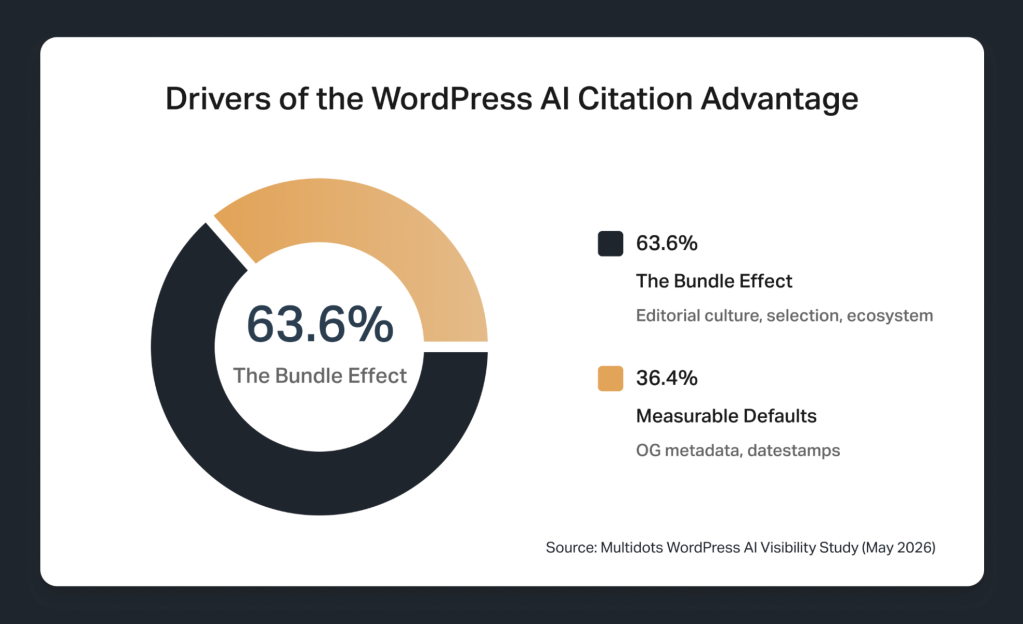
After controlling for those structural defaults, a significant advantage remained that the crawl data could not explain. It traces to editorial culture: the publishing habits, the editorial speed, and the content standards that grow around a platform. The regression can measure that effect but cannot name it in a single tag, which is precisely why no amount of schema closes it.
That is the real lesson for anyone chasing AI visibility through markup. You are trying to win a trust signal with a technical lever, and trust is not a technical property. The full report unpacks how much of the advantage is structural, how much is editorial, and what that means for where you should actually spend your effort.
What to Do Instead
Here are a few steps to take:
- Stop treating schema as your AI visibility strategy. Keep it for what it is genuinely good at, and stop expecting it to drive citations.
- Fix the two signals that did correlate: surface your datestamps, complete your OG metadata.
- Audit your own citation rate by running your key questions through ChatGPT and Google AI Overviews, then benchmark against the traffic-tier data in the report. A structured SEO audit is a good place to fold this in.
- Have a harder conversation about editorial culture and platform defaults, because that is where the majority of the gap actually lives, and where a platform migration changes your baseline.
Ready to transform your digital presence without the risk? Book your CMS consultation with Multidots today to learn how our AI-powered migration services can help you achieve a flawless and efficient transition.