
Key Takeaways
- TYPO3’s EOL and ELTS cycles are pushing enterprises to reassess long-term CMS costs.
- WordPress offers the strongest balance of editorial autonomy, ecosystem maturity, and migration simplicity.
- Sanity fits enterprises moving toward composable, omnichannel, API-first content architecture.
- Drupal works best for teams needing open-source flexibility, complex content models, and granular permissions.
- Migration success depends on content mapping, SEO preservation, multilingual structure, and custom functionality replacement.
If you run on TYPO3, 2026 is a decision year whether you planned for it or not. TYPO3 v11 dropped to paid-only extended support back in October 2024. Free security support for v12 ended in April 2026. And v13’s active support window closes on June 30, 2026. Whichever version you are on, the clock is either already past zero or counting down fast, and your only two options are to start paying for Extended Long-Term Support (ELTS) or take on a major-version upgrade that, on TYPO3, is closer to a rebuild than a patch.
You are not alone in asking whether the upgrade is even worth it. A growing number of teams are looking past the next ELTS invoice and asking a bigger question: should we still be on TYPO3 at all?
It is a fair question. TYPO3 is capable enterprise software, but it carries real structural costs, a relentless end-of-life treadmill, a custom configuration language in TypoScript, and a talent pool concentrated almost entirely in Germany, Austria, and Switzerland. Over the last 17 years at Multidots, we have helped hundreds of enterprise teams migrate off legacy and regional platforms, and the pattern around TYPO3 is consistent: the platform works, but the cost of keeping it staffed, upgraded, and supported keeps climbing.
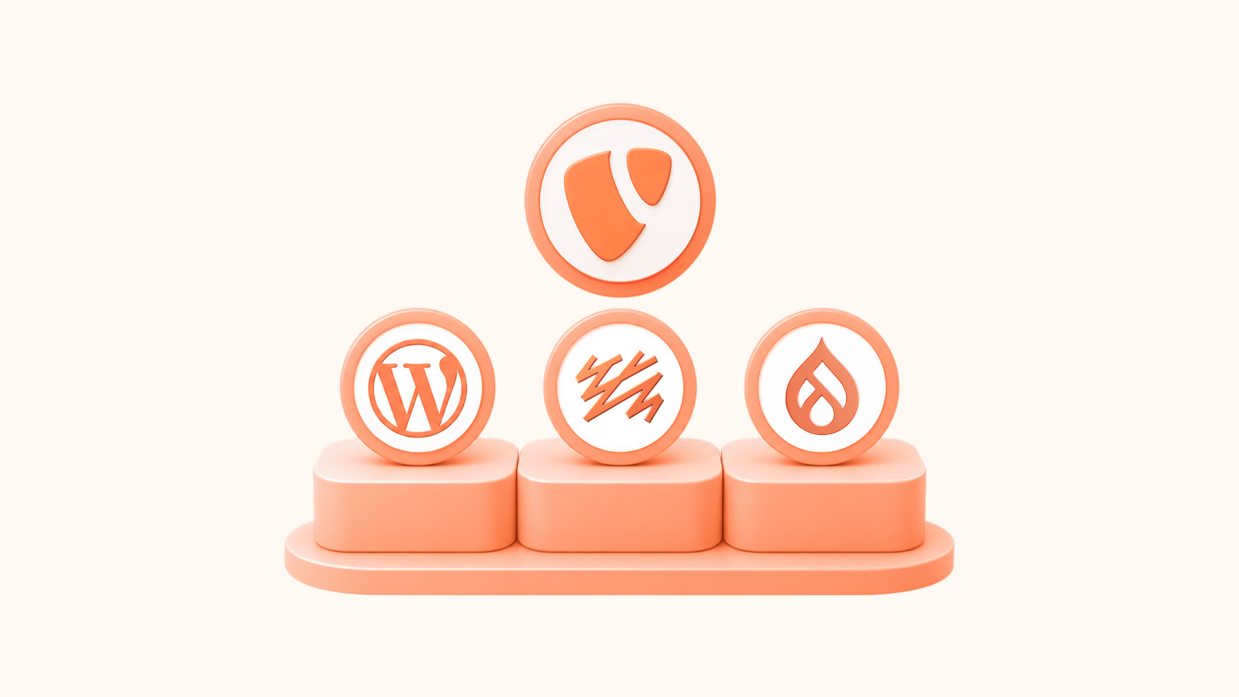
This guide breaks down three enterprise-grade alternatives to TYPO3: WordPress, Sanity, and Drupal. For each, we cover real cost comparisons, feature analysis, migration complexity, and the scenarios where each platform makes the most sense. Whether you are a CTO weighing another ELTS renewal, a marketing lead frustrated with editorial friction, or an IT director planning the next three years, the goal is simple: help you make an informed decision before the deadline makes it for you.
What TYPO3 Offers (And Why Companies Are Looking Elsewhere)
TYPO3 is an open-source, PHP-based enterprise CMS created by Kasper Skårhøj in 1998 and governed by the TYPO3 Association. It built its reputation on the enterprise and public-sector market in the German-speaking world, where granular permissions, multilingual handling, and deep configurability matter.
Core features
TYPO3’s strengths reflect its enterprise, developer-driven heritage.
- Granular access control: Fine-grained, role-based permissions designed for large organizations with complex editorial hierarchies.
- Strong multilingual support: Mature multi-language and multi-site handling, a major reason it took hold across pan-European organizations.
- Configurability through TypoScript: A custom configuration language that gives developers deep control over rendering and behavior.
- Multi-site management: A single installation can run many sites and domains, useful for organizations managing multiple brands or regions.
- Enterprise governance: A structured release model with defined LTS versions and a formal security team.
Pricing and costs
TYPO3 itself is free and open source, but the real costs sit elsewhere. Specialized TYPO3 development talent is scarce outside the DACH region, which keeps rates high and hiring slow. On top of that, staying secure past a version’s free support window means paying for ELTS, TYPO3’s commercial extended-support program, which buys time but not a way off the treadmill. When you add specialized development, hosting, and recurring extended-support fees, the total cost of ownership for an enterprise TYPO3 implementation runs well into six figures over a typical multi-year cycle.
Where TYPO3 falls short
Despite its capabilities, TYPO3 presents several challenges that increasingly push enterprise teams to look elsewhere.
- The end-of-life treadmill never stops. Per the TYPO3 end-of-life schedule, v11 free support ended in October 2024, v12 free security support ended in April 2026, and v13 active support ends June 30, 2026. Every couple of years you either pay for ELTS or fund a major upgrade.
- Major upgrades are effectively rebuilds. Moving across major versions frequently means rewriting TypoScript, updating or replacing extensions, and reworking templates. The effort to stay on TYPO3 often rivals the effort to leave it.
- TypoScript is a steep, specialized wall. TYPO3’s reliance on its own configuration language gives it a notoriously steep learning curve, slowing both editors and new developers.
- The talent pool is tiny and regional. Around 77% of TYPO3 sites are in Germany, with most of the rest in Austria and Switzerland. Outside DACH, qualified TYPO3 developers are hard to find and expensive to retain.
- Shrinking global mindshare. TYPO3 sits at roughly 0.4% of all websites and 0.5% of sites with a known CMS (W3Techs, June 2026). Fewer agencies specialize in it, and community momentum has narrowed to its regional base.
- Smaller extension ecosystem. The TYPO3 extension repository is a fraction of what mainstream platforms offer, so more requirements end up as custom development.
When staying on TYPO3 still makes sense
TYPO3 remains a defensible choice for organizations with deeply complex content models, strict multilingual and permission requirements, and an in-house team that already knows the platform, particularly within the DACH region where the talent and agency ecosystem is strongest. If you have that expertise on staff and your content architecture genuinely requires TYPO3’s depth, it still delivers. But for most teams, especially those operating outside German-speaking markets, the cost-benefit math has shifted.
Why Enterprises Are Migrating from TYPO3
Here are the core reasons enterprise teams are moving off TYPO3, each with the data behind it.
1. The Recurring End-of-Life and ELTS Treadmill
TYPO3’s release model means a forced decision every few years. With v11 already on paid-only support, v12’s free security window closed, and v13 reaching the end of active support on June 30, 2026, most of the install base is at or near a cutover point right now.
| Release | Released | Active Support | Security Support | Extended Long Term Support | Latest |
|---|---|---|---|---|---|
| 14 | 7 months ago (25 Nov 2025) | Ends in 1 year and 6 months (31 Dec 2027) | Ends in 3 years (30 Jun 2029) | Ends in 6 years (30 Jun 2032) | 14.3.4 (16 Jun 2026) |
| 13 | 2 years and 5 months ago (30 Jan 2024) | Ends today (30 Jun 2026) | Ends in 1 year and 6 months (31 Dec 2027) | Ends in 4 years and 6 months (31 Dec 2030) | 13.4.32 (16 Jun 2026) |
| 3 years and 9 months ago (04 Oct 2022) | Ended 1 year and 8 months ago (31 Oct 2024) | Ended 2 months ago (30 Apr 2026) | Ends in 2 years and 10 months (30 Apr 2029) | ||
| 5 years ago (22 Dec 2020) | Ended 3 years ago (31 Mar 2023) | Ended 1 year and 8 months ago (31 Oct 2024) | Ends in 1 year and 4 months (31 Oct 2027) | ||
| 6 years and 11 months ago (23 Jul 2019) | Ended 4 years and 8 months ago (31 Oct 2021) | Ended 3 years ago (30 Apr 2023) | Ended 2 months ago (30 Apr 2026) | ||
| 9 | 8 years ago (12 Dec 2017) | Ended 6 years ago (30 Apr 2020) | Ended 4 years and 9 months ago (30 Sep 2021) | Ended 1 year and 9 months ago (30 Sep 2024) | |
| 8 | 10 years ago (22 Mar 2016) | Ended 7 years ago (30 Sep 2018) | Ended 6 years ago (31 Mar 2020) | Ended 2 years and 3 months ago (31 Mar 2024) | |
| 7 | 11 years ago (02 Dec 2014) | Ended 9 years ago (01 Apr 2017) | Ended 7 years ago (01 Dec 2018) | Ended 3 years and 7 months ago (30 Nov 2022) |
ELTS extends critical fixes for a fee, but it is temporary and you are paying to keep a deprecated version alive while the eventual upgrade or migration still waits. For many organizations, the ELTS invoice is the moment they finally price out moving to a platform without the treadmill.
2. Editorial Friction and Slow Time to Market
TYPO3’s power comes with complexity that content teams feel daily. The backend and its TypoScript-driven configuration were built for developers, not marketers, so routine changes, new landing pages, and campaign updates frequently route back through development. For teams that need to publish and iterate quickly, that friction is a direct cost. Every hour an editor spends fighting the interface is an hour not spent on content strategy and growth.
3. The Ecosystem and Tooling Have Moved On
The broader market has consolidated around a handful of platforms with deep ecosystems, and TYPO3 is not one of them. With a small extension repository and shrinking global share, TYPO3 teams more often build custom what other platforms offer off the shelf, from SEO tooling to integrations to page building. Migrating is increasingly a move toward where the tooling, talent, and community investment already are, with a mature enterprise tier available through WordPress VIP for teams that need it.
The 3 Enterprise Alternatives to TYPO3
Here are the three platforms enterprise teams most often evaluate when leaving TYPO3.
1. WordPress
WordPress powers 41.5% of all websites and 59.3% of sites running a known CMS. Far past its blogging origins, it now runs enterprise publishers, Fortune 500 brands, universities, and government agencies through platforms like WordPress VIP. Its block editor (Gutenberg) gives content teams a modern visual experience, and its ecosystem of 59,000+ plugins covers virtually every enterprise requirement, from multilingual to permissions to integrations.
2. Sanity
Sanity is a headless CMS built around structured content and omnichannel delivery. Content lives as structured data in a real-time, globally distributed Content Lake, making it portable across websites, apps, and connected experiences. For TYPO3 teams already comfortable with structured content modeling and developer-driven workflows, Sanity offers a conceptually familiar approach rebuilt for modern composable architecture.
3. Drupal
Drupal is an open-source, PHP-based CMS known for flexibility, granular permissions, and complex content modeling, much of the same territory TYPO3 occupies. For teams that want to stay open-source and developer-centric but leave the TYPO3 treadmill, Drupal is the closest like-for-like move, with a larger global community than TYPO3 behind it.
The critical difference
These three take fundamentally different shapes:
- WordPress is a full, self-contained CMS that handles both content management and delivery, with the largest ecosystem and the gentlest editorial learning curve.
- Sanity is a headless content backend that requires a separate front end, best for teams going composable and omnichannel.
- Drupal is the closest open-source peer to TYPO3, a fit for teams that specifically want to keep a developer-driven, on-premise-capable, PHP-based platform.
Your choice depends on your team’s capabilities, your delivery requirements, and how much complexity you actually need.
Alternative 1: WordPress (Recommended for Most Enterprises)
WordPress is the world’s most widely adopted CMS. For teams migrating from TYPO3, it offers the largest ecosystem and talent pool in the industry, a content editing experience that does not require developer tickets for everyday publishing, and an escape from the recurring end-of-life treadmill.
Cost Comparison
Because TYPO3’s cost lives in specialized talent and recurring extended support rather than license fees, the most meaningful comparison is total cost of ownership, not sticker price.
Year 1 Total Cost: WordPress projects draw from an open, competitive market for both development and hosting, versus TYPO3’s scarce, premium-priced specialist talent and recurring ELTS fees once a version ages out.
- Licensing: Both are free and open source at the core, so the difference is everything around them.
- Development: WordPress taps the largest global talent pool of any CMS, with senior salaries of $100,000 to $150,000 and deep freelance and agency markets. TYPO3 talent is scarce and concentrated in DACH.
- Hosting: Open market, with WordPress VIP available for enterprise-grade needs, versus TYPO3’s more specialized hosting requirements.
- Ongoing support: No ELTS-style treadmill, regular updates are part of the mainstream ecosystem.
Average savings: Teams moving from a talent-scarce, ELTS-bound TYPO3 setup to WordPress typically see meaningful TCO reduction over three years, driven primarily by competitive development rates and the elimination of recurring extended-support fees.
Key Features for Enterprise Teams
WordPress matches or exceeds TYPO3 on the capabilities enterprise teams care about, with far lower implementation friction.
- Block editor (Gutenberg): A visual, component-based editor that lets content teams build and publish pages without touching code or TypoScript.
- Multilingual and multi-site: WordPress Multisite plus mature multilingual plugins cover the multi-region, multi-language scenarios TYPO3 is often chosen for.
- Granular roles and permissions: Role-based access control, extendable to fine-grained, field-level permissions for complex editorial hierarchies.
- REST API and GraphQL: Full headless and decoupled capabilities for teams that need to deliver to multiple front ends.
- Massive plugin ecosystem: 59,000+ plugins covering SEO, integrations, security, and more, so fewer requirements become custom builds.
- Enterprise hosting and compliance: WordPress VIP provides enterprise-grade hosting, security scanning, and code review for organizations with strict requirements.
- Performance and SEO: Strong performance optimization and deep SEO capabilities through mature, well-supported tooling.
When WordPress Makes Sense
WordPress is the strongest TYPO3 alternative when:
- You want the lowest-risk path off the TYPO3 end-of-life treadmill
- Editorial and marketing teams need to publish and iterate without developer involvement
- You operate outside the DACH region and want a large, competitive talent pool
- SEO and organic traffic are primary growth channels
- You manage multiple sites, brands, or languages from a central platform
- You want a mainstream ecosystem with enterprise hosting options like WordPress VIP
Migration Complexity: Low to Moderate
TYPO3 to WordPress is a well-understood path, and because both are open-source and PHP-based, much of the underlying content maps cleanly.
Timeline: 8 to 16 weeks for most enterprise migrations.
Risk level: Low to moderate, owing to mature tooling and a large talent pool experienced in both platforms. The core work involves content migration (pages, content elements, media, multilingual content), URL structure mapping and 301 redirects, a theme build on WordPress block architecture, replacing TypoScript-driven functionality and custom extensions with plugins or custom development, SEO preservation including metadata and schema, and migrating users and permissions.
Important Consideration: The hardest part of a TYPO3 migration is rarely the content, it is faithfully reproducing the TypoScript-driven behaviors and multilingual structures your site relies on, and preserving SEO equity through a clean redirect map. Get those wrong and you leak traffic; get them right and the move is largely invisible to readers.
As a WordPress VIP Gold Partner with 1000+ migrations completed, Multidots brings proven enterprise platform migration methodology to transitions like this. Our team handles content mapping, SEO preservation, custom development, and post-migration support. You can see examples of our work in our case studies.
WordPress for Enterprises: Learn the Secret Sauce of Big Enterprise WordPress Websites
An In-Depth Look at the Engineering and Design Behind Billion-Dollar Enterprises’ WordPress Websites


Alternative 2: Sanity (Best for Omnichannel, Composable Delivery)
Sanity is a content operating system built API-first for the modern web. It stores content as structured data in a real-time, globally distributed Content Lake, making it truly portable across websites, mobile apps, and connected experiences.
For TYPO3 teams already comfortable with structured content modeling and developer-driven workflows, Sanity offers a conceptually familiar approach rebuilt for today’s composable architecture demands, though it asks more of your front-end engineering.
Key Features for Enterprise Teams
Sanity’s feature set is built around content portability and developer flexibility, with every capability designed API-first.
- Real-time collaborative editing: Sanity Studio supports simultaneous editing with presence indicators and conflict resolution.
- Structured content modeling: Content is stored as structured data, not page-bound HTML, making it truly portable across channels and devices.
- GROQ query language: A precise, developer-friendly query language for fetching exactly the content each surface needs.
- Customizable editing environment: Sanity Studio is built in React and can be fully tailored to your editorial workflow with custom components and validation.
- Content Lake: A hosted backend that handles scaling, CDN distribution, and API delivery without infrastructure management.
- Portable Text: A specification for rich text stored as structured data, enabling consistent rendering on any front end.
When Sanity Makes Sense
Sanity is the strongest TYPO3 alternative when:
- Your content needs to reach three or more channels (web, apps, digital signage, connected experiences)
- Your development team has strong React, Next.js, or modern JavaScript capability
- Real-time collaborative editing across distributed teams is a core requirement
- You are deliberately building a composable, API-first architecture
- Content structure and portability matter more than out-of-the-box website features
Migration Complexity: Low to Moderate
Moving from TYPO3 to Sanity means redesigning your content model and building a new front end, but mature tooling and clear schemas keep the risk contained.
Timeline: 12 to 22 weeks for enterprise migrations.
Risk level: Low to moderate, with the main effort sitting in the separate front-end build rather than the content migration itself. The core work involves redesigning content into Sanity document schemas, scripted content migration, a front-end build in a JavaScript framework (the largest single effort), API and query development, URL preservation through new routing, SEO implementation in the front-end layer, and team training on Sanity Studio.
Important Consideration: Sanity is not a drop-in replacement for TYPO3. It is a content backend, so you will need a separate front end, hosting for it, and developers comfortable with modern JavaScript. Pricing is transparent up front, Free at $0, Growth at $15 per seat per month, and custom Enterprise contracts that can run into six figures annually, but the real cost is the front-end engineering you take on. The payoff is significant for teams with genuine omnichannel requirements and the talent to support them.
Alternative 3: Drupal (Best for Staying Open-Source and Developer-Centric)
Drupal is an open-source, PHP-based CMS known for flexibility, granular permission systems, and the ability to handle complex content architectures, much of the same ground TYPO3 covers. For teams that specifically want to stay open-source and developer-driven but get off the TYPO3 treadmill, Drupal is the closest like-for-like move.
Key Features for Enterprise Teams
Drupal’s strengths center on technical flexibility and enterprise-grade content modeling.
- Custom content types and taxonomies: Drupal’s entity system can model virtually any content structure, comparable to what TYPO3 teams build today.
- Granular access control: Role-based permissions configurable down to field-level access, a direct match for TYPO3’s permission depth.
- Strong multilingual support: Built-in translation workflows with support for complex locale configurations, one of the main reasons teams chose TYPO3 in the first place.
- API-first options: JSON:API and GraphQL modules support headless and decoupled delivery.
- Enterprise security and compliance: A dedicated security team and compliance-ready configurations for regulated sectors.
- Larger global community: Drupal’s community and agency ecosystem is bigger and less regionally concentrated than TYPO3’s.
When Drupal Makes Sense
Drupal is the strongest TYPO3 alternative when:
- You want to remain on an open-source, PHP-based, self-hostable platform
- Your content model is genuinely complex and requires deep entity and permission control
- Multilingual and granular access are hard requirements you are unwilling to compromise
- You have, or can hire, developers comfortable with a technical, developer-driven CMS
- You value staying close to TYPO3’s architecture while gaining a larger talent pool
Migration Complexity: Moderate
Because TYPO3 and Drupal share a developer-centric, complex-content philosophy, the content concepts map reasonably well, but it remains a full rebuild of templates and configuration.
Timeline: 10 to 18 weeks for enterprise migrations.
Risk level: Moderate. The core work involves redesigning content into Drupal entities and fields, scripted content migration, a theme rebuild, replacing TypoScript-driven logic and TYPO3 extensions with Drupal modules or custom code, multilingual and permission configuration, SEO preservation, and team training on the Drupal admin.
Important Consideration: Drupal solves the TYPO3 treadmill and talent-concentration problem, but it does not solve the underlying complexity, it is still a technical, developer-driven platform with its own learning curve and its own major-version upgrade history. If your goal is to reduce editorial friction and developer dependence, WordPress is usually the better fit. Drupal makes the most sense when keeping deep, open-source configurability is non-negotiable.
Final Comparison: TYPO3 vs WordPress vs Sanity vs Drupal
Here is how the alternatives compare across the factors that matter most when leaving TYPO3.
| Dimension | TYPO3 | WordPress | Sanity | Drupal |
|---|---|---|---|---|
| Best For | Complex DACH-centric enterprise sites | Content-driven sites, marketing teams, multi-site | Omnichannel, composable delivery | Open-source teams needing deep content modeling |
| Implementation Time | — | 8 to 16 weeks | 12 to 22 weeks | 10 to 18 weeks |
| Editorial Experience | Complex, TypoScript-driven | Intuitive block editor, low learning curve | Customizable, developer-configured | Complex, requires training |
| Developer Talent Pool | Scarce, regional (DACH) | Largest of any CMS | Modern JS developers | Moderate, global |
| E-commerce | Limited | Strong (WooCommerce) | Requires custom front-end build | Limited (Drupal Commerce) |
| SEO & Marketing | Custom-heavy | Excellent (mature tooling) | Depends on front-end build | Good with modules |
| Vendor Lock-in | Low (open source) | Low (open source, portable) | Moderate (Content Lake) | Low (open source) |
| Ongoing Support Model | EOL/ELTS treadmill | Mainstream, continuous | Managed SaaS | Major-version cycles |
| Extension Ecosystem | Small | 59,000+ plugins | App ecosystem | Moderate module library |
Making Your Decision: Which Alternative Is Right for You?
After working with hundreds of enterprise teams over 17 years, I have noticed clear patterns in which alternatives work best for which scenarios.
Choose WordPress if:
- You want the lowest-risk, fastest path off the TYPO3 end-of-life treadmill
- Editorial and marketing teams need autonomy to publish without developer tickets
- You operate outside DACH and want the broadest, most competitive talent pool
- SEO, organic traffic, and a mainstream ecosystem matter to your long-term plan
- You manage multiple sites, brands, or languages and want enterprise hosting options like WordPress VIP
Choose Sanity if:
- You are delivering content to three or more distinct channels and need true portability
- Your team has strong React/JavaScript capability and wants a composable architecture
- Real-time collaborative editing is a core workflow requirement
- You are comfortable building and operating a separate front end for the flexibility you gain
Choose Drupal if:
- Staying open-source, PHP-based, and self-hostable is a hard requirement
- Your content model genuinely needs deep entity, permission, and multilingual control
- You have or can hire developers comfortable with a technical, developer-driven CMS
- You want to stay close to TYPO3’s architecture while gaining a larger global community
For most enterprise teams leaving TYPO3, WordPress delivers the strongest combination of editorial experience, ecosystem maturity, cost efficiency, and migration simplicity. Sanity and Drupal are genuinely strong options, Sanity for composable omnichannel needs, Drupal for teams that must stay deeply open-source and developer-centric, but for the majority of TYPO3 migrations, WordPress is the recommendation we make most often, and the results from enterprise WordPress implementations consistently back that up.
Ready to Explore Your Options?
If your team is weighing another ELTS renewal against a migration, the first step is understanding exactly what your move involves: content audit, multilingual and permission mapping, SEO risk assessment, custom functionality replacement, and timeline planning.
Multidots is a WordPress VIP Gold Partner with 17+ years of enterprise WordPress experience and 1000+ successful migrations, including complex, multilingual transitions from open-source and legacy platforms. Our methodology preserves your SEO equity, maps your content architecture precisely, reproduces the behaviors your team relies on, and gets your editors productive quickly.
Get in touch with our team for a free migration assessment. We will review your current TYPO3 setup, identify risks and opportunities, and provide a written recommendation with a timeline and cost estimates. No sales pitch, no pressure.