
Key Takeaways
- If Substack fees are creeping toward $6,000 a year, it’s time to consider alternative platforms to publish your content.
- Prioritize platforms that allow you to own your content. Your domain, SEO equity, subscriber data, and monetization options become much more valuable as your audience grows.
- If email is your business, relying entirely on infrastructure you can’t control can become a hidden risk.
- If most of your new readers arrive via search, social, or referrals rather than Substack recommendations, switching platforms is usually much less disruptive.
The move away from Substack has happened in two waves. The first hit in early 2024, when a public letter from Substackers Against Nazis put the platform’s moderation choices under the spotlight and prompted several prominent writers to leave. The second arrived in 2025 – quieter, but much louder commercially. High-profile writers Petersen, Lenz, and Sole-Smith moved to Patreon, joining a growing list of high-earning creators who’d run the numbers and decided to go elsewhere.
Substack’s subscriber and revenue numbers are still growing. This isn’t a platform collapse story. It’s a growth story – specifically for publishers who are reaching a point where Substack’s offering no longer meets their needs.
This guide covers the commercial, operational, and platform-trust reasons behind that decision, and what a move to WordPress actually costs, requires, and recovers.
The Commercial Reasons Writers are Leaving
The moderation controversies get the headlines. For most creators, though, the decision is usually more practical: what does Substack cost, and what do you actually get in return?
For publishers at scale, those numbers are becoming increasingly difficult to justify.
The 10% Fee Becomes a Serious Cost at Scale
Substack takes 10% of all paid subscription revenue, with no cap. At modest volumes, that’s often a reasonable trade for avoiding infrastructure headaches. At larger volumes, it’s one of the largest line items in a creator’s operating costs:
- $2,000/month revenue: $2,400/year to Substack
- $5,000/month revenue: $6,000/year to Substack
- $10,000/month revenue: $12,000/year to Substack – and climbing from there.
Platformer’s Casey Newton has publicly said that leaving Substack saves his publication tens of thousands of dollars annually. That figure isn’t unusual at the top end of the creator economy.
Once platform fees cost more than running your own infrastructure, the case for staying becomes harder to make.
Email Deliverability is Quietly Declining
Substack’s core pitch is simple: direct access to subscribers’ inboxes. But there are limitations. Substack acknowledged open-rate reporting issues affecting some publishers, which sparked wider concerns around deliverability on the shared sending infrastructure every Substack newsletter relies on.
Because publishers can’t switch ESPs, manage their own sending reputation, or properly diagnose delivery problems, they have relatively little control when deliverability issues arise. Instead, they must rely on Substack to investigate and resolve issues within infrastructure they can’t directly access or manage.
No Automation, Segmentation, or List Control
Substack was built for publishing. As newsletters grow, that becomes more limiting. There’s no email automation, subscriber segmentation, or way to tailor content around subscriber behavior or interests. Everyone receives the same content, at the same time, in the same format.
Welcome sequences, trigger-based workflows, and interest tagging are either unavailable or significantly more limited than in dedicated email marketing platforms.
The Subdomain Model Weakens SEO and Brand
Publishing on yourname.substack.com means Substack builds the domain authority from your content, and you don’t. As Born Without Borders and others have pointed out, years of publishing on a Substack subdomain build equity into an asset you don’t own and can’t take with you. While Substack now supports custom domains, they require an additional fee, are still served via a subdomain, and don’t fully remove the platform dependency that comes with publishing on Substack.
Add in heavy JavaScript rendering and inconsistent metadata handling, and content that should rank in search often struggles to surface. Although these aren’t insurmountable SEO limitations, they do add friction compared to platforms that give publishers full control over rendering and metadata.
The Platform Shift Writers Didn’t Sign Up For
Substack launched as a clean, writer-owned email tool without algorithms or ads – just a direct line between a writer and their subscribers. That positioning deliberately rejected the attention-economy mechanics that had already made so many platforms exhausting to use.
The platform today looks quite different.
Notes introduced a social feed with its own engagement dynamics. The mobile app pushed content discovery further toward platform growth goals. And Eric Matthes, writing at Mostly Python, documented what he describes as dark patterns nudging writers into Notes participation and engagement loops – mechanics designed around platform metrics as much as subscriber relationships.
The business trajectory makes this shift pretty clear. In July 2025, Substack raised $100 million at a $1.1 billion valuation. By December, it had launched a native advertising pilot, directly reversing the anti-advertising stance that helped define the platform in the first place.
Months earlier, a lead investor had already described advertising as “a massive opportunity.” For writers who joined specifically because there were no ads, it was.
Where Users Are Going Instead
There’s no single destination replacing Substack. Where creators land depends on what they care about most: ownership, growth tools, community features, or cost structure. Each alternative solves a different subset of the frustrations covered above.
Ghost
Ghost is the closest structural alternative for writers focused on ownership.
It charges a flat monthly fee based on subscriber count, takes no revenue share, and doesn’t use discovery algorithms to push engagement metrics. It’s also open source, meaning self-hosted Ghost gives publishers full infrastructure control.
Platformer, Webworm, and Mostly Python all moved to Ghost. The common thread across those departures is ownership – writers built valuable audiences and decided they wanted ownership of the asset they created.
Patreon
Patreon takes 5–12% of revenue depending on your plan, but offers community tools, tiered memberships, and human customer support that Substack lacks. It’s also solving a different problem.
Patreon is built around recurring memberships rather than newsletter publishing, which makes it a better fit for creators whose audiences behave more like communities than readerships. Petersen, Lenz, and Sole-Smith all made the move, drawn by the membership economics and stronger community infrastructure.
Beehiiv
Beehiiv takes zero revenue share on paid subscriptions. As a publisher, you keep 100% of what you bring in minus standard Stripe processing fees – a meaningful difference once subscription revenue starts growing.
Beehiiv was designed specifically for newsletter growth, with subscriber segmentation, automation workflows, referral programs, and deeper analytics than Substack offers. For creators treating newsletters like a growth engine rather than simply a publishing tool, Beehiiv is considerably more capable.
Self-hosted WordPress
WordPress itself has no licensing fee, and takes no revenue share. But you’ll still need to pay for hosting, maintenance, security, and any premium plugins or services you choose to use. Publishers own their domain, subscriber list, SEO equity, and monetization model outright. The trade-off is more setup and maintenance. If you have an established audience and long-term independence in mind, that trade-off is often worth it.
Download a Free Actionable Guide: 45+ Actionable Tips to Boost WordPress Speed for High-Traffic Sites (Includes Impact Score)
What Moving to WordPress Involves
The financial case for leaving Substack is often clear before a publisher starts researching the move. The operational reality is where most underestimate the work, and where smooth migrations separate themselves from painful ones.
A successful migration means preserving comments and community history, categories, tags, authors, publication dates, and SEO signals, while carefully managing DNS and domain changes to avoid unnecessary downtime or search visibility losses. The more content and audience engagement you’ve built up, the more important it becomes to plan the migration properly from the outset.
SEO Preservation
Preserving rankings means mapping old URLs to their new destinations with 301 redirects, retaining metadata, canonical tags, publication dates, categories, and internal links where appropriate, updating XML sitemaps, carefully managing DNS and domain changes, and monitoring Google Search Console for crawl errors and indexing issues after launch.
For publishers moving to a new domain, protecting existing backlink equity is particularly important, as even small technical oversights can lead to unnecessary traffic losses. While no migration is entirely risk-free, a well-planned process can preserve the vast majority of organic performance and, in many cases, create opportunities to improve your technical SEO and site architecture at the same time.
Cost Comparison at Scale
The math on Substack is simple: The platform takes 10% of paid subscription revenue, forever, with no ceiling. For example:
- At $2,000/month revenue: $2,400/year to Substack.
- At $5,000/month revenue: $6,000/year to Substack.
- At $10,000/month revenue: $12,000/year to Substack.
On WordPress, the cost structure looks entirely different. Managed hosting can be tens of thousands of dollars annually for enterprise publishers, depending on traffic, infrastructure, and support requirements. Add an ESP like Mailchimp or Kit, and you’re looking at additional costs that can range from a few hundred dollars per year for smaller publishers to significantly more for enterprise publishers, depending on list size and features. There is no revenue share at any level.
Running Both in Parallel as a Stepping Stone
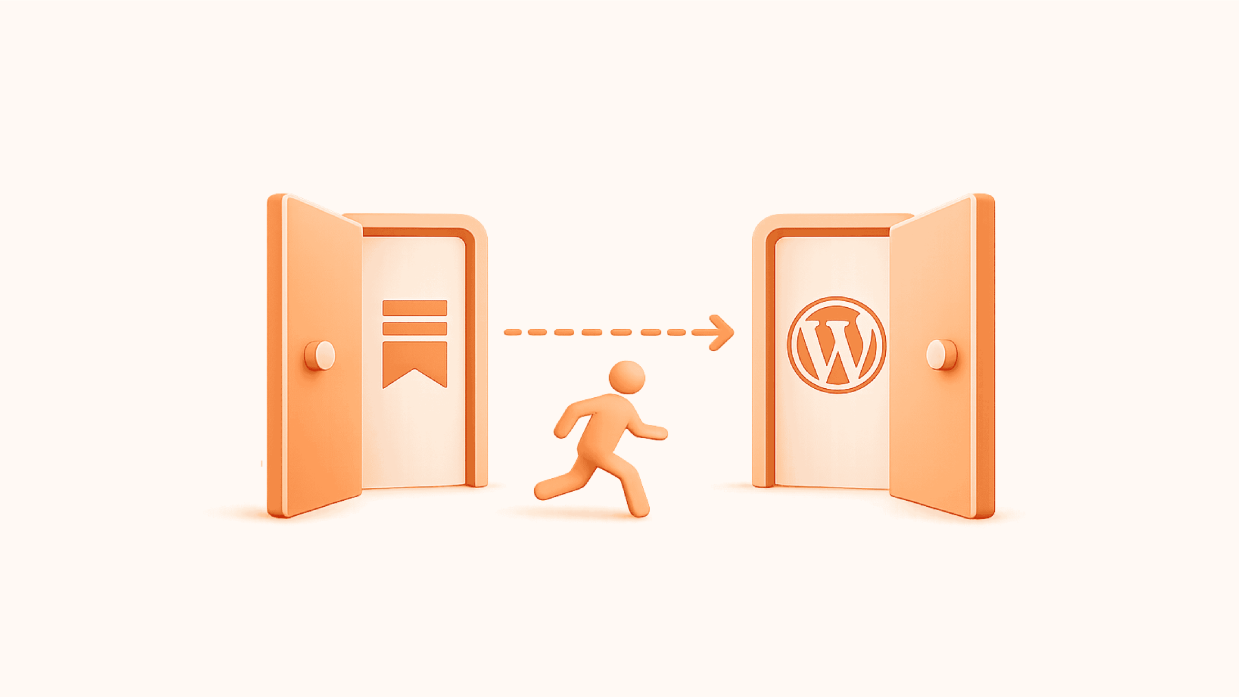
A hard cutover isn’t your only option. The WordPress Substack plugin lets you sync content across both platforms, keeping existing Substack subscriptions active while building a WordPress presence alongside it.
Content is published to WordPress, syncs automatically to Substack, and readers on either platform continue receiving posts without disruption. This setup is an ideal way to test WordPress workflows before fully committing. It’s also lower risk than moving everything at once, while allowing WordPress to gradually build SEO equity and direct subscriber relationships.
That said, it doesn’t solve the underlying issues. Substack still takes its 10%, and domain authority still accumulates on Substack’s subdomain.
A Decision Framework for Publishers
At its core, the decision comes down to comparing what you currently pay Substack with what independence costs to build and maintain.
$6,000 is a useful rule of thumb. Once annual Substack fees pass that amount, moving to WordPress usually pays back within the first year after hosting and ESP costs. Below that threshold, the financial case weakens somewhat, although ownership and SEO may still justify the move.
Four questions worth asking first:
- What are your current annual Substack fees? Run the 10% calculation against the last 12 months of revenue.
- Do you already have an audience and a domain? WordPress creates the strongest ROI when existing brand equity currently lives on someone else’s platform.
- How much growth comes from Substack discovery? Publishers dependent on recommendations lose that distribution when leaving. If you’re growing through search, social, or word of mouth, you lose less.
- How comfortable are you with setup overhead? WordPress requires more upfront configuration. Managed migrations remove much of the friction, but some operational change is unavoidable.
If you’re making more than $5,000/month in subscription revenue, the math tends to be fairly straightforward. The harder question is usually when and how to move.
Talk to a Migration Specialist Before You Switch
A migration done poorly loses subscribers and SEO equity. Done well, it recovers both and removes a high ongoing cost.
Multidots has completed 1000+ WordPress migrations, including publishers managing 50,000+ posts, with documented zero downtime outcomes and full subscriber preservation.
Book a migration scoping call to map your content footprint, timeline, and costs. It’s a low-commitment conversation designed to give you a grounded estimate before internal decisions start gathering momentum.