
Key Takeaways
- Define what “CMS” means before you shortlist anything. A content CMS, CMMS, compliance system, and ERP module solve very different manufacturing problems.
- Choose the CMS that fits your operation. WordPress or Sanity suit enterprise teams needing structure, governance, and headless delivery – including complex, high-volume editorial workflows; Sitecore is an option for teams committed to its wider DXP ecosystem, and Brightspot is a publishing-focused alternative.
- Make ERP and PLM integration a first-order requirement – the right CMS should consume existing product data automatically, rather than creating another system your team has to keep manually in sync.
- De-risk a legacy CMS migration with a phased cutover. Parallel builds, data validation, and rollback checkpoints let you modernize without gambling on a big-bang launch.
- Judge CMS ROI by operational friction, not license cost alone. Faster publishing, fewer developer dependencies, and easier regional rollouts can matter far more than the headline platform fee.
Search “CMS for manufacturing,” and you’re likely to find an automotive ERP module, a professional certification, a range of headless content platforms, and a maintenance management system, all competing for the same three letters. If you’ve been tasked with “finding a CMS” for your company’s web presence, there’s a tangle of terminology to sort through before you can even begin evaluating your options.
This guide clears up what CMS actually means in a manufacturing context, and which type your team needs, whether that’s a content platform for your product catalog and dealer portal, or something else it can point you toward instead.
What CMS Means in Manufacturing
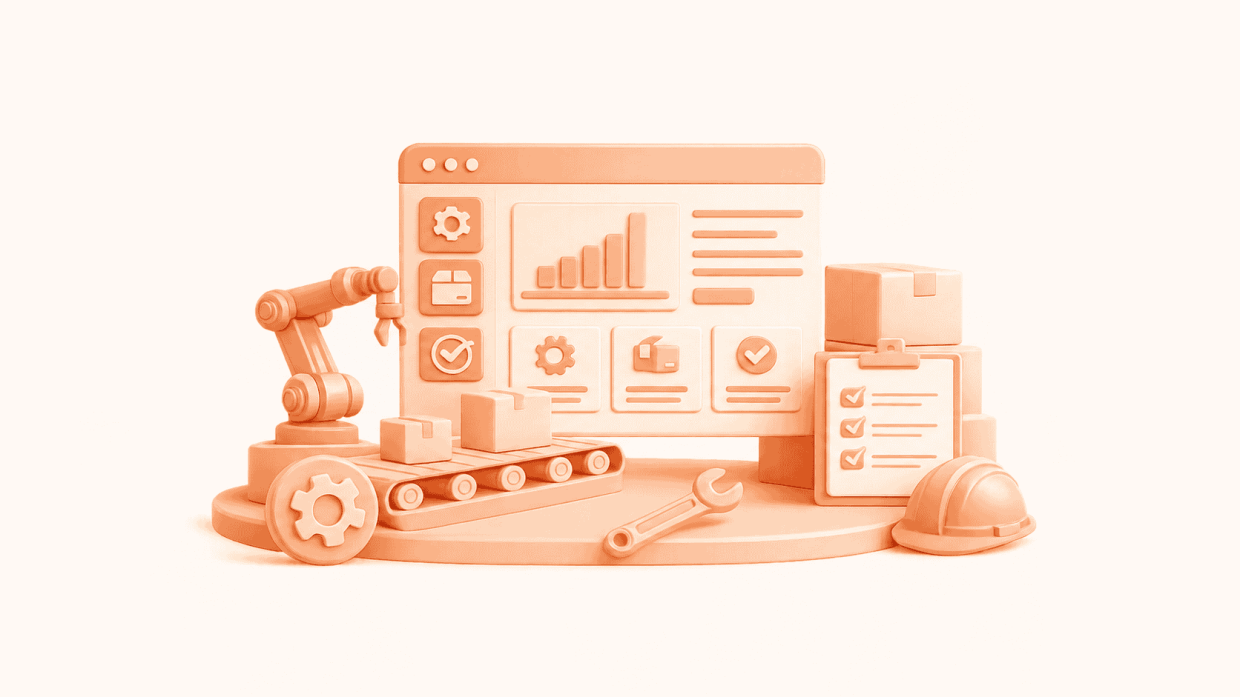
In manufacturing, CMS typically refers to a content management system: the software that runs your website, product catalog, and dealer or distributor portal. Although this is the meaning we’ll focus on in this article, it’s worth clarifying the other ways “CMS” gets used, since a search for the term will often surface all of them at once.
| Meaning | What it does | Who’s actually looking for it |
|---|---|---|
| Content CMS | Manages website content, product catalogs, and portal access | Digital, marketing, and IT teams modernizing the web presence |
| Compliance CMS | Manages OSHA, EPA, and ISO documentation and audit trails | Quality and regulatory affairs teams |
| Epicor automotive ERP module | Epicor’s purpose-built ERP platform for automotive Tier 1/2 suppliers | Supply chain and IT teams already running Epicor |
| CMMS (maintenance) | Tracks physical assets, machine performance, and uptime | Plant operations and maintenance teams |
Beyond these 4, “CMS” also appears as a naming convention for CNC and additive machining equipment brands, and occasionally as shorthand some contract manufacturers use for themselves. Neither is relevant to a software search, but they’re common enough in manufacturing to explain some of the less useful results a search engine may send your way.
It’s also worth putting the scale of that ambiguity into perspective: the CMMS market alone was valued at $1.29 billion in 2024. It’s a substantial category in its own right, but one focused on managing physical assets rather than content. If that’s what you’re looking for, this isn’t the guide you need. From here on, we’re talking specifically about the content CMS.
What a Manufacturing Content CMS Has to Handle
A manufacturing content CMS has to handle complex product catalogs, multilingual variants, tiered access, and tightly controlled technical documentation at scale: thousands of SKUs, multilingual product variants, tiered distributor access, and specs that stay accurate across every version.
Handling that workload means identifying the right capabilities. You need structured content modeling that treats a product as data rather than a page, multilingual support built into the architecture, role-based access control for different distributor tiers, and audit-trailed version control so every change to a spec sheet can be traced. Enterprise WordPress development can deliver all 4 when the platform is built around these requirements from the outset, rather than retrofitted later.
Governance matters just as much as functionality. WordPress VIP adds enterprise-grade security and access controls to that foundation, backed by its SOC 2 Type I attestation for the platform (with SOC 2 Type 2 for its data centers) – the level of governance you’d expect for a distributor portal handling tiered pricing.
Headless architecture is also worth understanding in this context. It separates content from the front end, delivering it via API to whichever interface needs it, whether that’s your main website or a regional storefront. That makes it particularly useful for manufacturers managing the same product content across multiple sites, markets, languages, and digital channels, without having to maintain it separately in each one. Multidots builds this approach specifically on WordPress and Sanity, the two platforms where this combination of structure, governance, and headless delivery has been proven at manufacturing scale.
How a CMS Connects to Your ERP and PLM Systems
A CMS connects to systems such as Epicor or SAP through APIs, often with middleware between the two to manage data transformation and timing. Product data flows from your Enterprise Resource Planning system (ERP) or Product Lifecycle Management system (PLM) into the CMS, keeping specs, pricing, and availability current without someone having to manually enter the same information twice. When this goes wrong, you get duplicated records when sync logic isn’t idempotent, and latency that leaves a distributor looking at outdated specs while checking availability in real time.
It’s also important to be clear about scope here, as Multidots doesn’t build or replace the ERP itself, nor does it implement Epicor as a product. Rather than replacing either one, the CMS is the layer that consumes and displays the information your ERP or PLM system already manages.
When that connection is built properly, catalogs stay accurate without your team having to manually intervene every time a spec sheet changes.
WordPress for Enterprises: Learn the Secret Sauce of Big Enterprise WordPress Websites
An In-Depth Look at the Engineering and Design Behind Billion-Dollar Enterprises’ WordPress Websites


Moving Off Sitecore or AEM Without Downtime
Sitecore and AEM are both capable platforms, and if your organization uses one of them today, that doesn’t mean it was the wrong choice. The more useful question is whether it remains the right fit for your cost structure, your editorial speed, and where your operation is heading over the next few years.
If the answer is no, the case for moving may be relatively clear. What often makes teams hesitate is the migration itself. That concern is understandable when you’re dealing with years of historical product data and a live catalog that customers rely on every day. The challenge, then, is finding a way to move without putting any of that at unnecessary risk.
That’s where a phased cutover becomes important. Rather than replacing the existing platform in one high-stakes move, the process runs in 4 controlled stages.
- First, a parallel build creates the new environment alongside the existing one, keeping the live platform untouched during construction.
- Data validation confirms that every product record, spec sheet, and historical asset has transferred accurately before anything changes for end users.
- Once that validation is complete, a zero-downtime switch moves traffic across without taking the site offline for a cutover window.
- And throughout the process, rollback checkpoints remain in place, so if something doesn’t perform as expected, reverting is a defined process rather than a last-minute scramble.
The value of this approach is that migration doesn’t have to mean choosing between modernization and continuity.
The ROI of a Modern Manufacturing CMS
A modern manufacturing CMS can cut total cost of ownership (TCO), improve page performance, and give content teams the freedom to publish without relying on developers for every update.
A $16 billion seating manufacturer reduced TCO by 35% after moving away from its legacy platform with Multidots’ help.
This is competitive ROI, rather than simply a cheaper alternative. The gains come from removing developer bottlenecks from routine content updates and making it faster to deploy new regional sites when the business needs them.
And the impact extends well beyond the IT budget. Product launches can move faster when marketing isn’t waiting for engineering capacity. Distributor and dealer portals can respond more quickly to changing needs. And across global markets, structured content and audit-trailed workflows help reduce the version errors that come with manually copying specification updates between regional sites.
How to Choose the Right CMS for Your Operation
There are 5 factors to prioritize when narrowing down your options:
- Catalog scale.
- Multilingual requirements.
- The depth of integration needed with your ERP or PLM systems.
- The migration risk associated with your current setup.
- The realistic timeline for getting there.
Map your requirements against those factors and your shortlist will soon take shape.
WordPress and Sanity both support enterprise content operations that need structure, governance, and headless delivery at scale.
Sitecore combines content management with personalization, digital asset management, and broader digital experience capabilities.
Brightspot provides enterprise publishing workflows and multisite content management, while Directus provides a lightweight, database-first headless layer.
If your requirements point toward enterprise-scale content, multilingual complexity, and meaningful ERP or PLM integration, book a consultation or explore Multidots‘ enterprise WordPress services to discuss what a migration could realistically look like for your operation.
Frequently Asked Manufacturing CMS Questions
SAP is an ERP, not a CMMS. CMMS belongs to a separate maintenance management category focused on tracking physical assets and equipment uptime, rather than enterprise resource planning.
A compliance CMS manages OSHA, EPA, and ISO records alongside audit trails, helping keep regulatory documentation organized and inspection-ready. It’s a distinct category from the content CMS covered in this guide: it manages regulatory records rather than website content.
CMMS leaders such as IBM Maximo are specifically designed to handle asset and uptime tracking. That’s outside the scope of this guide, which focuses on content management rather than maintenance software.
The Certified Manufacturing Specialist (CMS) is a professional certification offered by ATMAE and is unrelated to any of the software categories covered here.