

Key Takeaways
- Enterprise digital maturity depends on strategic authority, specialized teams, and operational discipline, with agility essential to sustaining leadership.
- Multisite governance unifies standards, security, and updates while supporting regional content, localization, and compliance.
- First-party data drives editorial, personalization, and pricing decisions across the enterprise.
- Security and compliance become core business functions, requiring continuous monitoring, timely patching, and strong authentication.
- Composable architecture enables parallel experimentation while protecting core operations and revenue.
Part 5 of our six-part series on the Multidots Digital Maturity Model. New to the framework? Start with the overview.
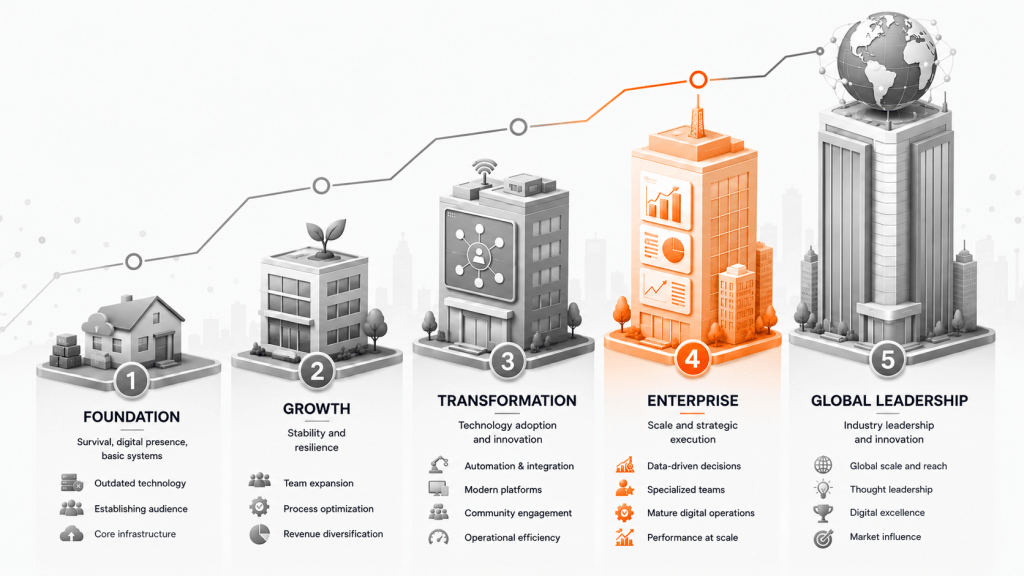
As organizations ascend to the Enterprise level, they mirror the Self-Esteem needs of Maslow’s Hierarchy. Having earned stability and community, the focus now shifts toward building a reputation for excellence and standing out as a clear leader in the field. The question is no longer whether you can operate, or even connect. It is whether you can lead.
At this stage, organizations run on well-defined digital strategies and dedicated, specialized teams across functions. They are not just participating in the digital landscape; they are shaping it, through constant innovation and data-driven decision-making. The work here is holding on to the speed that got you this far while operating at a size where a single wrong move is expensive.
You’re at the Enterprise Level If
- You run on a well-defined digital strategy, with dedicated, specialized teams across editorial, product, data, and engineering.
- You operate at scale: high traffic, multiple properties or markets, and real revenue riding on uptime.
- Decisions are data-driven, backed by first-party data and analytics rather than instinct.
- Security and compliance are board-level concerns, not tickets in a queue.
- You are expanding internationally, and localization and regional regulation are now live problems.
- Your competitors are other established leaders, so the bar is set by the best in your category.
If this is you, the challenge is no longer growth for its own sake. It is defending and extending a position of authority.
What the Enterprise Level Really Looks Like
At Enterprise, you are a known quantity in your field. The platform is mature, the teams are specialized, and the strategy is deliberate. Success is measured in market position, audience authority, and the efficiency of a large operation, not just traffic or revenue in isolation. This is where a business stops chasing the field and starts setting the pace for it.
The characteristic risk at this stage is losing agility to size. The bigger the operation, the more tempting it is to slow down: more approvals, more legacy to protect, more reasons to say not yet. Meanwhile smaller, hungrier competitors move fast. Advancing to Global Leadership is about keeping the reflexes of a startup inside the body of an enterprise, so scale becomes an advantage rather than an anchor.
Common Challenges at the Enterprise Level
The primary challenge at the Enterprise stage is holding on to agility and innovation while operating at a massive, often global, scale:
- Global expansion and localization. Adapting content, operations, and infrastructure to diverse languages, cultures, and strict regulatory environments.
- Innovation vs. disruption. Integrating emerging technologies like AI, machine learning, and automation without disrupting core revenue-generating operations.
- Market share and competition. Competing with other global leaders takes a deep, data-backed read of a fast-moving landscape.
- Talent acquisition and retention. Attracting and keeping top-tier talent with the skills to support sophisticated, global operations.
- Sustainability and social responsibility. Balancing aggressive business goals with ethical practices and environmental sustainability.
Handled well, these are what keep an established leader from quietly sliding into decline.
What Operating at Enterprise Scale Actually Involves
Enterprise maturity is less about any single capability and more about running many of them at once, reliably. In practice, it comes down to a few disciplines:
- Governing many sites as one. A multisite architecture lets a network of brands or regional sites share standards, security, and updates without a separate rebuild for each.
- Treating security as a core function. At this scale, a breach is a business event, not an IT incident. Continuous monitoring, patching, and strong authentication become non-negotiable.
- Operationalizing data. First-party data stops being a project and becomes the engine behind editorial, personalization, and pricing decisions across the organization.
- Localizing without fragmenting. Expanding into new markets means adapting language, content, and compliance while keeping one coherent brand and codebase.
- Building for parallel innovation. A composable architecture lets you trial new ideas alongside stable operations, so experiments never put core revenue at risk.
Together, these turn size from a liability into a moat.
How Multidots Solidifies Your Position as an Industry Leader
At Multidots, we serve as a strategic companion focused on maximizing your ROI through efficiency at scale. We help you move beyond being “wicked smart” to being experts at solving problems through collaboration.
1. Operationalizing expertise through advanced AI. We help Enterprise partners use AI to move the needle on both performance and editorial efficiency:
- Search intent prediction, using AI to anticipate user intent and optimize for long-tail keywords.
- Automated content auditing, running on-page audits for readability, keyword density, and backlink health to hold authority at scale.
- Dynamic pricing algorithms, adjusting against market trends to stay competitive.
2. Mastering the strategic roadmap. We don’t just plan for the next quarter; we build comprehensive Account Plans and Annual Roadmaps written for C-suite executives. Clear guardrails and waypoints, budget, timeline, taboos, and measurable, time-bound results, keep every project tracking toward your strategic destination.
3. Advanced security and compliance for global scale. For sites handling millions of monthly visits, security is a core business function. We implement behavioral anomaly detection to spot unusual bot activity and block brute-force attacks, continuous vulnerability scanning to patch themes and plugins automatically, and passwordless authentication, the FIDO2 approach behind our own Multipasskey, to remove passwords as an attack vector entirely.
4. Fostering a culture of Radical Candor. In complex enterprise environments, “yes people” are a liability. We bring Radical Candor, giving and receiving honest feedback so problems surface together, before they become large-scale failures.
5. ROI maximization through composable architecture. We keep you agile by keeping your architecture composable. That lets you run new, disruptive prototypes in parallel with stable, incremental improvements, without over-investing in a single unproven idea.
You can see this play out at scale. When Voice Media Group had to move five metro news brands off a discontinued legacy CMS, we migrated ten properties and 850,000+ pieces of content onto a single WordPress VIP multisite, on a hard ten-week deadline, without losing SEO authority. The network now serves 95 million page views a month from one governed platform. That is what Enterprise-grade consolidation looks like: many brands, one backbone, no loss of standing.
Next: The Global Leadership Stage
Enterprise is about authority: leading your field with strategy, data, and scale. Beyond it lies the summit, where an organization stops competing in its category and starts defining it, operating at global, multi-brand scale. That is the Global Leadership level. Read on, or reach out to talk through what your own ascent from Enterprise to Global Leadership could look like.
Frequently Asked Questions
Size is traffic and headcount; Enterprise maturity is authority. It shows up as a well-defined strategy, specialized teams, data-driven decisions, and the operational discipline to run all of it reliably. Plenty of large organizations still operate with Growth-stage habits.
They become core business functions. At millions of monthly visits and across multiple regulatory environments, a breach or a compliance miss is a business event. Continuous monitoring, automated patching, strong authentication, and privacy compliance are the baseline, not extras.
Through a composable architecture. It lets you trial new capabilities in parallel with the stable core, so an experiment can fail without taking production down. That separation is what makes fast innovation safe at scale.
Losing agility to size. More approvals, more legacy, and more caution let faster competitors close the gap. The organizations that stay ahead keep decision-making sharp even as the operation grows.