

Key Takeaways
- The five-tier model maps digital maturity from foundational platform ownership to global leadership and continuous innovation.
- Each tier requires distinct technology, team structures, monetization strategies, and operational priorities.
- Sequenced investments prevent premature complexity, stalled growth, and wasted capital while improving measurable ROI.
- Platform ownership, first-party data, workflow maturity, and monetization sophistication reveal an organization’s current tier.
- Multidots uses OKR-driven roadmaps to align engineering investments with current capabilities and the next achievable stage.
At Multidots, we’ve spent over 17 years watching the same pattern repeat itself: every organization is on its own digital transformation journey, yet many are traveling without a map. In our role as a strategic companion, we’ve learned that the most successful digital evolutions are rarely a sudden burst of activity. They are a purposeful ascent toward a higher state of capability.
To help our partners navigate that ascent, we built the Multidots Digital Maturity Model. It isn’t a technical checklist. It is an assessment of an organization’s current DNA, designed to surface hidden inefficiencies and unlock the high-impact growth opportunities hiding inside them.
This is the first post in a six-part series. Here we introduce the full model, the five tiers and the thinking behind them. In the five posts that follow, we go deep on each tier in turn: what it feels like to be there, the challenges that keep organizations stuck, and what it takes to climb to the next level.
A Human-Centered Framework for Organizational Growth
The journey of a digital landscape often mirrors the growth of an individual. Just as Maslow’s Hierarchy of Needs holds that our foundational needs must be satisfied before we can strive for self-actualization, an organization’s digital ecosystem requires a solid structural base before it can support industry-leading innovation. You cannot self-actualize on an empty stomach, and you cannot lead an industry on infrastructure that buckles under its own traffic.
Viewed through this lens, it becomes clear why a “one size fits all” approach fails. A creator fighting for survival at the Foundation stage—focused purely on basic platform stability and content creation—requires a vastly different playbook than an industry titan striving for Global Leadership. Handing both the exact same roadmap helps neither advance in the way they seek.
The true strategic value lies in recognizing the essential rungs that bridge these two extremes. As organizations ascend from turn-key tools, they enter the Growth stage, graduating to owned platforms like enterprise WordPress to stabilize operations, build dedicated teams, and establish sustainable revenue streams. From there, publishers move into the Transformation stage, actively modernizing legacy workflows, expanding multi-platform distribution, and leveraging first-party data to cultivate deep community engagement and audience belonging. Reaching the Enterprise stage means operating multi-functional teams at scale with advanced data analytics and multi-channel monetization to solidify brand authority and market leadership.
By weaving these intermediate steps into the journey, the maturity model offers a shared language and clear guardrails for organizational evolution. It gives leaders a candid way to name where they stand today, understand the specific technical and operational demands of their current tier, and chart their next logical waypoint—ensuring technology investments directly drive efficiency and yield maximum return on investment.
Why a Map Beats a Checklist
Most digital advice arrives as a checklist of disconnected tactics, but checklists lack sequence and timing, making the right move at the wrong time often worse than no move at all. Deploying enterprise complexity prematurely burns capital without returning value, while delaying necessary architectural upgrades throttles operational growth. Our maturity model solves this by guiding organizations not just on what to do, but when to do it, turning generic best-practice lists into decisions leaders can trust. At Multidots, we operationalize this model to build customized, consultative roadmaps that guide organizations through each phase of maturity, ensuring technical investments directly drive short-term efficiency and long-term returns.
Our roadmapping methodology systematically moves organizations across each rung of the ladder by tailoring engineering and operational strategies to their tier. We begin by helping Foundation-stage creators move off closed turnkey platforms to secure an owned, scalable platform with optimized performance and baseline monetization. As publishers transition into the Transformation stage, we might scale their editorial output with advanced search integration, automated workflows, dynamic paywalls, and/or first-party data strategies to deepen audience engagement. Scaling from Transformation to Enterprise could involve overcoming legacy tech debt, which ultimately paves the way to Global Leadership where composable architectures, real-time AI translation, and rapid prototyping might enable industry leaders to innovate aggressively without risking stability.
To prevent these roadmaps from sitting static in a PDF, Multidots embeds this sequence directly into an active partner cadence governed by Objectives and Key Results (OKRs) that serve as strategic guardrails and waypoints. We conduct monthly pulse checks to resolve immediate sprint bottlenecks, quarterly strategy sessions to audit performance and monetization data against execution plans, and semi-annual deep dives to chart the technical investments required for the next maturity stage. By continuously aligning development sprints with an organization’s current maturity tier, Multidots ensures every dollar invested yields operational clarity and measurable value.
The Five Tiers of Digital Maturity
Our model is based on five distinct levels. Each one represents a shift in mindset, technology, and operational focus, and each is built on the one beneath it.
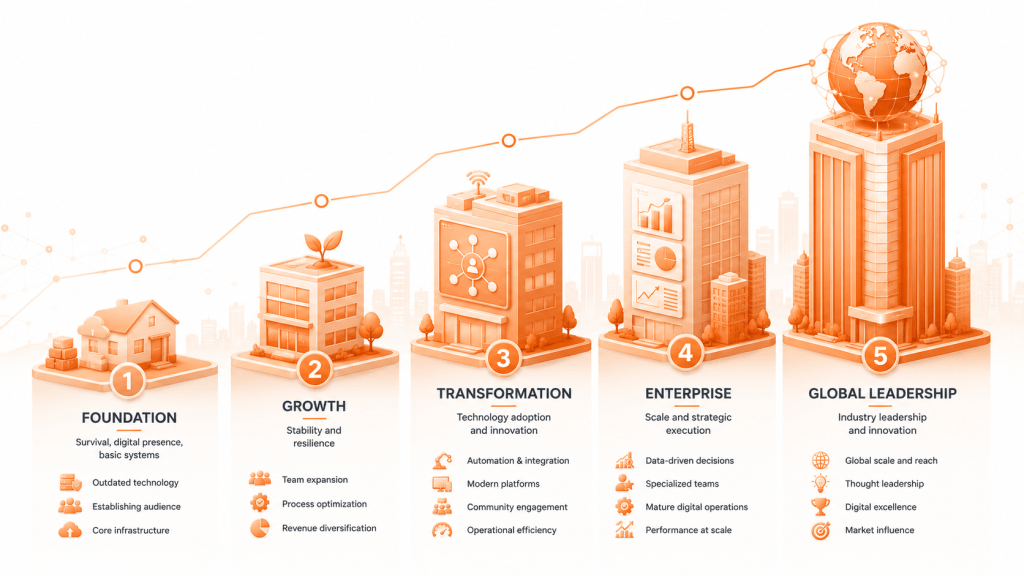
01. Foundation. Organizations at this level often rely on outdated systems or turnkey third-party platforms like Medium or Substack. The primary goal here is survival: establishing a presence and building a solid foundation of content and audience.
02. Growth. Once survival is ensured, the focus shifts to stability and resilience. These organizations own their web presence, often on a CMS like WordPress, and start optimizing operations, expanding their teams, and diversifying their revenue streams.
03. Transformation. At this level, organizations actively adopt new technologies to drive efficiency and foster deeper community connections. They are moving away from basic digital operations toward becoming a sophisticated publishing business.
04. Enterprise. These organizations run on well-defined digital strategies and dedicated teams across various functions. They leverage advanced data analytics to pursue their strategic goals at scale and establish themselves as respected leaders.
05. Global Leadership. The pinnacle of maturity. These industry leaders drive innovation, operate at a massive global scale, and set the standard for digital excellence.
The tiers are cumulative. You cannot skip one any more than you can build a stable house on an unfinished foundation. Each level earns the right to the next, and the challenges that feel impossible at one tier become the baseline you take for granted at the one above it.
The Five Tiers at a Glance
Before we break down each level in the posts that follow, here is the whole model on a single screen: the five tiers side by side, with the core focus of each and the one hurdle that separates it from the next.
| Tier | Maslow parallel | Primary focus | Typical platform | The challenge to clear |
|---|---|---|---|---|
| Foundation | Survival | Establish a presence, build an audience | Turnkey (Medium, Substack) | Owning your platform and your data |
| Growth | Safety and security | Stability, resilience, revenue | Own CMS (e.g. WordPress) | Scaling operations without breaking |
| Transformation | Love and belonging | Community and sophistication | Enterprise tech, composable | First-party data and team structure |
| Enterprise | Self-esteem | Authority, scale, data-driven decisions | Advanced stack, specialized teams | Staying agile at massive scale |
| Global Leadership | Self-actualization | Legacy and defining the field | Sophisticated composable architecture | Constant reinvention without instability |
How to Find Your Place on the Pyramid
The point of a map isn’t just to admire the landscape; it is to locate exactly where you stand today so you can chart the most efficient route forward. Most organizations recognize themselves in one maturity tier right away and feel the natural pull toward the one above. Many sit across two tiers at once—possessing enterprise-grade technology but constrained by fragile, manual workflows. That operational tension isn’t a failure; it is critical intelligence that points directly to where your next technology and talent investments will yield the highest ROI.
Four candid questions usually settle your true position quickly:
- Platform & Data Ownership: Who truly owns your infrastructure and audience relationships? If you rely on closed, third-party platforms rather than an owned, open-source core like enterprise WordPress, you remain tethered to the Foundation stage.
- Decision-Making Mechanics: How do you prioritize your roadmap? Relying on gut feel and anecdotal feedback points to earlier tiers, whereas leveraging first-party data, predictive analytics, and clear performance metrics marks higher maturity.
- Team Structure & Workflows: How is your operational talent deployed? A single multi-tasking group juggling maintenance and creation sits lower on the ladder, while dedicated, cross-functional teams operating with automated workflows sit higher.
- Monetization Sophistication: How do you convert audience engagement into revenue? Basic display ads signal an early growth stage, while dynamic paywalls, contextual commerce, and personalized subscription models define transformation and enterprise leadership.
Ultimately, the maturity model is less about earning a label and more about gaining complete strategic clarity. It uncovers the hidden friction quietly capping your growth and highlights the high-impact opportunities that open up the moment those bottlenecks are cleared. Naming your tier is the first honest step; from there, Multidots works alongside your team to translate that reality into OKR-driven roadmaps, clear guardrails, and high-velocity engineering sprints—turning digital transformation from a default effort into a predictable, ROI-generating investment.
Two Ways Organizations Get Stuck
Because maturity model tiers are cumulative, organizations typically stall in one of two opposite ways: overreaching or standing still. The first is overreaching—buying the tools, composable architectures, and organizational structures of a tier you haven’t earned yet. When an early-stage team invests in enterprise-grade infrastructure, they end up paying for complexity they cannot leverage while starving the fundamental publishing and audience-building workflows that actually drive growth. Ambition is never the problem; sequence is. Deploying capability before building the organizational foundation to support it burns capital without returning value.
The second failure mode is standing still—mistaking short-term comfort at your current tier for long-term success. The CMS platform still functions, traffic numbers look fine, and the friction of change feels larger than the pain of staying put. However, operational ceilings rarely announce themselves until performance degrades, yield stalls, or agile competitors quietly climb a tier ahead. In digital publishing, staying put is actually moving backward.
Knowing your stage protects your organization from both traps. At Multidots, we use this maturity mapping to establish clear strategic guardrails and OKR waypoints, aligning every engineering sprint directly with your current reality. This ensures you are neither overpaying for technical overhead you cannot use nor coasting toward an invisible ceiling that throttles your long-term return on investment.
Maximizing ROI Through Strategic Partnership
Transformation is rarely a straight line. It is a series of iterative loops. Our approach is built on a simple philosophy: “Serving People, Solving Problems.” We combine logic with humanity to ensure that your technical evolution isn’t a drain on resources, but a driver of measurable business value.
We use clear Objectives and Key Results (OKRs) as our compass and Continuous Discovery as our guide, so that every technical decision leads toward your ultimate strategic destination rather than away from it. The goal is never technology for its own sake. It is capability that pays for itself.
Across more than 17 years and 1000+ platform migrations, we have watched organizations make this climb again and again. The ones that move fastest are rarely the ones with the biggest budgets. They are the ones who know exactly which rung they are on and spend their energy on the next one, not three tiers ahead.
Take This Old House. We moved the brand off a restrictive Chorus CMS onto WordPress it now owns outright, migrating 10,000+ posts and improving page speed by 35% for 2.1 million monthly visitors. Or Ask Media Group, where we consolidated 11 properties and 50,000 posts into one WordPress network with zero downtime, now serving 245 million monthly visitors. In both cases the migration was not the goal; the climb was. The right platform, delivered with strategic support, is what lets an organization move up the model instead of hitting its ceiling.
What This Series Covers
Over the next five posts, we take each tier in turn and get specific about the challenges that define it and the moves that clear them:
- Foundation: surviving the turnkey trap and building a platform you own.
- Growth: building safety, security, and sustainable operations.
- Transformation: fostering community and a sophisticated business.
- Enterprise: authority, scale, and data-driven leadership.
- Global Leadership: setting the standard for digital excellence.
Taken together, they trace one throughline: how an organization actually moves up the model, one level at a time, with the strategic support that makes each climb deliberate rather than accidental.
The Journey Continues
Digital maturity is not a destination. It is a continuous cycle of discovery, alignment, and sustainability. The organizations that lead their categories are not the ones that reached some final tier and stopped. They are the ones that kept climbing, treating each new altitude as the base camp for the next.
Wherever you are on the pyramid, the first move is the same: know which tier you are standing on today. Over the next five posts, we’ll map each one in detail, starting with the Foundation level. If you would rather talk it through, reach out. We will help you find your place on the pyramid and chart the ascent from there.
Frequently Asked Questions
It is a framework that describes the stages an organization moves through as its digital capability grows, from basic survival to industry leadership. Rather than scoring you against a fixed checklist, it names your current stage so you can invest in the right things in the right order.
Start with the three questions above: who owns your platform and data, whether you decide by gut or by data, and how your team is structured. Most organizations recognize themselves in one tier immediately. If you straddle two, that gap is exactly where your next investment should go.
Not really. The tiers are cumulative, because each one depends on capabilities built in the one below it. You can move quickly, but you cannot leap from a rented platform to global-scale operations without laying the foundations in between.
It depends entirely on where you are starting and how deliberate you are about the climb. The model is not a stopwatch; it is a compass. Its value is making sure the effort you spend actually moves you upward instead of sideways.
The framework applies to any organization whose growth depends on its digital platform. We lean on publishing examples throughout because the media world shows these stages in their sharpest form, a creator on Substack and a global media network are unmistakably at different tiers. The same logic applies to any content-driven business.