
Key Takeaways
- Turnkey platforms simplify publishing but restrict content ownership, audience data, monetization, and long-term scalability.
- Moving from Foundation to Growth requires an owned CMS, structured workflows, stronger analytics, and scalable infrastructure.
- A carefully planned migration protects subscriber relationships, search visibility, content assets, and future revenue opportunities.
- Open-source platforms such as WordPress provide the control and flexibility required for sustainable digital growth.
Part 2 of our six-part series on the Multidots Digital Maturity Model. New to the framework? Start with the overview.
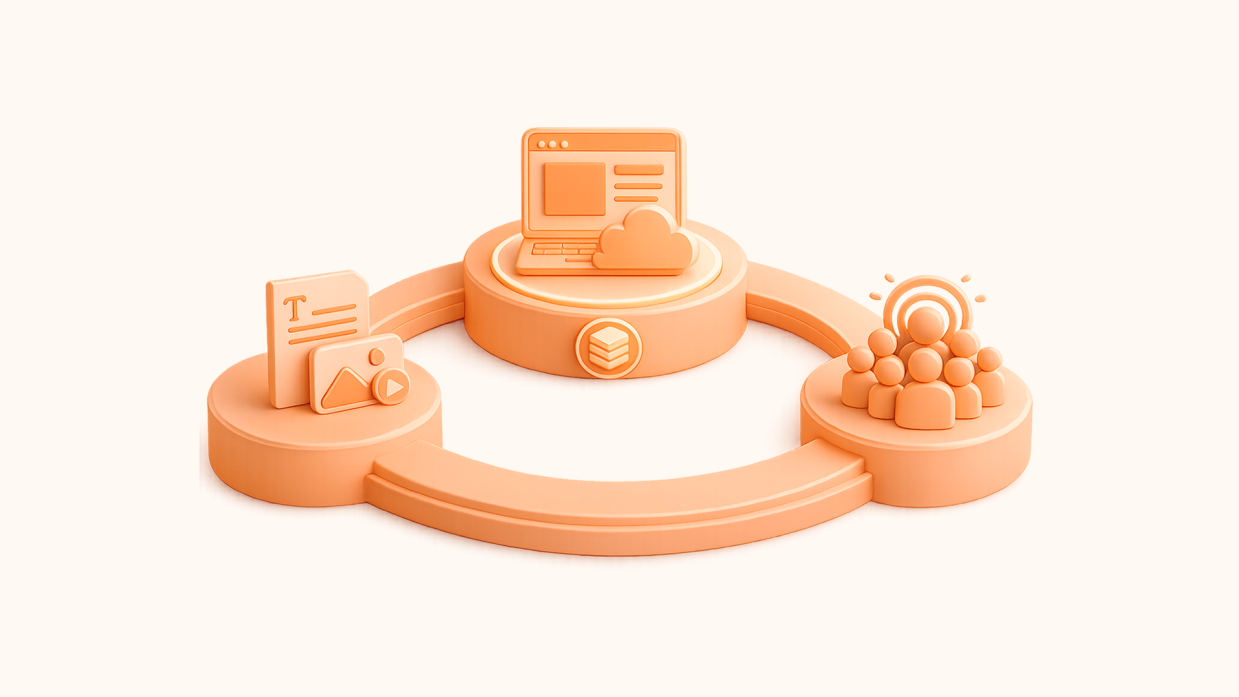
Every organization’s digital life begins the same way it does for a living thing: with survival. Before there is strategy, scale, or reputation, there is a more basic question. Can this thing exist, and keep existing? That is the Foundation level, and we think of it as the “physiological” stage of an organization’s digital life. Just as a human needs food and water to survive, a digital entity needs three things to exist: a platform, content, and an audience.
Organizations at this stage are often individual creators or small, agile teams focused almost entirely on the quality of their content. That focus is a strength. It is usually what earns the first loyal following. But the technical infrastructure behind that content is often a turnkey solution, think Medium or Substack, that trades control for convenience. These platforms offer immediate entry and a clean writing experience, and in return they quietly cap how much technical control and revenue you can ever have. For a while, that trade feels invisible. The ceiling only becomes real once you start reaching for it.
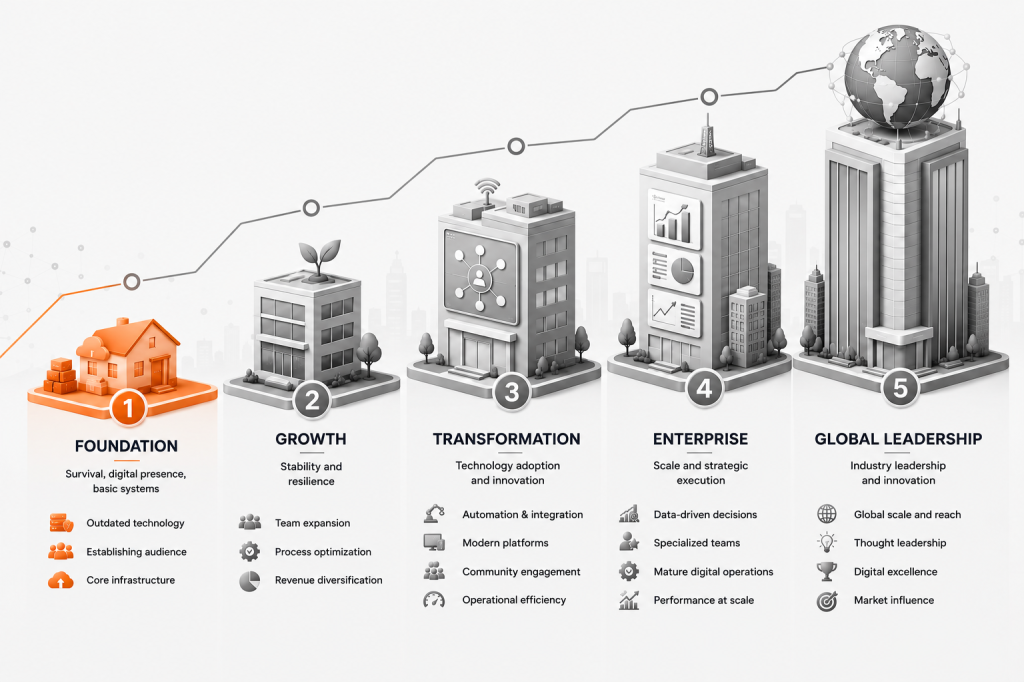
You’re at the Foundation Level If
- Your content lives on a platform you don’t own, and moving it would mean starting over.
- Your audience relationship is mediated by a third party. You may not even have direct access to your own subscriber list.
- Monetization is limited to whatever the platform allows, and it takes a cut.
- Workflows are informal: a shared inbox, a chat thread, and a lot of things held in someone’s head.
- You have little real visibility into audience behavior beyond the basic numbers the platform chooses to show you.
- Security, compliance, and uptime are somebody else’s responsibility, which also means they are outside your control.
If most of that sounds familiar, you are where almost everyone starts. The question is not whether you belong here; it is whether you are staying by choice or by default.
What the Foundation Level Really Looks Like
At Foundation, the site is the story and the story is the site. Publishing is manual, the team is small enough to coordinate over a single chat thread, and success is measured in follows and views rather than in owned relationships or revenue. There is nothing wrong with this. It is where almost everyone starts. The real risk is staying here by default rather than by choice, because the same simplicity that makes it easy to begin is what makes it hard to grow.
The turnkey platform is the classic Foundation-stage home. It removes every barrier to starting, which is exactly why it works so well at the beginning and so poorly later. You are, in effect, building your house on rented land. The landlord sets the rules, keeps a key, and can change the terms whenever they like. As long as you are only passing through, that is a fair trade. The moment you want to build something permanent, it becomes the problem.
Common Challenges at the Foundation Level
As these organizations begin to outgrow their initial shelter, they hit a ceiling. Moving from Foundation to Growth is often the most jarring transition of the entire journey, because it requires a fundamental shift in identity: from being a content creator to being a business owner.
- Technology limitations. Relying on basic platforms means you don’t own your data or your “house.” You are building an audience on land you rent. Transitioning requires a significant investment in a dedicated Content Management System (CMS), such as WordPress, along with the hosting to support it. It is the difference between decorating a rented apartment and owning the building.
- Workflow adaptation. What worked for an individual creator falls apart the moment a team expands. Informal handoffs and mental checklists stop scaling, and structured collaboration tools and project management processes go from “nice to have” to necessity, often overnight.
- Monetization mindset. Moving beyond simple ad placements into subscriptions, affiliate marketing, or e-commerce requires new technical integrations that basic platforms simply don’t support. The shift is as much mental as technical: you begin designing for revenue, not just for reach.
- Data silos. Foundation-level publishers often have no way to truly analyze audience behavior. The platform owns the data, and you see only what it chooses to show you. Without advanced analytics, you are winging it rather than making informed decisions.
- Security and compliance. As the site becomes more complex, so do the risks. Compliance with privacy regulations and robust security stop being someone else’s concern and become a primary one of your own.
Each of these is a symptom of the same root cause: the platform that made it easy to start is now the thing standing between you and what comes next.
What Escaping the Turnkey Trap Actually Involves
Leaving a turnkey platform sounds daunting, and the fear of “losing everything” keeps many organizations stuck longer than they should be. In practice, a well-run migration is a sequence of solvable problems, not a leap of faith. The pieces that matter most:
- Owning your content and data. The first goal is portability: getting your posts, media, and structure into a system you control, so no future decision is ever again someone else’s to make.
- Taking your audience with you. Your subscriber list and audience relationships are the real asset. A proper migration moves them into a database you own, rather than one you rent access to.
- Protecting your search visibility. Years of accumulated authority can be preserved with careful URL mapping and redirects, so a move forward does not become a step back in traffic.
- Choosing a platform that grows with you. A dedicated CMS like WordPress replaces the turnkey ceiling with a floor you can keep building on, adding the integrations, workflows, and revenue tools the old platform never allowed.
- Turning on real measurement. For the first time, you can see how your audience actually behaves, which turns guesswork into decisions.
None of these is exotic. Together they are simply what it means to move from renting to owning.
How Multidots Accelerates the Ascent to Growth
At Multidots, we act as your strategic companion to ensure this leap isn’t a fall. We don’t just hand you a new website and wish you luck; we build a foundation that is scalable by design.
1. Ownership through open-source. We help partners migrate from restricted platforms to open-source environments like WordPress. This shift grants you 100% ownership of your audience data and your technical roadmap, moving you from a renter to an owner in the digital landscape. Everything you build from here compounds in your favor, not the platform’s.
2. Implementing the strategic mindset. Every team member at Multidots, from engineers to project managers, thinks like a strategist. We don’t just build a site; we start from your business goals and work backward, so the new platform becomes a genuine conduit for ROI. We use Continuous Discovery to understand what actually matters to you before a single line of code is written. It is the same thinking behind our strategic approach to digital partnerships and the power of OKRs: every technical decision stays tied to a business outcome.
3. Performance and scalability “cheat codes.” To prepare a Foundation-level site for the Growth stage, we put high-impact optimizations in place from day one:
- Image compression: serving next-gen formats like WebP to ensure lightning-fast load times.
- Edge caching: utilizing CDNs like Cloudflare to serve content closer to users worldwide.
- Database cleanup: removing code bloat and unnecessary data to keep the system lean and responsive.
4. Designing for engagement. We apply Design Thinking and Empathy Mapping to understand your readers’ expressed and latent needs. By creating a user-centered experience from day one, we help you transition from “just having a site” to fostering a community that comes back.
5. Radical Candor in partnership. We believe we can solve 100% of the problems we know about, which means the whole game is surfacing them honestly. A relationship built on Radical Candor helps Foundation-level partners own their technical failures and turn them into learning opportunities. That honesty, more than any single tool, is what long-term viability really depends on.
This is the ascent in action. Sneaker News now runs on enterprise WordPress it fully controls, and that ownership is what let it plug in the third-party and affiliate integrations behind a 300% increase in sales, while serving 7.5 million monthly visits at a 1.2-second load time. That is the gap between a publication renting space at the Foundation level and one with the strategic support to climb beyond it.
Next: The Growth Stage
Foundation is about proving you can exist. Once survival is no longer the daily question, the focus shifts to stability and resilience: building operations that can take a hit and keep running. That is the Growth level, where a content operation starts to behave like a real business. Read on, or reach out to talk through what your own ascent from Foundation to Growth could look like.
Frequently Asked Questions
Not at all. They are excellent at what they are built for: getting you publishing quickly with almost no setup. They become a limitation only when your ambitions outgrow what they allow, which is precisely the Foundation-to-Growth transition this stage is about.
When the platform’s ceiling starts costing you more than its convenience saves you. The usual signals are a desire to own your subscriber relationships, to monetize in ways the platform blocks, or to build workflows for a growing team.
Not with a proper migration. Your subscriber list moves into a database you own, and search authority is preserved through careful URL mapping and redirects. The risk comes from migrating carelessly, not from migrating.
You need a platform you own and can extend. WordPress is our common recommendation because it is open-source, endlessly extensible, and scales with you from Foundation all the way up the pyramid, but the underlying principle is ownership, whatever the tool.