
Key Takeaways
- Transformation-level publishers shift from traffic growth toward deeper audience relationships, loyalty, and community.
- First-party data foundations enable effective personalization, audience retention, and sustainable monetization.
- Composable, API-driven architecture supports new capabilities without repeated platform rebuilds.
- Responsible AI adoption requires human oversight to protect editorial quality and audience trust.
- Clear roadmaps, specialized roles, and continuous discovery prevent organizational complexity from stalling enterprise progress.
Part 4 of our six-part series on the Multidots Digital Maturity Model. New to the framework? Start with the overview.
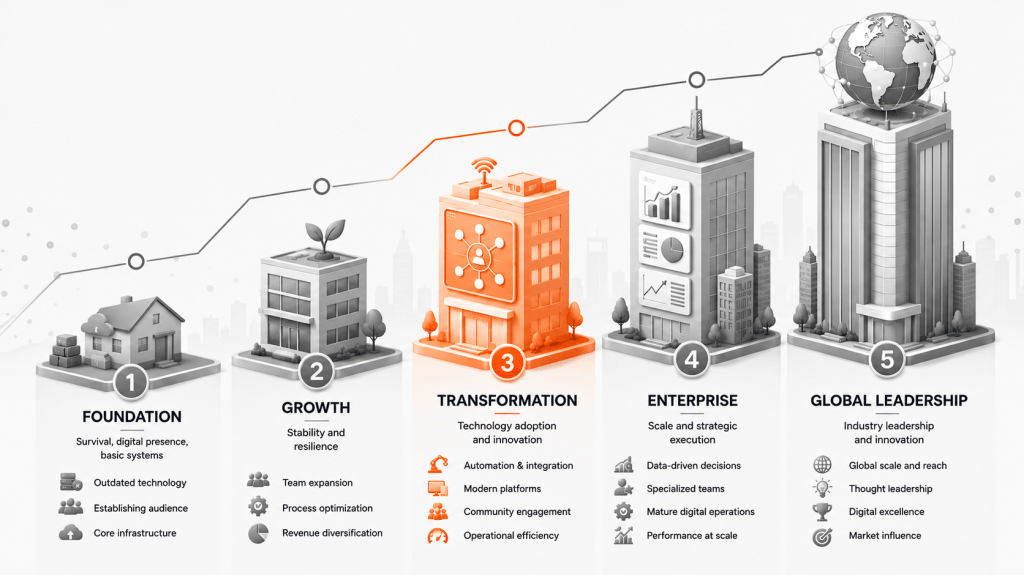
As organizations reach the Transformation level, they move past the primary focus on stability and survival and begin to seek Love and Belonging, the third tier of Maslow’s Hierarchy. A publisher here is no longer just a digital operation. It is becoming a sophisticated publishing business, one that competes on the depth of its audience relationships, not just the volume of its output.
These organizations have dedicated teams across key functions and are making real investments in enterprise-level technology. The goal shifts from transactional interactions, a click, a view, a one-time visit, toward a lasting, emotional connection with the audience. This is the stage where a business stops asking only “how many people did we reach” and starts asking “how many people feel they belong here.”
You’re at the Transformation Level If
- You have dedicated teams across functions, editorial, product, data, rather than one group doing everything.
- You are investing in enterprise-level technology and starting to feel the limits of a monolithic stack.
- You are moving beyond basic analytics toward a first-party data strategy, and the ambition to actually use it.
- You are experimenting with AI and automation in content creation, distribution, or moderation.
- Community and engagement are becoming real objectives, measured and invested in, not just byproducts of traffic.
- You are expanding into new formats, markets, or audiences, and your infrastructure is starting to feel the strain.
If this is where you are, stability is no longer the question. The question is how sophisticated, and how connected, you can become.
What the Transformation Level Really Looks Like
At Transformation, the business works. The platform is stable, the operation is professional, and the numbers are healthy. What changes is ambition. The focus moves from running a reliable operation to building a genuine relationship with an audience, from being a place people visit to a place people belong. That means investing in first-party data, personalization, modern architecture, and the team structure to support all three.
The characteristic danger at this stage is what we call paralysis by overthinking. As the organization grows, so does its complexity, more teams, more tools, more competing priorities, and it becomes easy to stall in analysis while the market moves. Advancing to Enterprise is about turning that complexity into clarity: making deliberate bets, learning fast, and building the architecture and culture that let you keep moving without breaking what already works.
Common Challenges at the Transformation Level
The path to the Enterprise stage introduces a level of complexity that can tip into paralysis if it is not managed well. The key challenges:
- Organizational structure. Adapting to a larger, multi-team structure with clear roles can be difficult for teams used to agile, small-group dynamics.
- Legacy systems and processes. Replacing outdated, foundational workflows with modern, scalable ones takes real investment and disciplined change management.
- Advanced data management. Moving from basic analytics to a genuine first-party data strategy, and to real insight into audience behavior, requires new expertise and infrastructure.
- AI and emerging tech adoption. Bringing AI and machine learning into content creation, distribution, and monetization means a willingness to experiment and to fail fast.
- Global reach and scalability. Expanding into new markets and diverse audiences demands a global perspective and infrastructure that scales without breaking.
Handled well, these are the investments that separate a sophisticated business from a merely stable one.
What Building a Sophisticated Publishing Business Actually Involves
Transformation is where technical architecture and audience strategy finally have to move together. In practice, the work comes down to a few connected shifts:
- Standing up a first-party data foundation. As third-party signals disappear, owning and unifying your audience data becomes the prerequisite for everything else: personalization, retention, and smarter monetization.
- Moving from monolith to modular. A composable, API-driven architecture is what lets you add new services, an AI writing assistant, automated moderation, a new front end, without rebuilding the whole platform each time.
- Integrating AI responsibly. The opportunity is real, but so is the risk to quality and trust. The goal is to use AI where it genuinely helps editors and readers, with humans firmly in the loop.
- Designing for belonging. Personalization and community features only matter if they make readers feel understood. That starts with empathy for what your audience actually needs, not just what is technically possible.
- Restructuring teams around clarity. New capability demands new roles and clean handoffs. Without deliberate change management, added complexity turns into friction rather than progress.
Done together, these moves turn a stable operation into a business an audience is loyal to.
How Multidots Elevates You to the Enterprise Level
At Multidots, we believe Continuous Discovery is not a kickoff phase but an ongoing process of understanding your evolving goals, guided by clear OKRs so that every investment stays tied to a business outcome. We help Transformation-level partners move from thinking-to-build to building-to-think.
1. Turning scattered ideas into a structured roadmap. As teams and priorities multiply, good ideas get lost in the noise. We bring a set of simple, shared rules that focus attention on the decisions that actually matter, so a growing organization can move in sync instead of pulling in five directions at once.
2. Mastering first-party data and personalization. We guide the transition to owning your audience relationship through:
- AI-enhanced content optimization, analyzing keyword gaps and search intent to lift performance.
- Content personalization, tailoring recommendations to individual behavior and past interactions for deeper engagement.
3. Implementing Design Thinking for the community. We use Design Thinking to get past the technical requirements of a task to the “why” behind it. With Empathy Mapping, we define what your personas say, think, do, and feel, so your digital products solve real human problems, not just technical ones.
4. Scaling with composable architecture. We help you move away from monolithic bottlenecks toward a composable architecture. That modular approach keeps your stack flexible enough to add new services, from AI-powered writing assistants to automated content moderation, or a digital asset manager like our MultiDAM to centralize and version media across a growing network.
5. Cultivating Radical Candor and ownership. As your organization grows, communication becomes the number one driver of success. A culture of Radical Candor encourages your team to own failures and surface problems early, building the trust needed to manage the complex stakeholder relationships waiting at the Enterprise level.
You can see the shape of this in the numbers. When celebrity-news publisher Wonderwall needed to modernize off an aging Django stack, we migrated it to WordPress VIP and rebuilt how editors handle media, managing over a million media assets and 74,068 articles through a custom interface, while cutting operating costs by 40%. That is the Transformation move in miniature: retiring legacy workflows for a modern, sophisticated operation that frees the team to focus on the audience.
Next: The Enterprise Stage
Transformation is about depth: richer data, modern architecture, and a real sense of community. Once those are in place, the focus shifts to authority and scale, operating with well-defined strategy and specialized teams, and shaping your field rather than just competing in it. That is the Enterprise level. Read on, or reach out to talk through what your own ascent from Transformation to Enterprise could look like.
Frequently Asked Questions
First-party data is the audience information you collect and own directly, rather than renting it from third parties. As third-party tracking disappears, it becomes the foundation for personalization, retention, and durable monetization. Transformation is the stage where building it stops being optional.
You need enough modularity to add new capabilities without rebuilding everything each time. For many Transformation-stage publishers, a composable approach on WordPress delivers that flexibility without the full cost and complexity of going entirely headless. The right answer depends on your roadmap, not the trend.
More than at any stage before it. The moment you start collecting first-party data and wiring in new integrations, your attack surface grows and privacy regulation becomes your problem, not the platform’s. Treat security as an ongoing discipline: protect user data, meet regulations like GDPR and CCPA, and harden every new service you add. Building it in now is far cheaper than retrofitting it at Enterprise scale.
It becomes both a growth lever and a compliance requirement. Meeting standards like WCAG widens your audience, reduces legal risk, and usually improves SEO and usability for everyone. Transformation is the right time to bake accessibility into your design system and editorial workflow, rather than retrofitting it across a larger, more complex site later.
Use it where it clearly helps, drafting support, search optimization, moderation, and keep humans in the loop on anything that reaches the reader. The failure mode is treating AI as a replacement for editorial judgment rather than a tool that gives your team more time for it.
Start with empathy for what your audience actually wants, then use personalization and engagement features to make them feel understood. Community grows when people feel a place is theirs, which is a product and content decision as much as a technical one.