

Key Takeaways
- Growth-stage digital maturity requires scalable operations, stronger security, regulatory compliance, and sustainable revenue beyond advertising.
- WordPress performance must withstand peak traffic, not merely average daily demand.
- Automated editorial workflows maintain quality and efficiency as content volume, channels, and teams expand.
- First-party audience data enables informed monetization, personalization, and engagement strategies.
- Advancing to Transformation requires stable operations, diversified revenue, modular architecture, and disciplined experimentation.
Part 3 of our six-part series on the Multidots Digital Maturity Model. New to the framework? Start with the overview.
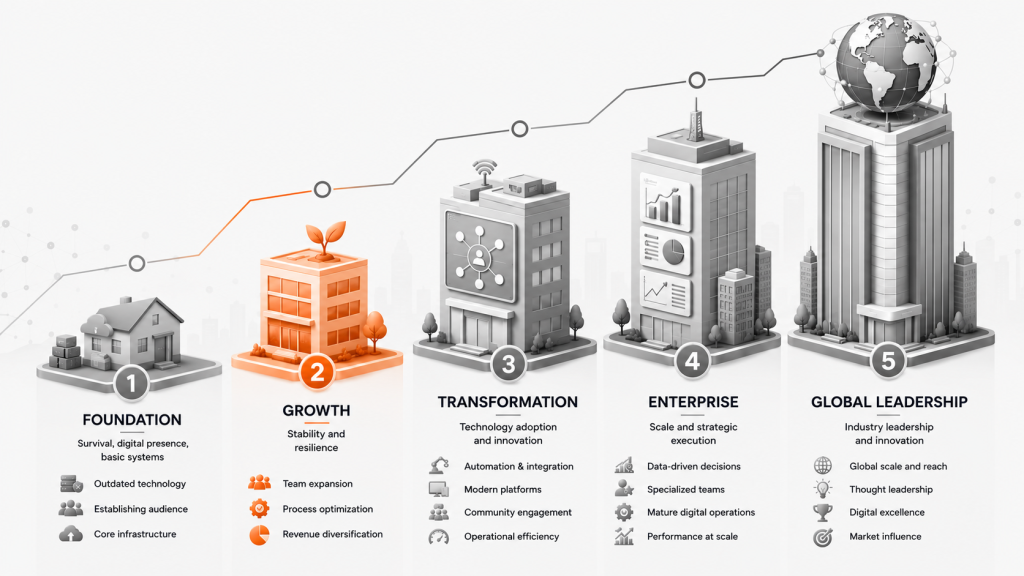
If the Foundation level is about survival, the Growth level mirrors the Safety and Security needs in Maslow’s Hierarchy. Organizations here have graduated from basic turnkey platforms and established their own web presence, usually on a content management system like WordPress. The daily question is no longer whether you can exist. It is whether you can keep existing under load, and turn a working site into a durable business.
These publishers are in a crucial transition. They are no longer just finding their voice; they are investing in professional resources, tools, and people to build sustainable operations and grow their reach. The trap at this stage is subtle: doing more of the same, faster, feels like progress, right up until the point it stops working. Real growth is not just more output. It is building the operational floor that lets output scale without the whole thing buckling.
You’re at the Growth Level If
- You own your platform and your data, usually on WordPress, but operations still strain every time volume climbs.
- Content production is expanding across more formats and channels, and the manual processes that once worked are starting to crack.
- Revenue leans heavily on advertising, and you are actively exploring subscriptions, memberships, or commerce.
- You have basic analytics, but you are not yet using data to personalize or to make decisions with confidence.
- Your team is growing, and informal roles are hardening into real functions with real handoffs.
- Traffic spikes still make you nervous, because performance wobbles when the audience shows up all at once.
If that is your reality, you have cleared Foundation. The work now is turning a site you own into an operation that holds up as it scales.
What the Growth Level Really Looks Like
At Growth, you own the house, and the job shifts from decorating it to running it. The passion that built the audience is still there, but it is now surrounded by budgets, tools, hires, and the first real processes. Success stops being measured only in views and starts being measured in retention, revenue, and resilience. This is the stage where a content operation quietly becomes a business.
The characteristic risk here is the plateau. What got you off Foundation, more content, more hustle, more manual effort, has a ceiling of its own. Past a certain volume, adding people and pages without adding systems just multiplies the chaos. Advancing to Transformation is less about working harder and more about building the operational and technical backbone that makes the next level of scale possible.
Common Challenges at the Growth Level
Getting from Growth to Transformation takes more than doing “more of the same.” It means clearing a set of technical and organizational hurdles that only appear at scale:
- Scaling content operations. As production spreads across more formats and channels, manual workflows break down. Efficient processes and automation become essential to hold quality steady at higher volume.
- Developing new revenue models. Moving past simple advertising into subscriptions or memberships requires both technical integrations and a genuine shift in how you think about audience value.
- Data and personalization. Understanding complex audience behavior, and acting on it, calls for advanced analytics and the in-house expertise to interpret them, not just dashboards nobody reads.
- Adopting emerging technologies. Experimenting with AI or automation in content and distribution takes a willingness to invest and trial approaches before they are fully proven.
- Technical architecture. Shifting from a monolithic setup toward a composable architecture, built from modular components and APIs, is a change in engineering philosophy as much as in tooling.
- Compliance and security. Protecting user data and keeping pace with evolving privacy regulation becomes a serious legal and technical responsibility, not an afterthought.
Left unaddressed, each of these quietly caps how far the current setup can take you.
What Scaling Past “More of the Same” Actually Involves
The leap from Growth to Transformation is an infrastructure and operations problem before it is a content one. In practice, it comes down to a handful of moves:
- Hardening performance for the spikes, not the average. A site that is fast on a quiet Tuesday can still fall over on your biggest traffic day. Layered caching and media optimization are what keep it standing when the audience arrives all at once.
- Turning workflows into systems. The goal is repeatable editorial and publishing processes, supported by automation, so quality does not depend on a specific person remembering a specific step.
- Diversifying revenue deliberately. Rather than betting everything on ads or rushing a paywall, you build a portfolio: ads, subscriptions, memberships, and commerce, each tested and sized to your audience.
- Laying a first-party data foundation. Before you can personalize anything, you need to actually own and understand your audience data. Growth is where that groundwork gets laid.
- Loosening the monolith. Moving toward modular, API-driven components is what lets you add new capabilities later without rebuilding the whole site each time.
None of this is glamorous. It is the plumbing that makes everything above it possible.
How Multidots Propels the Ascent to Transformation
At Multidots, we help you bridge the gap between stable operations and a sophisticated business by acting as an indispensable extension of your team. The focus is on maximizing ROI by turning technical debt into strategic assets.
1. Mastering performance for scale. High-traffic sites, reaching 1M+ monthly visits, need robust optimization. We implement strategies such as:
- Edge caching, using advanced CDN features to serve content worldwide with minimal latency.
- Object caching, storing database query results in memory to reduce server load on dynamic sites.
- Media optimization, scaling and compressing assets for speed without sacrificing quality.
2. Strategic monetization roadmapping. We shift the focus from winning an argument to solving the revenue problem, helping Growth-level partners build a portfolio approach to monetization:
- AI-driven contextual commerce, embedding product recommendations based on reader behavior.
- Membership and subscription models, including gated content for exclusive access, the kind of native, cookie-based gating our own Multigate is built to power
3. Applying Design Thinking to audience connection. To move into Transformation, you have to deepen your relationship with your community. We use Empathy Mapping to understand not just what your users do, but how they feel, then build features that create engagement and belonging rather than just clicks.
4. Building a culture of Radical Candor. Scaling means getting comfortable with failure. Through Radical Candor, we help partners own missteps openly and quickly, so a “failed” experiment becomes a genuine learning input for the next iteration instead of a thing nobody talks about.
5. OKRs as a compass. We replace winging it with Objectives and Key Results (OKRs). Clear, qualitative destinations and measurable waypoints make sure every technical task, from code minification to SEO audits, feeds directly into your long-term viability.
This is what the ascent looks like in practice. When Foursquare outgrew a restrictive Contentful setup, we moved it onto WordPress and rebuilt the editorial workflow, cutting average load time from 7.0 to 3.1 seconds, a 54% speed gain, while streamlining the approval process that had been slowing publishing down. Faster infrastructure and smoother operations together are exactly what a Growth-stage business needs to keep scaling without breaking.
Next: The Transformation Stage
Growth is about building a business that holds up under load. Once operations are stable and revenue is diversified, the focus shifts from resilience to relationship: turning a solid publishing operation into a sophisticated business that an audience feels part of. That is the Transformation level. Read on, or reach out to talk through what your own ascent from Growth to Transformation could look like.
Frequently Asked Questions
The clearest signal is that your constraints stop being about capacity and start being about sophistication. When your bottleneck is no longer “can we publish enough” but “can we personalize, use our data, and deepen community,” you are pushing into Transformation.
Usually not yet, and forcing it early is a classic overreach. At Growth, the priority is a stable, well-optimized platform and repeatable operations. Composable architecture becomes worth its complexity as you move into Transformation and need to integrate more systems.
Treat monetization as a portfolio, not a switch you flip. Test gated or members-only offers alongside your existing model, size them to what your audience actually values, and let the data show you where to push rather than walling everything off at once.
Performance under peak load and manual editorial workflows, usually in that order. A site that feels fine day to day can buckle on its biggest traffic day, and processes that depend on one person’s memory stop scaling the moment the team grows.