
Key Takeaways
- Start with the reason you’re leaving Optimizely. A platform that’s perfect for cutting costs might be the wrong fit if your real challenge is hiring developers or simplifying your stack.
- Price the platform over 3–5 years. Implementation, specialist talent, support, and extra modules often end up costing more than the software itself.
- Don’t mistake “all-in-one” for “best value.” If you’ll never use half the bundled features, a composable platform can be both cheaper and a better fit.
- Ask every vendor to show you migrations like yours, not just logos on a customer page. Relevant case studies reveal far more about delivery risk than a polished demo ever will.
Finding good Optimizely alternatives starts with identifying what’s driving the need for a change. If you’re evaluating Optimizely as a CMS and Digital Experience Platform (DXP), you’re probably weighing it up against Adobe Experience Manager, Sitecore, or WordPress – and that’s exactly what this guide covers.
If, on the other hand, you’re looking for an A/B testing platform, or a replacement for Google Optimize, you’re in the wrong place.
Here, we’ll break down Optimizely alternatives by cost and capability for publishers, media brands, and global enterprises that are weighing this decision.
What Optimizely Offers
Before comparing alternatives, it helps to know exactly what you’d be walking away from. Optimizely One is a modular Digital Experience Platform (DXP), so knowing which parts you’re using (and paying for) makes comparing competitors against it far easier.
Platform Overview
Optimizely brings together content management, experimentation, commerce, data, and recommendations as separately licensed modules under a single brand (Optimizely One). Since rebranding from Episerver in 2021, it’s been built on a proprietary .NET stack – a technical detail that can influence everything from the availability of the talent you can hire to how flexible integrations are.
Optimizely offers:
- Content management with an embedded digital asset manager (DAM).
- Rules-based personalization.
- Opal AI agents built into the workflow.
- Native experimentation and feature flags.
- Multi-site publishing from a single install.
This is a feature set that’s worth properly evaluating before deciding it’s time to move on.
Pricing and Positioning
Pricing is where things get more complicated. Optimizely is sold on annual contracts, modules are licensed separately, and there’s no self-serve monthly plan to trial it with. The full DXP suite routinely tops $200k a year before implementation costs, with three-year total ownership costs for a mid-sized publisher often reaching $700k to $1m or more.
Whether that’s money well spent depends largely on your use case. For B2B manufacturers and industrial organizations that need commerce tightly integrated, Optimizely performs particularly well, and remains a strong contender alongside Sitecore and Adobe Experience Manager in financial services. Publishing is where it struggles to compete. At enterprise scale, WordPress VIP and Adobe are often stronger options.
When Optimizely Is Still the Right Choice
Optimizely isn’t a platform organizations outgrow by default. If you’re a B2B organization with experienced Optimizely developers in-house, renewals often make perfect sense. The expertise already exists, the integrations are already in place, and switching platforms may create more work than value.
It also remains a compelling option for enterprises that want CMS, experimentation, and commerce from a single vendor, backed by one support contract. When reducing vendor sprawl is high on your priority list, that’s a worthwhile advantage.
Why Enterprises Look Beyond Optimizely
For everyone else, two issues tend to keep coming up. The first is cost. Separate module licensing can push total ownership costs far beyond what teams expect. Before long, what looked like a manageable CMS investment can soon become a platform-sized budget commitment.
The second is talent. Optimizely’s .NET-only architecture narrows the hiring pool considerably. Experienced developers are harder to find, typically more expensive, and replacing them becomes increasingly difficult as teams grow or change over time. Together, these two pressures eventually send enterprise buyers looking elsewhere.
The Four Alternatives
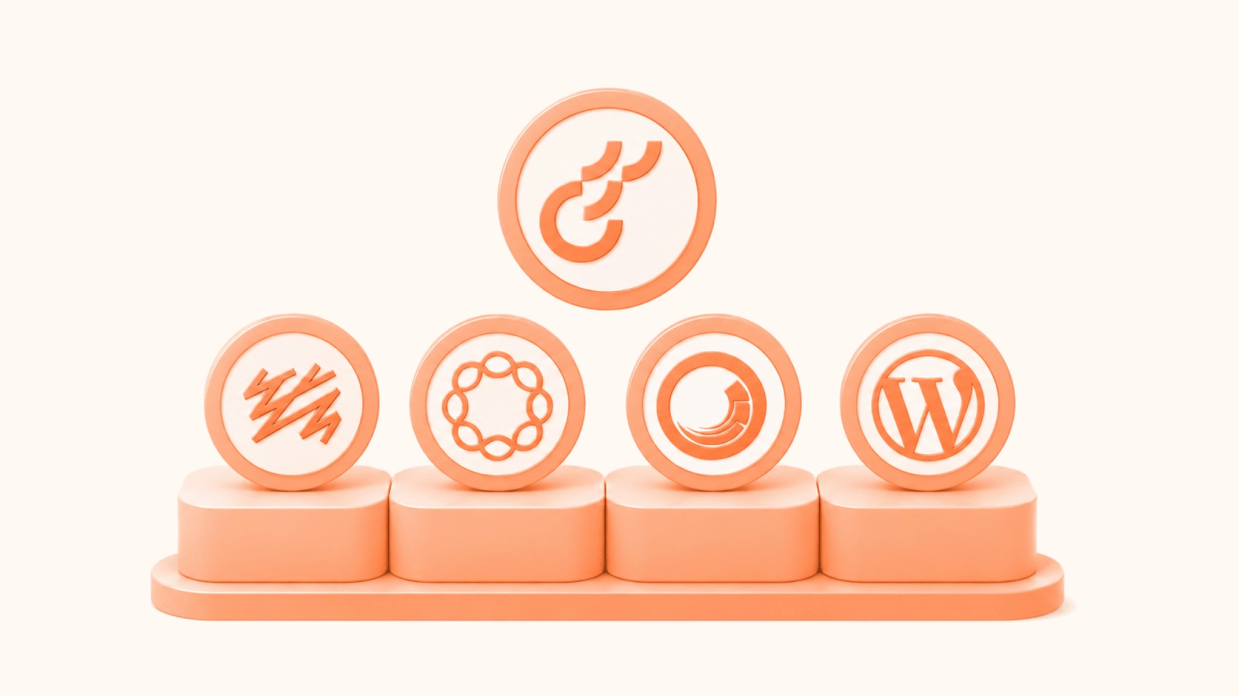
This guide focuses on four enterprise platforms that are able to replace Optimizely at the scale of a global brand or enterprise publisher:
- WordPress (on WordPress VIP): The world’s most widely used CMS, paired with enterprise-grade managed hosting and the largest developer community on this list. If access to talent and lower long-term costs matter, this is the obvious place to start.
- Sitecore: A proprietary DXP built on the same .NET foundation as Optimizely. It’s the closest architectural match, and a familiar option for teams already invested in that ecosystem.
- Sanity: A headless, API-first CMS with no bundled modules or prescribed vendor stack. A strong fit for teams that want structured content without the baggage of a traditional DXP.
- Adobe Experience Manager: The natural choice for organizations already committed to Adobe Analytics, Target, or Commerce, and looking to consolidate around a single vendor.
Four very different philosophies, four very different buyers, but each with the security, scalability, and enterprise capabilities needed to compete seriously. We’ll break them down one by one, starting with the platform that gives you the most for the least.
WordPress as an Alternative to Optimizely
WordPress powers 43% of the web. On WordPress VIP infrastructure, it also powers enterprise publishers and global brands at exactly the kind of scale Optimizely targets, often at a fraction of the cost.
Cost Comparison
WordPress core is open source and free, while WordPress VIP managed hosting starts from $25k per year – a relatively modest figure next to Optimizely’s DXP pricing.
Compare the two over time, and WordPress VIP‘s total cost of ownership is typically lower than an equivalent Optimizely CMS/DXP implementation, often by a factor of 2–3x. The exact gap depends on project scope, integration complexity, migration effort, and the specific licensing tier you’d be moving to.
Features Comparison
Feature for feature, WordPress compares better than you might expect. The Gutenberg block editor, combined with custom blocks, delivers a visual editing experience comparable to Optimizely’s while offering greater flexibility in how content is assembled.
Where the two platforms diverge is experimentation, DAM, and personalization. WordPress delivers these through plugins and partner integrations rather than bundled modules. Although you gain more freedom to build the stack you want, you also give up some of the all-in-one convenience Optimizely is known for.
Use Cases
WordPress VIP is an excellent fit for enterprise publishers, multi-brand media groups, and organizations running mission-critical editorial workflows where downtime simply isn’t an option.
It’s also well suited to regulated industries and government-adjacent organizations. WordPress VIP holds FedRAMP Moderate authorization, a valuable credential during procurement.
Success Stories and Case Studies
Enterprise buyers don’t switch platforms on promises alone. Ask Media Group migrated 11 websites and more than 50,000 posts to WordPress VIP in just 12 weeks, and with zero downtime, showing that even large, content-heavy estates can make the move from Optimizely to WordPress without sacrificing business continuity.
Download a Free Actionable Guide: 45+ Actionable Tips to Boost WordPress Speed for High-Traffic Sites (Includes Impact Score)
Sitecore as an Alternative to Optimizely
Of the four platforms on this shortlist, Sitecore is the nearest architectural match to Optimizely. Both are proprietary .NET DXPs, making Sitecore the most familiar option for teams already working in the Microsoft ecosystem. If your developers already know .NET, there’s very little mental re-mapping required.
Cost Comparison
Sitecore licensing is enterprise-only and entirely quote-based. Pricing typically starts around $40k per year and climbs into the hundreds of thousands for a full composable stack, depending on the modules you choose.
Annual contracts are standard, and total cost of ownership (TCO) usually lands in a similar range as Optimizely’s DXP bundles. If reducing spend is your primary goal, this probably isn’t the platform you’re looking for.
Features Comparison
From a capability standpoint, Sitecore is a strong composable DXP. XM Cloud provides the headless CMS, supported by personalization and experimentation modules that closely mirror Optimizely’s offering.
The challenge is Sitecore runs on the same proprietary .NET foundation, so the same difficulty around specialist developer availability follows you. When you’re moving between two .NET ecosystems, switching platforms doesn’t necessarily solve the talent shortage.
Use Cases
Sitecore is a natural fit for enterprise organizations already invested in .NET, particularly those with experienced Sitecore developers in-house. It also has an established reputation across financial services, automotive, and B2B, where the platform has built considerable credibility over the years.
Success Stories and Case Studies
Sitecore’s customer list reflects their strength, with a case study library that features global brands spanning retail, finance, and automotive.
Sanity as an Alternative to Optimizely
Sanity takes the opposite approach to Optimizely entirely with no bundled modules or forced vendor stack. Instead, a structured content API plugs into whatever frontend or commerce layer you already run. For teams that value flexibility over turnkey convenience, that difference in philosophy is every bit as important as the feature list.
Cost Comparison
Sanity’s Growth plan starts at $15 per user, per month, with Enterprise pricing available on request – comfortably below Optimizely’s DXP tier. Costs scale by documents and seats rather than bundled products, so you’re only paying for the parts you use.
Features Comparison
Sanity is a headless, API-first CMS built around a real-time collaborative Studio and structured content. Native experimentation and commerce aren’t included, so you’ll need dedicated tools for those elsewhere in your stack. Although Sanity arrives with fewer built-in capabilities, it has far more freedom to build the platform you want.
Use Cases
Sanity is a natural fit for product and marketing teams building custom frontends, especially those working in developer-led environments. Organizations with strong in-house engineering often prefer that flexibility over having every feature bundled out-of-the-box.
Success Stories and Case Studies
Sanity’s customer list leans toward consumer, SaaS, and design-led brands, although there are plenty of enterprise deployments too.
Adobe Experience Manager as an Alternative to Optimizely
Adobe Experience Manager (AEM) sits at the top of the enterprise CMS market by contract value, and for organizations already running Adobe Analytics, Target, or Commerce, it’s the most natural platform to adopt. Rather than introducing another ecosystem, it extends the one your teams already know.
Cost Comparison
AEM is enterprise-only, with pricing available by quote, and typically lands at or above Optimizely’s DXP pricing. Licensing starts at around $30k per year for a single module and climbs well beyond $200k for full suites. Most organizations buy it as part of a wider Adobe Experience Cloud agreement, which often pushes the overall investment beyond the headline license cost.
Features Comparison
AEM covers CMS, DAM, Sites, and Assets, with deep ties into Adobe Target, Analytics, and the broader Experience Platform. On the AI front, Adobe Sensei and Firefly Services support both content and asset workflows, giving teams generative and predictive capabilities inside the tools they already use every day.
Use Cases
AEM makes the most sense for enterprises already committed to Adobe Experience Cloud, particularly those relying on Analytics, Target, and Commerce. If those tools are already central to how your teams operate, AEM closes the loop rather than adding a new system to manage.
Success Stories and Case Studies
Adobe’s customer stories reflect its enterprise focus, featuring global brands across retail, travel, telecoms, and more.
Other Platforms Worth Considering
Three other platforms regularly appear on enterprise CMS shortlists, even though they fall outside the main four. Each fills a gap that Optimizely’s bundled DXP doesn’t serve particularly well.
Contentful: Pure CMS Without the DXP Bundle
Contentful is probably the best-known headless CMS in this category. Enterprise plans typically range from $5k to $70k per year, making it considerably cheaper than Optimizely’s full DXP offering. It’s a strong fit for teams already running a composable stack that simply need a CMS, without paying for commerce or experimentation as part of the same contract. If you only need one piece of what Optimizely offers, Contentful lets you buy exactly that.
Contentstack: Composable DXP With Modular Pricing
Contentstack targets enterprise teams that want the support, SLAs, and capabilities of a composable DXP without the proprietary .NET lock-in associated with Optimizely or Sitecore. Its modular pricing also avoids the bundled-software problem, letting organizations pay for the services they use rather than an entire suite. It’s particularly popular in media and retail, and frequently appears alongside Contentful when businesses are moving away from proprietary .NET platforms.
Bloomreach: When Commerce Discovery Is the Real Need
Bloomreach stands out because it solves a different problem altogether: commerce discovery. It combines a headless CMS, search, and AI-powered merchandising under a single enterprise contract, making it especially well suited to organizations that adopted Optimizely for commerce and personalization rather than content publishing. If product discovery is the priority, Bloomreach may prove a closer fit than any of the CMS-first alternatives above.
Choosing the Right Platform for Your Use Case
Evaluating one platform at a time only gets you so far when several are on the table simultaneously. The table below maps all eight platforms covered in this guide across the dimensions that tend to matter most once a contract is actually on the table.
| Platform | Pricing | Architecture | Best-Fit Use Case | Migration Effort | Vendor Lock-In | AI Capabilities |
|---|---|---|---|---|---|---|
| Optimizely | $200k+/year full suite | Proprietary .NET | B2B manufacturing, industrial commerce | High (source platform) | High | Opal AI agents |
| WordPress (on WordPress VIP) | From $25k/year | Open-source | Enterprise publishing, multi-brand media | Moderate | Low | Via plugins/partners |
| Sitecore | ~$40k/year and up | Proprietary .NET | Financial services, automotive, B2B | High | High | Native personalization modules |
| Sanity | From $15/user/month | Headless, API-first | Developer-led custom frontends | Moderate | Low | Limited native AI |
| Adobe Experience Manager | $30k+/year per module | Proprietary, Adobe stack | Existing Adobe Experience Cloud users | High | High | Adobe Sensei, Firefly Services |
| Contentful | $5k–$70k/year | Headless, API-first | Composable stacks needing pure CMS | Moderate | Low | Limited native AI |
| Contentstack | Modular, quote-based | Composable DXP | Media and retail exiting .NET platforms | Moderate | Low | Growing AI feature set |
| Bloomreach | Enterprise, quote-based | Commerce-experience platform | Commerce discovery and merchandising | Moderate | Moderate | AI merchandising |
Need Help With CMS Consultation? Contact Us
Every platform in this guide has a legitimate use case. The right choice comes down to your existing tech stack, compliance obligations, your team’s technical capabilities, and how much vendor lock-in you’re prepared to live with over the long term.
Multidots has delivered more than 1000 enterprise CMS migrations, all with zero-downtime cutovers and 100% data integrity. When your editorial operation can’t afford disruption, this kind of track record reduces the risk of a disruptive migration.
If you’re considering a move away from Optimizely, contact Multidots to understand exactly what the migration would involve, scope the project, and plan the right path forward.